Mobile County Announced Cody Road Expansion and Closure Plan in 2009
A 2009 WKRG report described plans to expand a section of Cody Road in West Mobile and close it for construction.
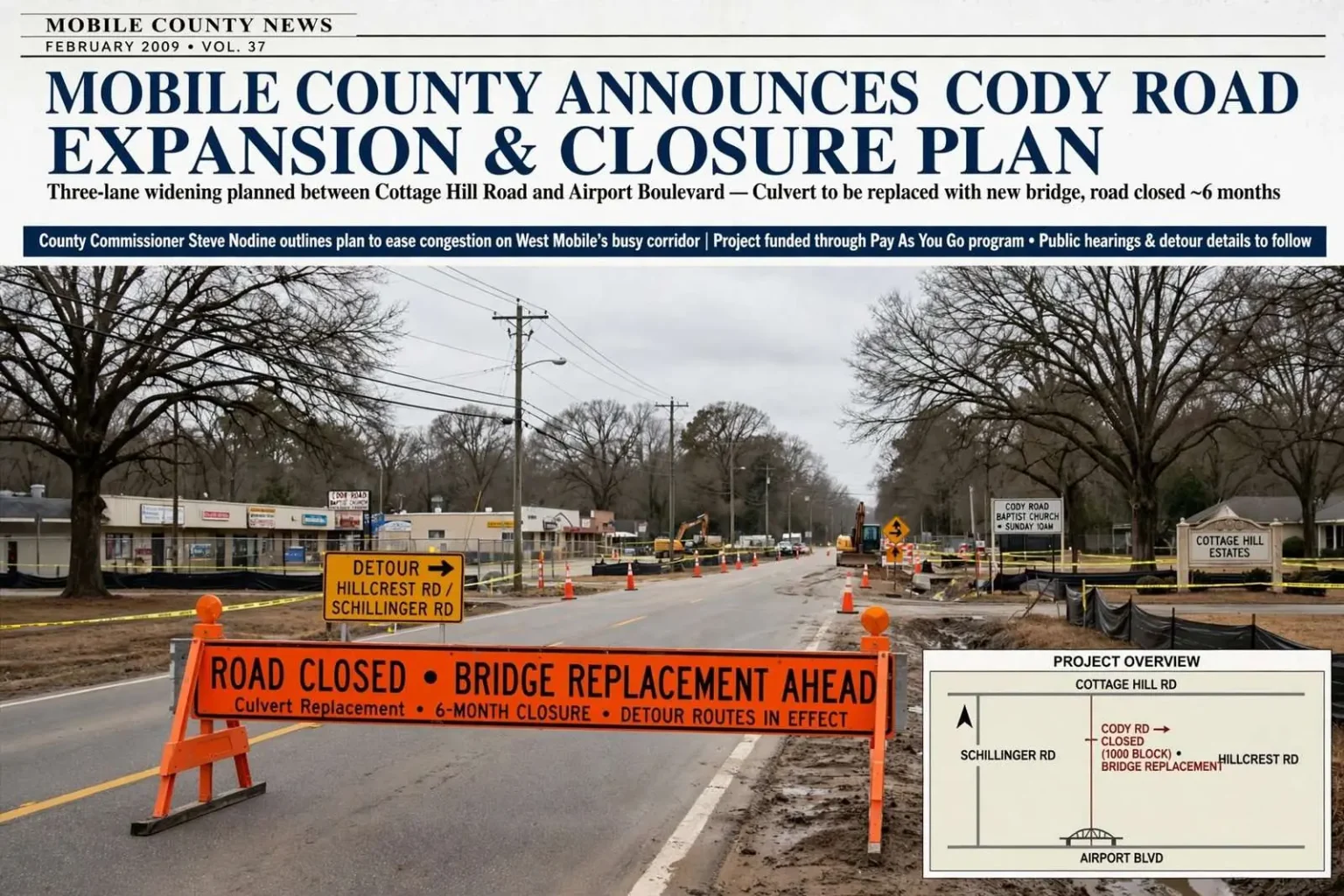
Mobile County officials announced in February 2009 that a section of Cody Road in West Mobile was planned for expansion to three lanes between Cottage Hill Road and the area near Airport Boulevard, a project that promised relief for one of the area’s busiest and most congested local corridors. County Commissioner Steve Nodine said the project would require the replacement of a culvert near the 1000 block of Cody Road South with a bridge, and that the culvert work was expected to require a road closure lasting about six months.
The announcement put one of West Mobile’s principal north-south roads at the center of the county’s road-improvement agenda. Cody Road carries a heavy daily load of commuter, school and commercial traffic through a corridor that grew rapidly as residential development pushed west and south from the city of Mobile during the preceding decades. Widening the road to three lanes — a travel lane in each direction with a center turn lane — is a standard remedy for the kind of turning-movement congestion that builds along suburban corridors lined with neighborhoods, churches, schools and small businesses.
Officials said they planned public hearings and detour information before the closure, an acknowledgment of how disruptive six months without a through route would be for residents and businesses along the corridor. Nodine pointed to Hillcrest and Schillinger roads as alternate major routes, directing through traffic to the parallel north-south roads that bracket Cody Road in West Mobile’s grid.
Why Cody Road Mattered to West Mobile
By 2009, Cody Road had become one of the main arteries of West Mobile, threading between Cottage Hill Road and Airport Boulevard — two of the area’s dominant east-west commercial corridors. The stretch between them passes through some of the county’s most active residential territory, with neighborhood entrances, school zones and shopping areas generating constant turning traffic. A two-lane configuration on a road carrying that volume produces the familiar suburban pattern: long queues behind left-turning vehicles, difficult entrances from side streets and creeping travel times at peak hours.
The three-lane conversion addressed that problem directly. The center turn lane removes left-turning vehicles from the travel lanes, smoothing flow for through traffic while preserving access to the businesses and neighborhoods that line the road. For a growing suburban corridor, the improvement is often the difference between a road that functions and one that drivers avoid — a distinction that matters when the alternatives, like Hillcrest and Schillinger, have congestion problems of their own.
The project also reflected the westward shift of Mobile County’s population. The areas around Cody, Schillinger, Hillcrest and Cottage Hill roads grew from rural crossroads into suburban communities over the final decades of the 20th century, and the county’s road program has been racing to catch up ever since. Corridor upgrades like the Cody Road expansion were the county government’s principal response to infrastructure that predated the growth it now serves.
The Culvert and the Bridge
The most disruptive element of the project was hydraulic rather than pavement-related: the replacement of a culvert near the 1000 block of Cody Road South with a bridge. Culverts — large pipes that carry creek and drainage flow beneath the roadway — are common along West Mobile’s many small streams, but aging or undersized culverts create both flood risks and structural weaknesses. Replacing one with a bridge is a bigger, longer and more expensive undertaking, because it requires removing the existing roadway, building abutments and reconstructing the road on new structures.
A six-month closure for that work underscores the scale. A simple road-widening can often be done with lane closures and flaggers, but a culvert-to-bridge conversion effectively removes the road from service at the crossing point, leaving no practical way to keep traffic moving past the work zone. Planning ahead — hearings, signage, published detours — was the county’s attempt to soften the blow for the thousands of drivers who used the road daily.
How West Mobile Traffic Would Move During Construction
The designated alternates tell the story of West Mobile’s road network. Schillinger Road runs roughly parallel to Cody Road to the west, and Hillcrest Road provides a parallel route to the east; both connect Cottage Hill Road and Airport Boulevard and both already carried substantial traffic of their own. With Cody Road closed at the bridge site, those two roads were positioned to absorb the diverted volume, and county officials’ decision to name them early was meant to give commuters, school traffic and delivery drivers time to adjust their routines.
Local access was the thornier question. Business owners and residents along Cody Road raised questions about maintaining access during construction, a familiar concern whenever a corridor project takes a road offline. Businesses that depend on drive-by traffic fear a six-month drop in customers; residents fear long detours just to leave their own streets. The county’s promise of hearings and detour information before the closure was the mechanism for working through those issues — identifying which intersections and driveways would remain reachable, where signage would point customers, and how emergency vehicles would navigate the area during the bridge work.
Public hearings also serve a formal role in county road projects, giving commissioners and engineers a record of community concerns and, sometimes, revisions to the plan. For a project touching one of West Mobile’s main commuter routes, the hearings were expected to draw property owners from along the entire corridor.
The Pay As You Go Program
The report said the work was to be funded through the county’s Pay As You Go program, Mobile County’s long-standing method of financing road and bridge improvements from current revenues rather than borrowed money. The approach — building infrastructure as cash becomes available, rather than issuing bonds — has been a hallmark of the county’s public works philosophy, credited with keeping the county free of road debt while delivering a steady stream of widenings, resurfacing projects and bridge replacements.
The trade-off of pay-as-you-go funding is pacing: projects move forward as funds accumulate, and large undertakings can wait years for their turn. For residents of the Cody Road corridor, the 2009 announcement was the moment their long-discussed project reached the funded stage — with construction expected to begin later that year, according to the report. The funding method also means the county can respond to shifting priorities, though a major economic disruption in the same period — the national recession and its effect on local revenues — put pressure on infrastructure budgets across the region during those years.
What the Project Meant for the Corridor
For commuters, the expansion promised the everyday benefit that three-laning delivers: fewer minutes lost behind turning vehicles, safer access out of side streets and neighborhood entrances, and more predictable travel between Cottage Hill Road and Airport Boulevard. For emergency responders, a smoother Cody Road shortens response times through a part of the county served by volunteer and municipal fire districts and county sheriff’s patrols. For property owners, a widened road typically brings increased traffic counts — a mixed blessing that can raise visibility for businesses even as it changes the character of residential frontage.
The bridge component carried benefits beyond the roadway itself. Replacing an aging culvert with a properly sized bridge improves drainage through the stream crossing, reducing the flooding that can close roads and damage property during heavy Gulf Coast rains — no small consideration in an area where slow-moving storm systems regularly drop inches of rain in a day.
This is a historical summary of a 2009 planning report, and construction plans, schedules and road conditions may have changed since publication. But the announcement captured a defining moment for West Mobile’s infrastructure: a fast-growing suburban corridor, a county with a funded plan to bring its main north-south road up to standard, and a community preparing for six months of detours in exchange for a road built for the traffic it actually carries.
The People Behind the Project
The announcement also reflected the role of county commissioners in Mobile County’s road program. As the district’s representative on the three-member Mobile County Commission, Steve Nodine was the official communicating the plan to West Mobile residents, and commissioners of his era took an active hand in prioritizing which roads advanced through the county’s improvement pipeline. Road announcements of this kind typically followed years of engineering study, right-of-way evaluation and budget positioning, even when the public first heard of them in a single news cycle.
For residents, the sequence to watch was the one officials outlined: hearings first, detour plans published, then the closure and construction, with the work expected to begin later that year. Each step moved the corridor closer to a finished road — and each step also gave property owners another chance to weigh in on access, drainage and the details of construction staging that matter most to the people who live and work on the road being rebuilt.
West Mobile’s experience with road projects by 2009 had taught residents the rhythm of such work: survey crews first, utility relocations next, then heavy construction. A six-month full closure was longer than most, but the payoff — a three-lane road on a new bridge, funded without debt — was the kind of improvement the area had been asking for as its population outgrew the two-lane roads it inherited.
Detours, Schools and Daily Life During a Closure
The practical effects of a half-year closure ripple through every routine that touches the closed road. School routes shift when a main road goes offline; parents adjust drop-off paths, and school transportation planners rework routes that use the closed segment. Commuters recalibrate earlier wake-up times to account for the extra miles and the added load on Schillinger and Hillcrest. Local traffic grows on the neighborhood streets that connect to the open corridors, a familiar side effect that residents of parallel routes brace for whenever a main road closes.
The businesses along Cody Road faced the sharpest version of the problem. A corridor lined with storefronts, offices and service businesses depends on visibility and easy turns, and a full closure at the bridge site cuts the road in half, separating customers on one side of the work zone from businesses on the other. That is why the county’s promise of detour information and public hearings carried such weight in the announcement — the details of where signs point and which access points stay open can decide whether a corridor’s businesses survive a construction season.
Weather adds its own variable to Gulf Coast road work. Construction schedules in the Mobile area must absorb the region’s heavy rainfall, and a six-month closure can stretch if storms interrupt the earthwork and bridge construction at the heart of the project. Officials’ estimate of about six months represented the plan, not a guarantee, and residents following the project were advised to watch for county updates as the work progressed.
A Snapshot of the County’s Growth Strategy
Stepping back, the February 2009 announcement was a snapshot of how Mobile County managed its explosive suburban growth: identify the corridors where development had overwhelmed the old roads, widen them to three lanes, replace undersized drainage structures with bridges, and pay for it all from current revenue so the county’s road program never accumulated debt. Cody Road was one entry in that broader program — a corridor whose time had come as West Mobile filled in between Cottage Hill Road and Airport Boulevard.
The plan’s elements — the culvert-to-bridge replacement near the 1000 block of Cody Road South, the three-lane section between Cottage Hill and the Airport Boulevard area, the six-month closure, the Hillcrest and Schillinger detours and the Pay As You Go funding — together told residents what to expect: disruption first, then a road built for the traffic it actually carries. As a historical summary of a 2009 planning report, the account records the county’s intentions at the time; actual construction plans, schedules and road conditions may have changed in the years since.