
Coffeeville Shooting Suspect, Two Other Clarke County Cases Head to Court Aug. 11
A Coffeeville shooting suspect, along with defendants in a fatal Gainestown crash and a years-old human trafficking case, are set for court dates in Clarke County on Aug. 11.
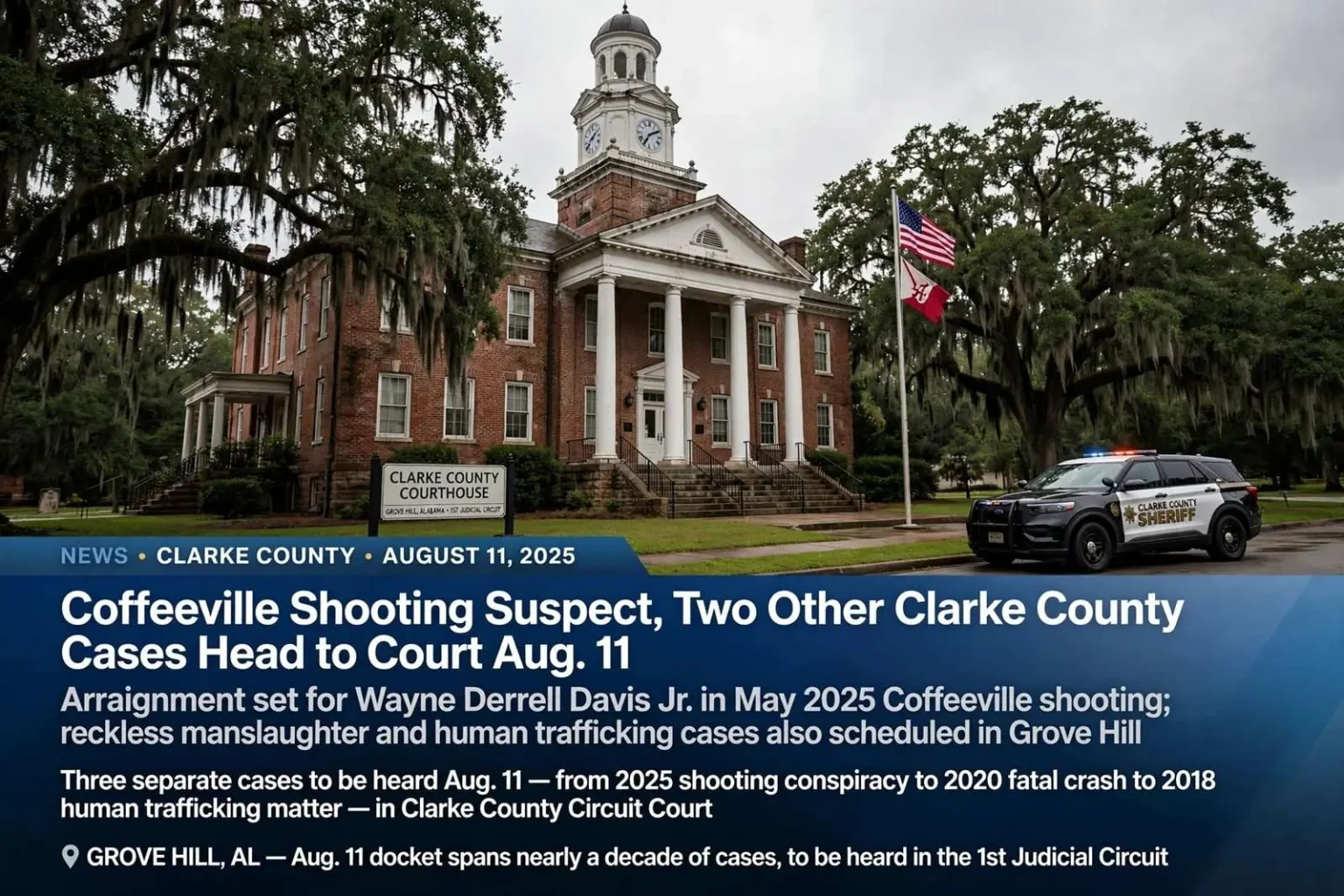
A man indicted on conspiracy to commit murder and related firearms charges in connection with a shooting during a community event in Coffeeville last year is scheduled to be arraigned in Clarke County Circuit Court on Aug. 11. Wayne Derrell Davis Jr. was indicted by a Clarke County grand jury earlier this year for his alleged role in the May 24, 2025 shooting. The arraignment will formally present the charges against him and set the case on the circuit court’s path toward trial or resolution.
According to the indictment, Davis and three co-defendants — Courtney Lavelle Holt Jr., Robert Isaiah Biggs III and Deontae La’Derrius Milton — conspired to commit murder and discharged a firearm into the occupied Coffeeville home of Raymond Jerry Courington and Joan Shepherd Courington. The shooting occurred during a community event, when the town’s streets and gathering places were crowded, adding to the danger the gunfire posed. A shooting into an occupied home during a public event is among the most serious firearms cases prosecutors handle, carrying the potential for homicide charges if anyone inside had been struck.
Davis faces additional charges of being a person forbidden to possess, carry or use a firearm, attempting to elude and discharging a firearm into an occupied dwelling. The indictment alleges Davis tried to flee from an officer attempting to arrest him, leading to the eluding charge. The weapons-possession count rests on his status as someone legally barred from having a firearm, a designation that typically follows a prior felony conviction and that carries its own prison exposure regardless of the outcome of the shooting charges.
From Probation to Prison
At the time of the shooting, Davis was on probation stemming from a prior conviction. That probation was subsequently revoked, and he was returned to prison. The revocation means Davis has already been serving a prison term for the probation violation while the new charges moved through the grand jury process — a common sequence in Alabama courts, where new felony charges often proceed in parallel with the administrative consequences of a supervision violation. His appearance in circuit court on Aug. 11 will take place while he is in state custody.
The charges against Davis’s three co-defendants will move on their own track. Conspiracy and shooting-into-occupied-dwelling cases with multiple defendants often involve differing levels of evidence against each participant, and prosecutors typically negotiate separately with defendants whose roles differ. Whether any of the co-defendants reach agreements with the state before trial remains to be seen; none has been announced.
Coffeeville, a small town on the Tombigbee River in western Clarke County, holds community events through the year that draw residents from across the region, and the May 2025 shooting — occurring during one of those gatherings — left residents shaken. Small-town events depend on a sense of safety, and gunfire during a crowded community function is the kind of incident that shapes local debates about security for months afterward. The charges stemming from that night will now play out in Grove Hill, the county seat, where the circuit court meets.
Other Cases on the Aug. 11 Docket
Also scheduled to be resolved Aug. 11 is the reckless manslaughter case against Antonio Nameatric Hunt. Hunt was indicted in 2020 in connection with the death of Timothy Nobles Flinn in Gainestown, another small Clarke County community. According to the indictment, Hunt caused Flinn’s death “by operating a vehicle at an excessive rate of speed, failing to maintain a single lane of travel and allowing his vehicle to be on the wrong side of the roadway.” The language of the indictment describes the classic profile of a fatal rural crash — speed, lane departure and wrong-way travel combining to produce a death that the law treats as reckless rather than intentional.
Reckless manslaughter in Alabama covers killings caused by a conscious disregard of a substantial and unjustifiable risk — a standard that sits between negligent homicide and intentional murder. Cases built on driving conduct turn on reconstruction evidence: how fast the vehicle was going, where it left its lane, and what the road’s physical evidence shows about the moments before impact. Hunt’s indictment in 2020 means the case has been pending for years, a span not unusual for rural manslaughter prosecutions where accident reconstruction and court schedules both move slowly.
In a case dating back to 2018, Shannon Foster is expected to appear for what is anticipated to be the final disposition of her role in a human trafficking case. Foster cooperated with prosecutors, and the charges against her were not pursued. According to the indictment, Foster and co-defendant Linda Wrights benefited financially from a scheme involving sexual or labor servitude, and knowingly recruited another person for labor or sexual servitude by visiting Donald Morgan. Her expected appearance on Aug. 11 is the formal closing of her portion of a case that has been on the county’s docket for the better part of a decade.
The allegations describe conduct that Alabama’s human trafficking statute treats with severe penalties, targeting those who recruit others into servitude or profit from it. Foster’s cooperation with the state shaped the outcome of her own exposure; prosecutors routinely decline to pursue charges against participants who assist in building cases against others, and her Aug. 11 appearance is expected to memorialize that resolution on the record. The case against other defendants in the trafficking scheme has followed its own course since the 2018 indictment.
Clarke County Circuit Court arraignments give defendants the opportunity to formally hear the charges against them and enter an initial plea before a judge, typically setting the stage for pretrial proceedings or plea negotiations in the months that follow. An arraignment is a short proceeding — the charges are read, counsel is confirmed or appointed, and a plea of guilty or not guilty is entered — but it is the moment a case formally becomes a circuit court prosecution, with trial dates and pretrial deadlines following.
The Aug. 11 docket illustrates how a single day in a rural circuit court can span nearly a decade of cases. Davis’s charges arise from a 2025 shooting, Hunt’s indictment came in 2020, and Foster’s case began in 2018. Circuit judges in Alabama’s rural circuits manage calendars stretched across multiple counties, and cases wait their turn through grand jury sessions, defense continuances and the slow pace of pretrial preparation. For victims’ families, the passage of time between indictment and resolution is often the hardest feature of the system — the courtroom dates arrive late, and rarely all at once.
Clarke County’s circuit court serves a broad, largely rural jurisdiction that includes Coffeeville, Gainestown, Thomasville, Grove Hill and the smaller communities between them. Serious felonies from across the county funnel to the Grove Hill courthouse, where grand juries meet several times a year to review the cases investigators send up. The August session, with a murder conspiracy arraignment, a manslaughter resolution and a trafficking case’s final disposition, represents the kind of mixed docket the court handles routinely, even though each case carries years of accumulated history.
Davis’s arraignment will also set practical questions in motion: whether he will be represented by private counsel or the court, what bond conditions apply to the new charges given his revoked probation, and how the case will be scheduled relative to his co-defendants. Defendants being arraigned while already in prison on related violations are typically produced from custody for the hearing, and the court will address how his existing sentence interacts with any future prosecution.
The firearms charge of being a person forbidden to possess a weapon deserves particular weight in the Coffeeville case. Federal and state law both bar people with certain convictions from possessing firearms, and violations committed alongside new violent offenses are prosecuted to add prison exposure and to document patterns of armed reoffending. In cases that end without a conviction on the underlying shooting, the weapons-possession count can still result in a significant sentence on its own — one reason prosecutors file it frequently in cases involving defendants with prior records.
For the Courington family, whose occupied home was shot into during the community event, the arraignment marks the first circuit court stage of a prosecution that began with a night of gunfire in their town. For the families of Timothy Nobles Flinn and the victims in the trafficking case, Aug. 11 represents the closing of files that have been open since 2020 and 2018, respectively. One day, three cases, and years of waiting — the ordinary arithmetic of justice in a rural Alabama circuit.
The Aug. 11 session also reflects the workload carried by the 1st Judicial Circuit, which serves Clarke, Washington and Monroe counties. Judges rotate through the member counties on a fixed schedule, meaning serious cases from Coffeeville or Gainestown share a judge with docket loads from Monroeville and Grove Hill. Scheduling conflicts, witness availability and defense continuances accumulate in that system, and the years-long pendency of cases like Hunt’s is the predictable result rather than an exception.
When the court convenes on Aug. 11, Davis will be produced from state custody for his arraignment, Hunt’s reckless manslaughter case is expected to reach its resolution, and Foster’s long-running trafficking matter is anticipated to conclude. Court records will show the outcomes entered that day, and any plea or sentencing in the Hunt case would be the first formal accounting of Timothy Nobles Flinn’s death since the 2020 indictment. For a county the size of Clarke, it will be a consequential day in the courtroom, assembling in one docket the full range of what the circuit court handles: violence, tragedy and, finally, resolutions that families have waited years to hear.


