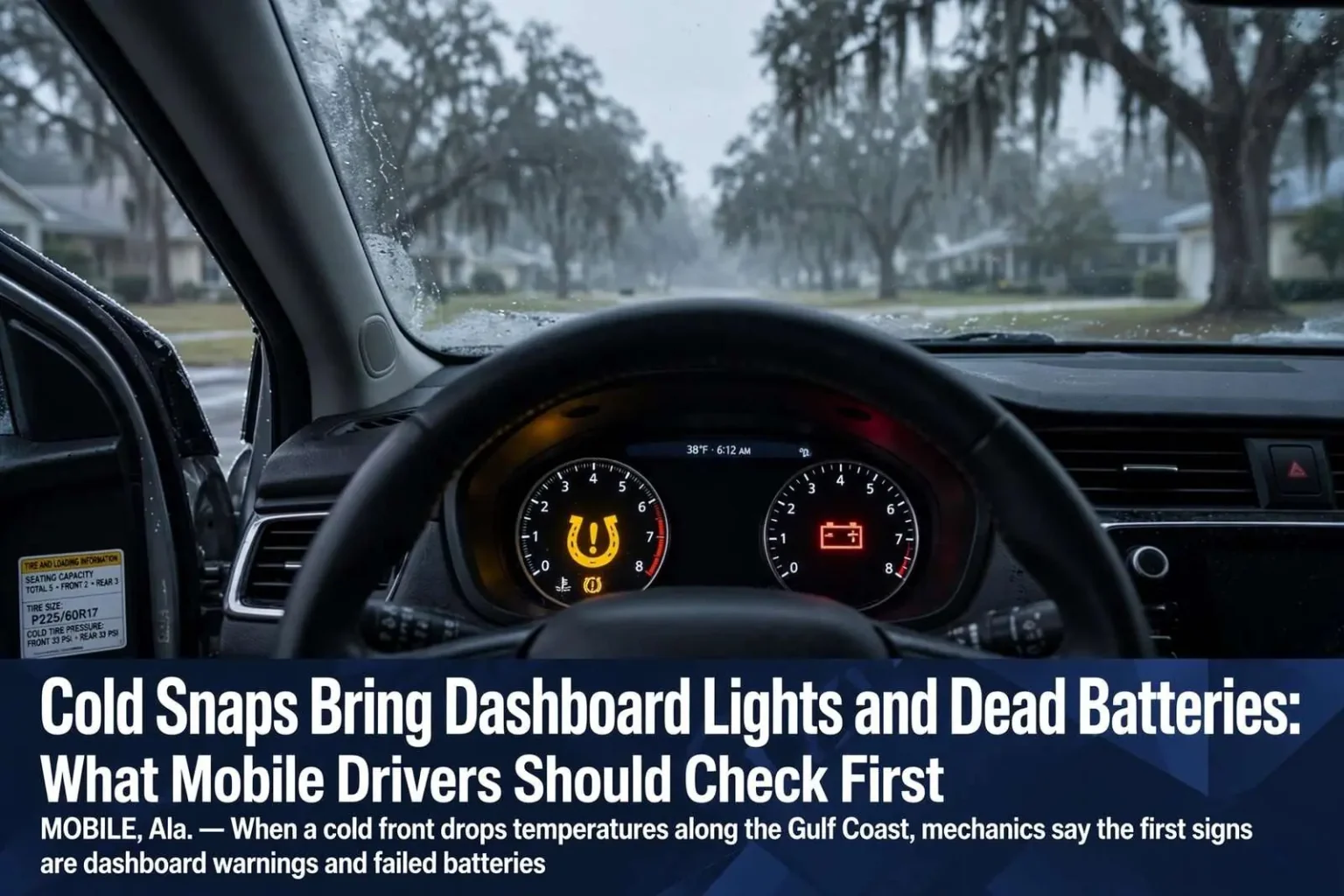
MOBILE, Ala. — When a cold front pushes into the Gulf Coast, area mechanics say the first sign of trouble often shows up on the dashboard. Drop the temperature, and warning lights have a way of switching on — most commonly the tire pressure monitor. Cold air causes tire pressure to fall, triggering the sensor in many vehicles and sending a stream of Gulf Coast drivers to service shops with a warning they may never have seen before.
The fix starts with a sticker: open the driver’s door and check the label inside the door crease, which lists the proper PSI for your tires. That factory placard is the authoritative source for what your specific vehicle’s tires should read, and reinflating tires to that specification is usually all it takes to clear the light once temperatures rebound.
Batteries are the other frequent cold-weather casualty, and they tend to fail without warning. Older batteries in particular may not respond well to the first real chill of the season. Service technicians recommend having a battery tested as seasons change — or simply replacing it if it’s already several years old — because the morning a battery dies is rarely a morning anyone has time to deal with it.
The dashboard itself has become the messenger for nearly every automotive system over the past two decades. Tire pressure monitors became standard equipment on new vehicles well before they were legally required across the board, and modern cars also monitor battery charging voltage, coolant temperature, oil life, and dozens of other readings that used to go unnoticed until something broke. That means a cold snap in Mobile produces a small wave of dashboard lights that would never have appeared in an older car — not because the vehicles are more fragile, but because the vehicles are more observant.
Mechanics say the pattern repeats with every significant front: the first cold morning brings a cluster of drivers wondering why their dashboards have lit up, and the answer, more often than not, is four underinflated tires rather than any mechanical failure.
Why Gulf Coast Cold Snaps Are Hard on Cars
Gulf Coast vehicles face cold differently than cars in northern climates. In Mobile, a cold front can swing temperatures thirty degrees or more in a matter of hours, and vehicles that sit outside — the norm in a region where attached garages are the exception rather than the rule — feel every degree of it. Tires lose roughly a pound of pressure for every ten-degree drop in temperature, so a sharp front that arrives overnight can leave every car in the neighborhood underinflated by morning.
That physics is why the tire pressure monitor is the dashboard’s most common cold-weather visitor. The sensors are calibrated to alert drivers when pressure falls below a threshold, and a Gulf Coast cold snap reliably pushes marginal tires past it. The condition is usually harmless if corrected promptly, but driving for weeks on underinflated tires increases wear, hurts fuel economy, and affects handling — which is why mechanics urge drivers to address the light rather than ignore it.
Batteries fail in the cold for a different reason: the chemical reactions that produce electricity slow down as temperatures drop, precisely when a cold engine demands more cranking power to turn over. A battery that started fine all summer can prove inadequate on the first genuinely cold morning, and batteries past their service life rarely announce their decline in advance.
Checking Tire Pressure the Right Way
Checking tire pressure is a five-minute task most drivers can do at any gas station with an air pump. The procedure: remove the valve cap, press a gauge onto the valve stem, and compare the reading against the number on the driver’s door sticker — not the maximum pressure molded into the tire’s sidewall, which is a common mix-up. Tires should be checked when cold, before the car has been driven far, since driving heats the air inside and inflates the reading.
The door sticker matters because manufacturers set pressures for each specific vehicle based on its weight, suspension, and tire size, and the right number can differ between the front and rear axles. Inflating to the placard spec after a cold snap restores the handling and wear characteristics the vehicle was engineered for, and it usually extinguishes the dashboard light within a few minutes of driving once the sensor sees the corrected pressure.
Advice From the Service Bay
“It’s probably a little more dramatic going from hot to cold than cold to hot, so the biggest thing is to be prepared,” said Tito McKinney, service director for Gulf Coast Auto Group. The observation captures the regional reality: Gulf Coast cars spend most of their lives in heat and humidity, and the sudden arrival of a cold front stresses systems that have adapted to the opposite extreme. Preparation, in McKinney’s telling, is the difference between a dashboard light and a stranded morning.
McKinney’s shop also recommends checking the cooling system and replacing worn wiper blades before winter arrives. The cooling system advice surprises some drivers — in South Alabama, coolant usually gets attention for surviving summer, not winter — but the same fluid that protects an engine in August has to keep flowing in a January cold snap, and old coolant that has never been changed can lose its effectiveness in either direction. Wiper blades, meanwhile, harden and crack in the heat, and a blade that cleared a summer thunderstorm may smear across a cold morning’s mist.
Both items are inexpensive by automotive standards, and both are the kind of preventive work that fits a routine service visit. Technicians can test a battery’s remaining capacity in minutes, top off or replace coolant, and check blade condition — a short list that eliminates most of the common cold-weather failures local shops see when a front moves through.
Before the Holiday Road Trip
For holiday travelers heading out on long drives — possibly through several different climates along the way — a pre-trip inspection is worth the time. A car that behaves fine on Mobile’s short urban trips faces a different test on an interstate run north, where temperatures fall with every hour of driving and a marginal battery, tire, or cooling system has hours of sustained demand rather than minutes to expose itself.
A pre-trip inspection covers the same territory as the seasonal checklist — battery test, tire pressure and tread, coolant condition, wiper blades, lights — plus the items long-distance driving adds, like checking the spare and making sure fluids are topped. Shops around the Gulf Coast see the holiday travel rush each year, and technicians generally advise booking the inspection before the roads fill rather than during the travel window itself.
Packing for the What-If
Packing emergency supplies in the trunk is smart insurance in case bad weather hits or the car breaks down far from home. The Gulf Coast version of that kit looks a little different from a northern one — no ice scraper required — but the essentials remain: a phone charger, jumper cables or a jump starter, a flashlight, water, a basic first-aid kit, and a blanket for the unlikely but possible scenario of waiting out a breakdown in a cold front’s chill.
The blanket is the item most Gulf Coast drivers skip and most regret skipping if they need it. A region acclimated to heat can be genuinely cold when a strong front arrives, and a vehicle that loses power on a rural stretch of interstate at night can get uncomfortable quickly. A few items stuffed in a duffel take up almost no space and cover the gap until help arrives.
Shops around the region say the battery test takes only a few minutes and gives a clear answer: a reading of the battery’s capacity under load, compared against its rated spec. Batteries that pass can be left in place with confidence; batteries that fail the test are replaced on the spot, which is a far cheaper outcome than a no-start in a grocery store parking lot on the coldest morning of the year. Many shops perform the test free during a routine visit, making it one of the least demanding items on any seasonal checklist.
The Seasonal Habit Worth Building
The broader lesson from the region’s mechanics is that the Gulf Coast’s weather swings reward a seasonal maintenance habit. The same drill — tire pressures checked against the door-sticker PSI, a battery test, a glance at coolant and wipers — serves twice a year: before the first cold front of winter and before the first triple-digit heat of summer. Vehicles in this climate age differently from those in steadier climates, and the swings between extremes are what expose the weak components.
For most drivers, the dashboard’s tire pressure light will be the only cold-weather drama they experience, resolved with a few minutes at an air pump and a glance at the sticker inside the driver’s door. For those with older batteries or a road trip on the calendar, a little attention before the next front arrives is the cheaper path by far — and the one area technicians recommend to every customer who asks what the cold will do to their car.