Conecuh County burglary turns deadly; one suspect shot, later dies
A burglary attempt in Conecuh County turned deadly when the homeowner opened fire, leaving one suspect dead and his brother charged with burglary.
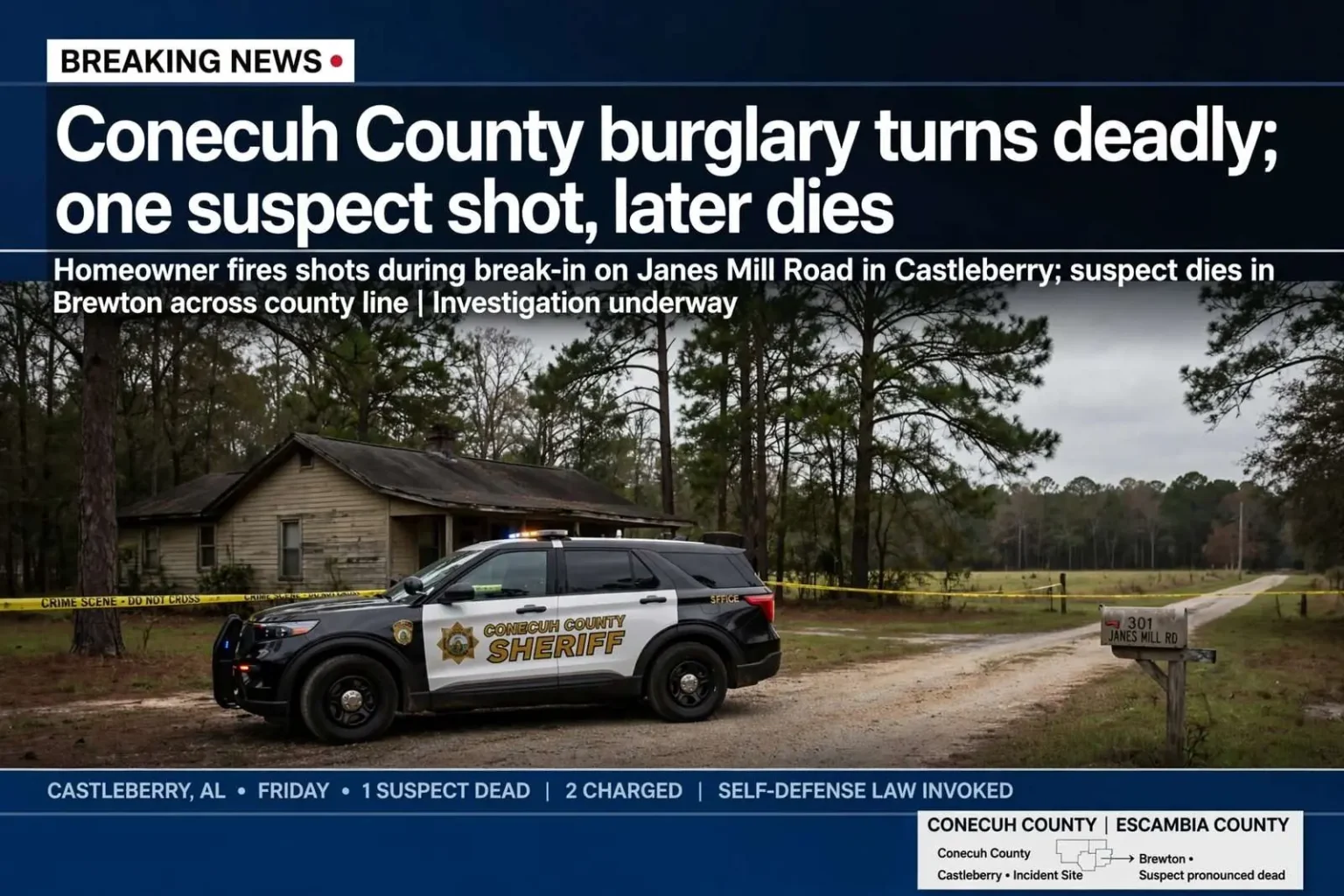
A burglary attempt in Conecuh County turned deadly Friday afternoon, leaving one suspect shot and later dead, according to Sheriff Randy Brock. The case, which began with a reported break-in at a rural home and ended with a death across the county line in Brewton, has left two men facing the justice system and a homeowner who fired the fatal shots at the center of an investigation.
The sheriff said the incident happened in the 300 block of Janes Mill Road in Castleberry, a small Conecuh County community off the corridors between Evergreen and the Escambia County line. Two brothers and another family member tried to break into a home, not realizing the homeowner was inside. When the intrusion began, the homeowner armed himself and fired shots, striking one of the men inside the residence.
Rather than call for help, the group loaded their wounded relative into a pickup truck and fled east into Escambia County, where authorities located them. The suspect who was shot did not survive. He was identified as Blake Addison. His brother, Charles Addison, was charged with second-degree burglary, and the sheriff said the case will go to a grand jury with additional charges likely.
The wounded man was pronounced dead at a home in Brewton, the Escambia County seat, after the flight from the scene. Brock said the homeowner was the one who called the Conecuh County Sheriff’s Office to report that he had shot someone, meaning the homeowner both defended his residence and immediately brought the incident to authorities — details investigators will weigh as they assemble the case.
Self-Defense Law in Alabama
The shooting raises questions that Alabama law answers with unusual clarity. The state is among the many that have adopted castle-doctrine protections, and its statute goes further than most: under Alabama law, a person presumes a reasonable fear of death or serious bodily injury when someone is unlawfully and forcibly breaking into an occupied dwelling, and that person has no duty to retreat before using deadly force in response. The protection extends to occupied vehicles and, in cases of abduction or robbery, to any place a person has a right to be.
That legal framework means the homeowner’s account and the physical evidence will be measured against a statute designed to protect residents who defend their homes from forcible entry. Prosecutors and investigators will still examine the circumstances — whether the intruders were armed, how the encounter unfolded, and whether the force used was proportionate — but the starting presumption in Alabama favors a homeowner confronted by a burglary in progress. The decision on any charges in connection with the shooting will rest with the district attorney, and the grand jury process that Brock referenced will be where the broader case is ultimately tested.
The flight from the scene added a second layer to the investigation. Moving a gunshot victim across county lines, rather than summoning emergency medical help, cost critical time and moved the death investigation into Escambia County’s jurisdiction. Cases that span two counties typically involve both sheriff’s offices working alongside investigators from the district attorney’s office, with the coroner’s office in the county where the death occurred handling the formal pronouncement and autopsy.
Second-degree burglary, the charge Charles Addison faces initially, applies under Alabama law to unlawful entry into a dwelling with intent to commit a crime. A conviction can carry a sentence of up to 20 years, and Brock’s expectation of additional charges suggests prosecutors are reviewing the conduct of all three participants — including the family member who has not been named — for everything from the entry itself to the transport of a wounded suspect.
Who Was Involved and What Comes Next
The identity of the third participant — the additional family member who joined the two brothers in the break-in attempt — has not been released, and the sheriff’s office has not said whether that person was taken into custody on the night of the incident or is being sought. What is clear from Brock’s account is that all three were relatives, a detail that turned a burglary case into a family tragedy that now extends across two counties and two households.
The grand jury process that will review the case works differently from a trial. In Alabama, a grand jury hears evidence presented by the district attorney and decides whether there is probable cause to indict; its proceedings are closed to the public, and additional or upgraded charges often surface at this stage. That is where decisions about the homeowner’s conduct, if any questions remain about the shooting itself, would also be resolved — either through an indictment, a presentment, or a decision that no charges are warranted under the state’s self-defense statutes.
For Castleberry and the surrounding rural stretches of Conecuh County, the case is a stark reminder of how quickly property crime can turn lethal. Communities like Janes Mill Road sit far from the nearest municipal police department, and response times from the county sheriff’s office can stretch long in a county with limited resources. Rural homeowners across south Alabama routinely keep firearms for protection, a reality that intersects with laws like Alabama’s when intruders miscalculate whether a house is empty.
The geographic facts of the case tell their own story. Castleberry lies in the eastern part of Conecuh County, close enough to the Escambia County line that a fleeing vehicle can cross it in minutes, and Brewton is the nearest substantial town. The route the suspects took — wounded man in a pickup truck, racing from the scene of the shooting to a residence in Brewton — traces the practical geography of the border country between the two counties, where law enforcement agencies regularly assist each other across jurisdictional lines.
The Investigation Ahead
Sheriff’s investigators will now assemble the record: statements from the homeowner, forensic work at the Janes Mill Road scene, evidence from the Brewton residence where the suspect died, autopsy results, and the accounts of anyone who saw the pickup truck’s flight. The Alabama Law Enforcement Agency often assists in officer-involved shootings, and while this case involved a civilian rather than an officer, the same habit of inter-agency cooperation applies in rural jurisdictions with small investigative staffs.
The homeowner, meanwhile, faces a legal process that will examine his actions even as the law gives him strong protection. Advocates for castle-doctrine statutes argue that such laws spare defenders the ordeal of proving they had no safe way out; courts still require that the force used meet the statutory conditions. The fact that he reported the shooting himself, as Brock noted, will be among the details weighed when prosecutors decide how to proceed.
For the Addison family, the case has already produced one death and one felony charge, with more possible when the grand jury convenes. For the Conecuh County community, it stands as a case study in how a single afternoon — a decision to break into a house, a homeowner awake and armed, a flight across a county line — can end in a homicide investigation with no criminal charges against the person who fired the fatal shots. The grand jury will have the final word on the legal outcome, but the facts as the sheriff laid them out have already settled the narrative: an attempted burglary met with deadly force, under a state law written for exactly that encounter.
A Closer Look at Conecuh County
Conecuh County, with its county seat at Evergreen, is one of south Alabama’s smaller counties, sparsely populated and heavily rural, with timber long the dominant land use and law enforcement provided by a sheriff’s office and small municipal departments in Evergreen and Castleberry. The county sits along the Interstate 65 corridor north of Atmore, bordered to the east by Escambia County, and its communities rely on volunteer fire departments and county services that stretch thin across a wide area.
Janes Mill Road runs through the kind of countryside where houses sit back from the road on family land, where neighbors know each other’s vehicles, and where an unfamiliar truck in a driveway is noticed. Incidents like Friday’s tend to ripple through such communities quickly, discussed at churches and stores for weeks, both because of their rarity and because they touch on questions every rural homeowner considers: what would you do, and what does the law allow you to do?
The answer Alabama gives, compared with other states, is among the most protective in the country. The state’s self-defense statute does not merely create a presumption of reasonable fear in home invasions; it also shields the defender from civil liability in many circumstances when the force was justified. Lawmakers expanded these protections over the years with rural constituents in mind, people who may be many minutes from the nearest law enforcement response and who must make split-second decisions on their own.
Prosecutors, for their part, do not simply wave such cases through. Even under strong castle-doctrine laws, district attorneys review the totality of circumstances, and juries hear the facts when charges are brought. The presumption changes the burden, but the process still runs its course — investigation, grand jury review, and, where warranted, prosecution of those whose conduct falls outside the justification statute. That is the path this case now takes, with Charles Addison already charged and the homeowner awaiting the same system’s judgment on his actions.
Until the grand jury acts, the sheriff’s summary stands as the authoritative account: three relatives attempting a break-in, a homeowner inside and armed, one suspect shot, a flight into Escambia County, a death in Brewton, one arrest, and more charges likely. It is the kind of case that will be cited for years in discussions of Alabama’s self-defense laws, and its resolution will be watched in two counties.