
Contenū to Host Wellness Retreat, Silent Auction Benefiting Crisis Center of Alabama Staff
Contenū will hold its annual Wellness & Healing Retreat Aug. 26 at Gulf State Park, featuring a new silent auction that will raise funds for Crisis Center of Alabama employees.
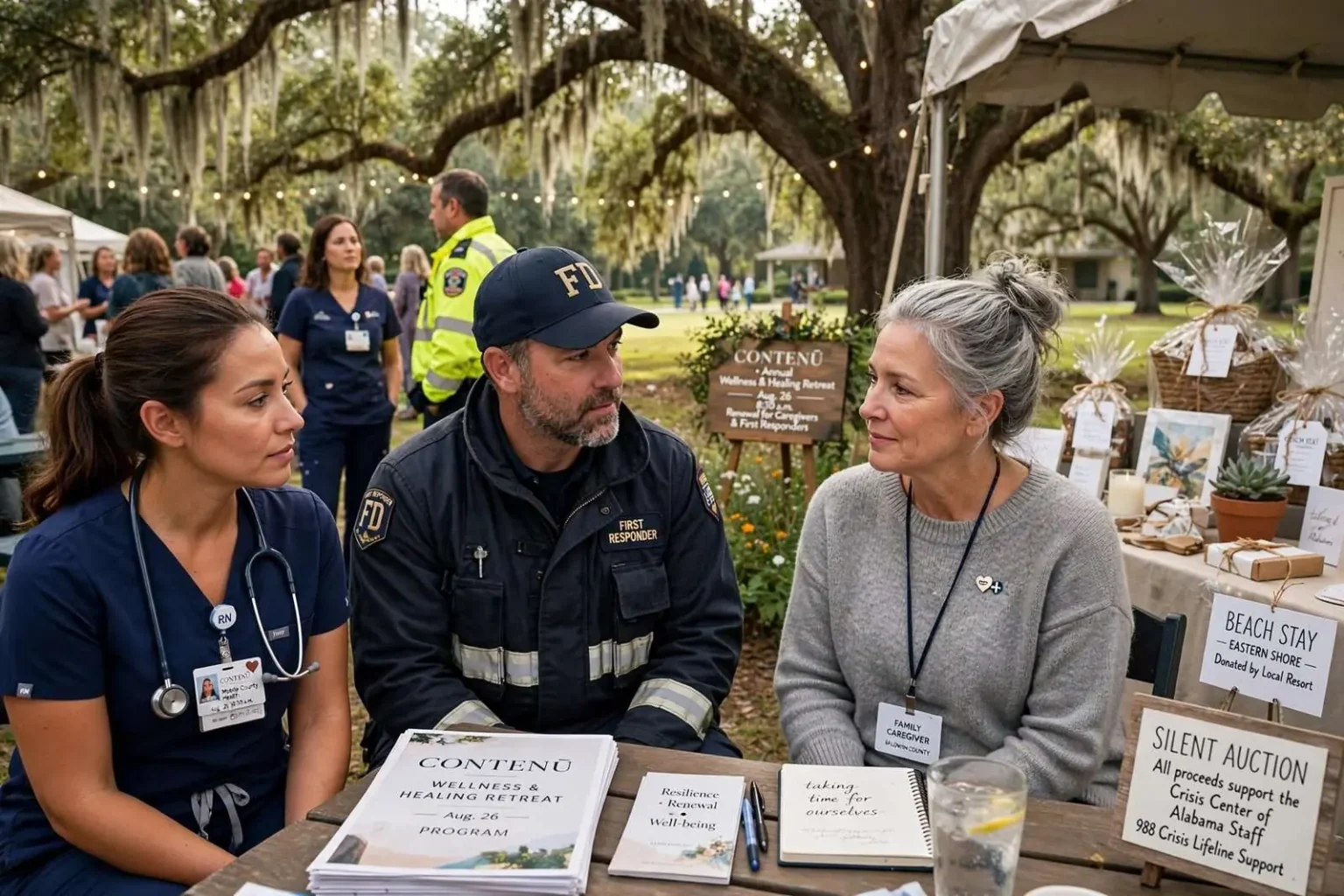
Contenū will host its annual Wellness & Healing Retreat on Aug. 26, offering healthcare professionals, caregivers, first responders and others in high-stress professions a day focused on renewal, resilience and personal well-being. The nonprofit organization, which supports individuals impacted by serious illness, their loved ones and the professionals who care for them, will hold the retreat from 8:30 a.m. The event doubles as a fundraiser: a silent auction held in conjunction with the retreat will benefit the staff of the Crisis Center of Alabama, directing proceeds toward the people who answer the region’s crisis calls day and night.
The pairing is deliberate. The retreat’s intended guests — nurses, aides, therapists, emergency dispatchers, firefighters, paramedics and family caregivers — and the crisis center’s own staff occupy the same emotional territory: work defined by other people’s worst days. Contenū’s mission has always recognized that serious illness and crisis do not stop at the patient; they spread outward through families, and they settle hardest on the professionals whose job is to absorb them. A retreat that serves the caregivers while its silent auction serves the crisis counselors is a single argument about the same population.
Days like Aug. 26 answer a need that health systems across the Gulf Coast have been forced to take more seriously in recent years. Burnout in the caring professions is not a mood problem — it is an occupational hazard with measurable costs, from turnover in hospital units to the attrition of volunteer and paid first responders. Southwest Alabama’s healthcare workers carried an extraordinary load through the pandemic years, and the region’s hospitals, nursing homes, hospice agencies and emergency services still compete for staff in a market where exhaustion pushes trained people out of the field entirely. A one-day retreat does not fix that, but it names it, and it gives the people affected a room in which the subject is finally their own well-being.
What the retreat is built to do
Wellness retreats for caregiving professionals typically blend several elements: guided sessions on stress and resilience, movement and mindfulness practices, quiet time, shared meals and, importantly, permission to talk honestly about the weight of the work among peers who understand it without explanation. Contenū’s annual gathering follows that model, opening at 8:30 a.m. so participants can complete a full day of programming and still be home by evening — a practical detail that makes attendance feasible for hospital staff on shift schedules and caregivers who cannot leave their households for more than a day.
The guest list tells its own story about the Gulf Coast’s caregiving economy. Mobile County is the region’s medical center, anchored by its major hospital systems and a web of clinics, rehab facilities and home-health agencies stretching across the county and into Baldwin County’s fast-growing communities. First responders in both counties work for municipal departments, county sheriff’s offices and volunteer companies. Family caregivers, the least visible group of all, outnumber every paid category — thousands of southwest Alabama households quietly managing the care of a parent, a spouse or a child with serious illness. All three groups are the audience the Aug. 26 retreat is built for.
For attendees, the day also functions as a point of connection. Isolation is one of the defining features of caregiving burnout — the nurse who works three twelves a week and the daughter who has managed her father’s care for five years rarely meet anyone facing the same arithmetic. A retreat puts them in the same room, and nonprofit organizers have long found that the conversations started over a retreat lunch outlast the event itself, turning into the informal peer networks that carry people through the hardest stretches of the work.
The silent auction and the Crisis Center of Alabama
The silent auction is the retreat’s fundraising engine, and its beneficiary — the staff of the Crisis Center of Alabama — makes the event’s purpose concrete. Crisis centers operate the region’s hotlines: suicide prevention lines, crisis intervention services and text-and-chat lines that connect callers in their darkest hours to a trained voice. Alabama’s crisis center network has taken on added weight since the national 988 Suicide & Crisis Lifeline went live, routing more contact volume into local centers whose answer rates, staffing levels and counselor training determine whether a call in crisis becomes a moment of rescue or a hold tone.
That work exacts a toll of its own. Crisis counselors absorb, call after call, the full range of human emergency — suicidal despair, domestic violence, substance crisis, grief — and the field has learned that the counselors themselves need deliberate support to stay in the work. Staff-support initiatives are the standard response: training in vicarious trauma, scheduling that limits continuous exposure, debriefing after the hardest calls, and retreats and renewal events of exactly the kind the Aug. 26 auction funds. The silent auction’s proceeds going specifically to staff, rather than to general operations, reflects Contenū’s founding insight — that the people who care for others are the population most likely to be forgotten by everyone else’s charity.
Silent auctions, for their part, have become a fixture of Gulf Coast nonprofit fundraising because they work on two levels at once. Local businesses — restaurants, salons, outfitters, artists, resorts from the Eastern Shore to the beaches — donate goods and experiences, guests bid quietly through the event, and the competition itself becomes part of the afternoon’s energy. For the nonprofits, an auction turns a community’s donation pool into revenue while introducing the organization’s mission to every bidder who writes down a number. For the donors, it is visibility in a room full of exactly the professionals and supporters a local business wants to know.
Why caregiver support has become a regional priority
The retreat lands amid a broader reckoning in healthcare over the people who provide the care. Professional organizations in nursing, medicine and emergency services have spent recent years treating burnout, moral injury and compassion fatigue as system problems to be measured and managed rather than private weaknesses to be endured. The consequences of ignoring them are concrete: experienced nurses leaving bedside work, paramedic turnover that hollows out ambulance crews, and a shrinking pipeline of hospice, home-health and mental health workers across the Gulf South. Communities that fail to support their caregivers eventually discover the cost at the worst possible moment — in the emergency room queue, on hold with a crisis line, or without an ambulance at the door.
Nonprofits like Contenū occupy the space the institutions leave open. A hospital can offer an employee assistance program; a county agency can mandate a debriefing; but the organic support — a day away, peers who understand, a community that visibly values the work — has historically come from the independent organizations and faith communities that surround the caring professions. Contenū’s model, built around people impacted by serious illness and the professionals who serve them, grew from that recognition, and its annual retreat is the most public expression of it.
The Aug. 26 event is also a reminder of how southwest Alabama’s nonprofit sector threads through everyday life. Between Mobile’s major medical institutions, Baldwin County’s growing communities and the region’s network of volunteer and professional responders, thousands of residents spend their working lives on the stressful side of other people’s emergencies. When a nonprofit stages a day of renewal for them and sends its auction proceeds to the counselors who answer the region’s crisis calls, it is doing something more than hosting an event: it is publicly paying a debt the community owes to the people who stand on the hard side of the hardest days. Registration details for the retreat and auction items are made available by Contenū in advance of the Aug. 26 opening at 8:30 a.m.
Inside the retreat day
The shape of a retreat day matters as much as its message. Programming that runs from the 8:30 a.m. opening into the late afternoon is generally arranged so that the morning carries the reflective work — sessions on stress physiology, resilience and the emotional labor of caring professions — while the afternoon moves toward renewal: guided movement, quiet intervals, shared meals and the auction itself as the social centerpiece. That arc is intentional. Caregiving professionals spend their working hours in permanent reactivity, responding to whatever the next pager, call light or radio transmission demands; a retreat succeeds when it reverses that rhythm and gives participants a day in which nothing is urgent.
Peer conversation is the element organizers most often describe as the reason people return. In a hospital, a fire station or a family living room, admitting exhaustion carries professional or personal risk — the fear of being seen as unfit for the work. Among peers at a retreat, the same admission is unremarkable, and the exchange of coping strategies, warnings and encouragement happens with a speed that no formal employee program replicates. Contenū’s focus on serious illness, its loved ones and its professionals puts the full circle in one room: the person who survived the diagnosis, the family member who carried them through it and the nurse who walked the ward beside them.
The retreat also serves a quieter institutional purpose. Healthcare and public-safety agencies across the region track the health of their workforce through retention numbers, and supportive events outside the workplace have become part of the retention conversation. An organization that sends its people to a community-hosted retreat is signaling, in front of the whole region, that it treats staff well-being as a recruitment and retention asset rather than a private matter. In a labor market where experienced caregivers can move, that signal has dollar value — and the agencies that participate in events like Aug. 26 are, in effect, investing it.
The community around the auction
A silent auction is also a map of the local economy’s generosity. Gulf Coast businesses have long supplied events like this one with restaurant gift cards, golf rounds, beach-stay packages, salon services, art and event tickets, and the bidding sheets tell attendees where their neighbors are willing to stand behind a cause. For a fundraiser benefiting crisis center staff, the donor roll often crosses surprising lines — hospitality businesses, medical practices, banks and retailers all appearing on the same sheet — because the crisis line is one of the few community services everyone understands the need for without explanation.
The Crisis Center of Alabama’s end of the equation deserves the emphasis the auction gives it. Hotline work is staffed around the clock, which means nights, weekends and holidays covered by counselors whose availability is the difference between a caller in crisis reaching a human voice or an automated menu. National attention to suicide prevention and the launch of the 988 lifeline have raised expectations for local answer rates, and every increase in expected coverage is an increase in the trained staff a center must retain. Funding that targets staff support — training, debriefing, renewal — goes directly to the capacity a center needs to keep its lines answered.
Contenū’s annual gathering closes the loop among all of it: the hospital nurse and the crisis counselor, the family caregiver and the paramedic, the donor bidding on a weekend getaway and the local business that donated it. On Aug. 26, beginning at 8:30 a.m., the region’s caregiving community gets a day that is about them, and the auction at its center converts that community’s attention into tangible support for the people who answer the phone when someone else’s worst night arrives. For southwest Alabama — where the medical, emergency-response and family-caregiving workforce holds up far more of daily life than most residents ever see — the event is small, local and exactly the point.