Convicted Pensacola sex offender sentenced to 30 years for child sexual abuse
A convicted Pensacola sex offender was sentenced to 30 years in prison for sexually abusing a child under 12, court records show.
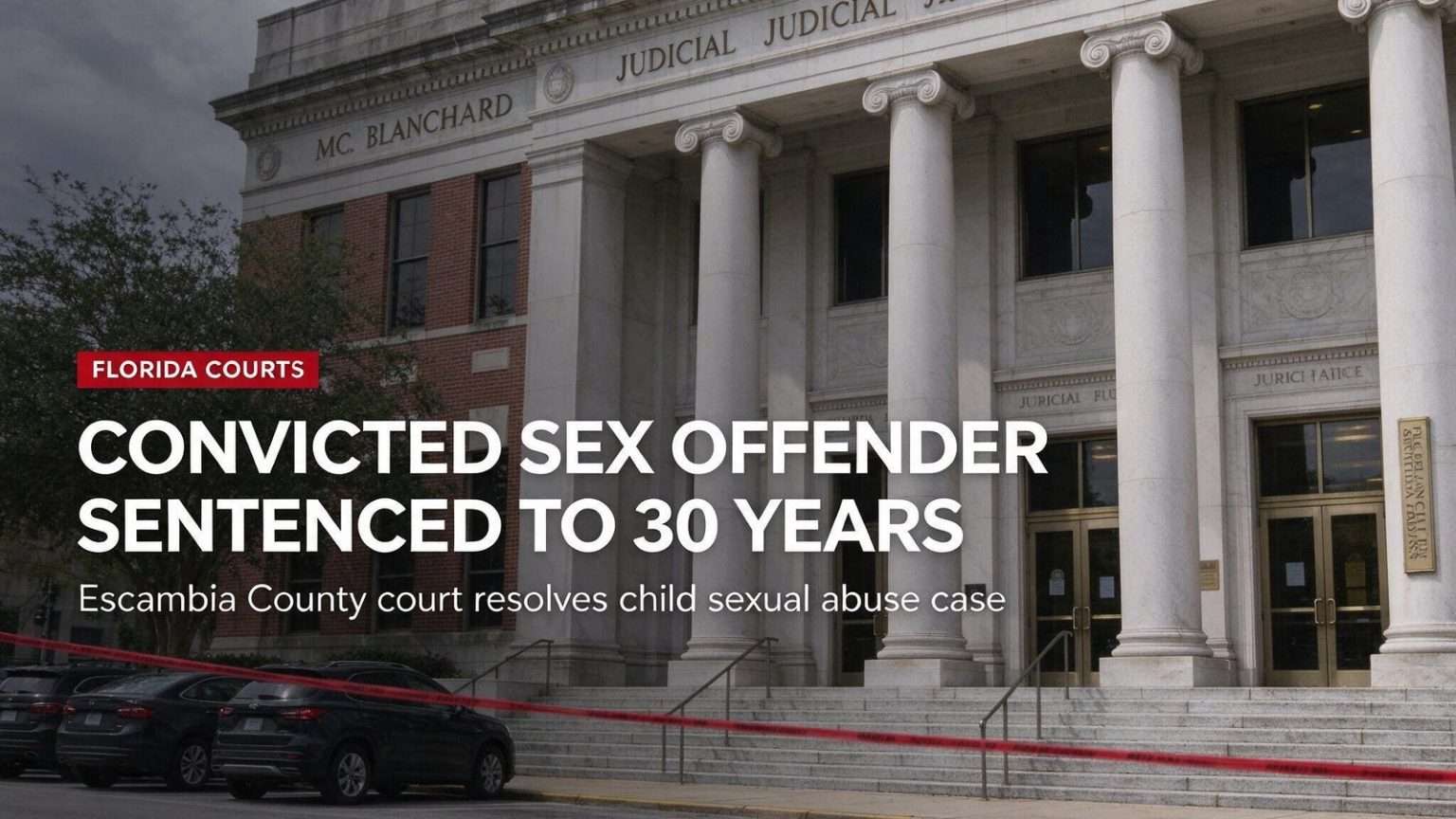
PENSACOLA, Fla. — A convicted sex offender has been sentenced to 30 years in prison for sexually abusing a child under the age of 12, according to court records. The sentence, handed down in Escambia County court, closes a case that prosecutors pursued through a series of felony counts carrying some of the heaviest penalties in Florida’s criminal code, and it ensures the defendant will spend the next three decades in state custody before beginning an extended period of supervised release.
Joe Philyaw, 39, pleaded to four counts of sexual battery while in a position of familial or custodial authority and three counts of battery of a child. The charges reflect the circumstances alleged in the case: abuse of a child by someone whose role gave him authority and access, an aggravating factor Florida law treats with particular severity. Under Florida statutes, sexual battery on a victim under 12 carries a mandatory minimum sentence, and the familial or custodial authority designation underscores the breach of trust at the center of the prosecution.
Escambia County Judge Gary Bergosh imposed the 30-year sentence. Bergosh, a veteran member of the local bench who has handled felony dockets in the First Judicial Circuit for years, has presided over many of the region’s most serious criminal cases, and sentencing hearings before him in child-abuse matters routinely include statements from prosecutors about the long-term harm to young victims.
After his release, Philyaw will serve 10 years of sexual offender probation and is designated a sexual predator who must register for life. The sexual predator designation, set apart from the broader sex offender registry category, carries the strictest notification and reporting requirements Florida imposes: lifetime registration with the sheriff’s office in whatever county the offender resides, updates whenever he moves, changes jobs or enrolls in school, and public listing on the Florida Department of Law Enforcement’s offender database that residents can search at any time.
The charges and the plea
Court records show the abuse occurred between 2011 and 2017, a span of years that prosecutors say reflects a sustained pattern rather than a single incident. Cases involving child victims who were very young when the abuse began and old enough to disclose it years later often hinge on delayed disclosure, and the timeline in this case is consistent with how such prosecutions typically unfold in the Pensacola area.
The plea structure — seven felony counts resolved in a single proceeding — avoided a trial while preserving the full sentencing exposure. Sexual battery while in a position of familial or custodial authority is a first-degree felony under Florida law, punishable by up to 30 years per count, while battery of a child adds further counts to the sentencing calculation. Negotiated pleas in multi-count child-abuse cases are common because they spare child victims from testifying, and they give judges a complete picture of the conduct through the facts read into the record.
Escambia County prosecutors, working out of the State Attorney’s Office for the First Judicial Circuit, handle a steady volume of crimes against children each year, assisted by the Children’s Advocacy Center in Pensacola, which conducts forensic interviews designed to minimize repeated questioning of young victims. The office’s specialized units coordinate with Pensacola police, the Escambia County Sheriff’s Office and the Department of Children and Families on cases of this kind.
A prior record that preceded the case
Philyaw had previously entered a no-contest plea to lewd and lascivious conduct involving a 14-year-old, which required him to register as a sex offender. That earlier case already placed him under Florida’s registration system before the conduct in this case came to light, meaning his release from prison will follow decades of documented offenses against minors.
Florida’s registry distinguishes between sexual offenders and sexual predators, with the predator designation reserved for offenders classified as the greatest risk to public safety. Once designated, an offender cannot shed the label through the passage of time; the only path off the registry is a petition to the sentencing court after 25 years, and even then only if the court finds the offender no longer poses a threat. For residents of Escambia County and elsewhere, the FDLE database allows searches by name, neighborhood and distance, and law enforcement agencies conduct periodic address verifications to confirm that registered offenders live where they say they do.
What the sentence means
The 30-year term followed by a decade of sexual offender probation means Philyaw’s supervised custody will extend into his late 70s, assuming he serves the full term. Sexual offender probation is stricter than standard probation: it requires compliance with a special set of conditions, including curfews, prohibitions on contact with minors, mandatory treatment, and unannounced searches by probation officers trained to supervise sex offenders. Any violation can return the offender to prison to serve the remainder of the original sentence.
Child protection advocates in Northwest Florida note that sentences of this length reflect both the statutory framework Florida has built over the past two decades and the growing willingness of local courts to impose near-maximum terms in cases involving sustained abuse of young children. The Legislature has repeatedly increased penalties for sexual battery on minors, including mandatory minimums that remove much of the discretion judges once had to impose shorter terms.
For the victim’s family, the resolution of the case through plea means an end to the uncertainty of trial, though the sentence does not undo the harm described in the charging documents. Victim advocates in Escambia County point families toward counseling resources through local agencies and the court’s victim services office, which assists survivors throughout the prosecution and after sentencing.
The case now moves fully behind the defendant: the prison term begins immediately, the registration obligation attaches upon any eventual release, and the 10 years of probation will follow. According to court records, the 30-year sentence and lifetime predator designation together place the defendant under some form of state supervision or public registry for the remainder of his life.
Behind the courtroom outcome sits a larger system that Escambia County residents interact with more than they may realize. The Florida Department of Law Enforcement maintains the state’s public registry, and the Escambia County Sheriff’s Office handles local registration and verification duties for offenders living in the unincorporated county and in Pensacola itself. Registered offenders are required to report in person at intervals set by law, to update their information within 48 hours of any change of address, and to observe residential proximity restrictions that keep them away from schools, parks, playgrounds and other places where children regularly gather.
Those proximity rules matter in a county like Escambia, where schools, childcare centers and youth sports complexes are dense across the Pensacola metro area and in communities such as Cantonment, Bellview and Ferry Pass. Deputies conduct periodic compliance checks, and violations of registration requirements are themselves felonies that can add years to an offender’s custody. The system is designed so that a predator designation follows the individual across county lines: an offender who moves from Escambia to another Florida county, or into another state, must re-register with the new jurisdiction, and failure to do so triggers prosecution.
Judge Bergosh’s courtroom is one of several in the M.C. Blanchard Judicial Building in downtown Pensacola, where the First Judicial Circuit’s felony dockets run continuously. Sentencing hearings in child-abuse cases there often include testimony or statements about the psychological toll on young victims, the length of counseling typical after disclosure, and the way delayed reporting shapes the evidence available to investigators. Prosecutors in the circuit’s specialized units work closely with Pensacola police detectives and sheriff’s investigators, who coordinate initial response with the Gulf Coast Children’s Advocacy Center so that a child is interviewed once, on camera, by a trained specialist.
For neighbors and parents who learn of a case like this one, the practical takeaways are straightforward. The FDLE sexual offenders and predators registry is searchable and free, community notifications are issued when a designated predator establishes residency in a neighborhood, and local law enforcement agencies encourage residents to report suspicious conduct around children rather than assume someone else has already done so. Advocates also point families to prevention education resources available through schools and community organizations across the Panhandle.
The 30-year sentence in this case ranks among the longer terms imposed in Escambia County in recent years for offenses against a single child victim, reflecting both the number of counts to which the defendant pleaded and the statutory weight of the familial or custodial authority enhancement. Court records in the case remain available through the Escambia County Clerk of the Circuit Court, and the defendant will remain in Florida Department of Corrections custody, with his placement determined by the department’s classification system based on the nature of the offenses and his institutional record.