Court Filings Reveal New Details in Lawsuit Over Deadly BCSO Shooting on Interstate 10
Depositions and 911 logs filed in federal court reveal new details in the wrongful death suit over a deadly Baldwin County deputy-involved shooting.
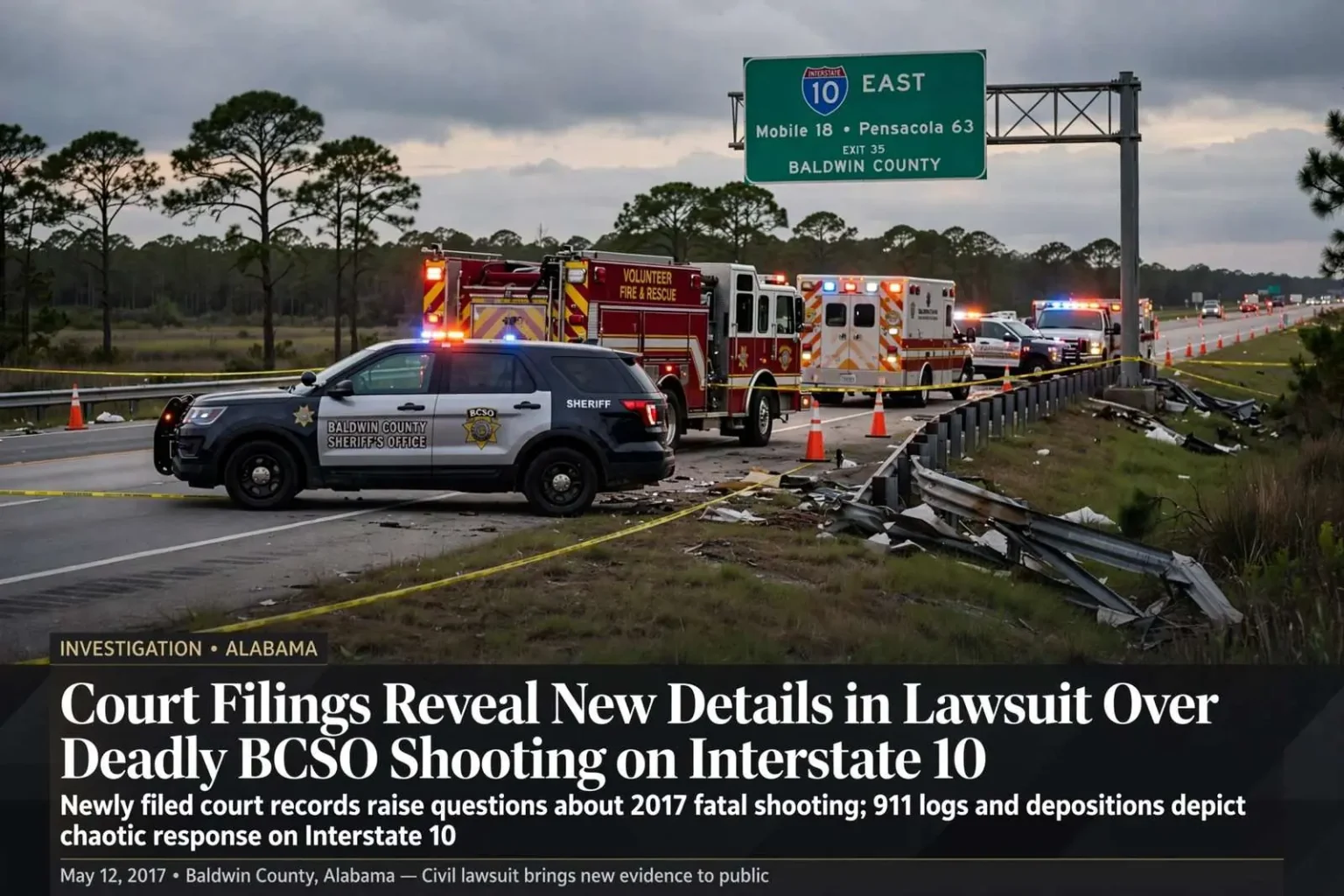
Newly filed court records are raising questions about how a 2017 fatal shooting by a Baldwin County Sheriff’s Office deputy unfolded, with depositions and 911 call logs submitted in federal court depicting a more chaotic response than the account authorities gave the public after the incident.
Jonathan Victor, an unarmed Louisiana man, was shot four times and killed by Cpl. Matthew Hunady on May 12, 2017, roughly half an hour after deputies were dispatched to a single-vehicle crash on eastbound Interstate 10. Volunteer firefighters and paramedics had called for law enforcement help after finding Victor bleeding, erratic and uncooperative inside his vehicle.
A grand jury cleared Hunady of criminal wrongdoing in 2017, but Victor’s mother, Donna Chisesi, later filed a civil lawsuit against Hunady and Sheriff Huey “Hoss” Mack alleging wrongful death and excessive force. The civil case has now become the first venue in which the raw records of that afternoon — radio traffic, dispatch logs, sworn testimony — have been laid out in public.
The shooting occurred on one of the busiest stretches of highway in southwest Alabama. Eastbound Interstate 10 carries commuter, tourist and commercial traffic across Mobile Bay and through Baldwin County, and crashes along the corridor routinely draw a mixed response of state troopers, municipal police, volunteer fire departments and county deputies. It was that mix of first responders, assembled at the crash scene, whose calls set the sheriff’s office response in motion.
Because grand jury proceedings are secret and deputies were never criminally charged, the accounts authorities gave the public in the days after the shooting went largely untested until the lawsuit began producing documents. The filings submitted in recent weeks offer the most detailed picture yet of what dispatchers, deputies and paramedics actually said and did between the first 911 call and the gunfire.
The Baldwin County Sheriff’s Office is the primary law enforcement agency for much of Alabama’s largest county by area, patrolling unincorporated communities and supporting municipal departments from the Florida line to the Mobile Bay causeway. Deputies there handle everything from rural patrol to Interstate 10 corridor calls, and the highway work carries a particular set of hazards: high traffic speeds, drivers in medical distress, and crash scenes where fire and EMS units often arrive first and summon deputies when a situation turns unpredictable.
That is essentially what the records describe on May 12, 2017. The initial call was a crash — a single vehicle off the road — and the people closest to Victor were not deputies but volunteer firefighters and paramedics, whose evolving impressions of what he was holding and how he was behaving were relayed secondhand through 911 operators and sheriff’s dispatchers before reaching the deputies driving to the scene.
What the Radio Traffic Shows
According to call logs and depositions filed as part of a motion in the case, a 911 operator first relayed reports of a possible weapon at 5:17 p.m., telling a sheriff’s dispatcher that first responders believed Victor had something on his lap that could be a gun.
But subsequent transmissions showed growing uncertainty: operators described “something” in Victor’s lap, said responders could not tell what it was, and passed along word from firefighters that Victor appeared to be talking to himself and suffering from an altered mental state. The movement from “something unknown” to “possible weapon” and back is at the center of the dispute, because the language of a dispatch shapes how deputies are trained to approach a scene.
Attorneys for Chisesi argue in the filings that the altered-mental-status warning was only partially relayed to deputies, and that despite having time to investigate whether Victor was actually armed, deputies took up defensive positions rather than doing so. In their telling, the record shows a response shaped by worst-case assumptions when the information available should have invited a more careful approach.
Deputies were logged arriving at 5:31 p.m.; the first radio report of shots fired came at 5:42 p.m., minutes after Louisiana authorities reported Victor had no criminal history. That eleven-minute window, the plaintiff’s team argues, was time enough to gather more from the paramedics and firefighters who had been with Victor — and who, unlike a dispatcher working a phone line, had seen him up close.
Hunady’s First Public Account
A deposition taken December 1 marks the first public statement from Hunady himself. The 16-year BCSO veteran and retired Navy corpsman testified he had never fired his service weapon on duty before that day, that he responded initially “as a welfare concern,” and that he positioned himself behind a fire engine 30 to 40 feet away while trying to get Victor to drop what was in his hands — though he acknowledged he never used the words “gun” or “weapon.”
Victor emerged from his BMW with his hands wrapped in a shirt, holding an unidentified object, and advanced toward Hunady, who fired four shots from about seven yards away. Deputies handcuffed him, and Hunady himself applied a tourniquet to Victor’s leg.
In law enforcement terms, the defense views that sequence as a straightforward deadly-force encounter: an advancing subject, hands wrapped and concealing an object, refusal of commands and a distance too short to retreat. The plaintiff’s team views the same sequence very differently — as the endpoint of a response that treated an injured, disoriented crash victim as an armed threat before anyone had verified that he was one.
The deposition is also the first time Hunady’s own training and background have been laid out in sworn detail. His service as a Navy corpsman, a medic’s role, has figured in earlier descriptions of the incident, and it underlies the detail that he applied a tourniquet to Victor’s leg after the shooting — an act the defense points to as evidence that deputies tried to save Victor’s life once the threat had passed.
Witness Statements in Question
The filings also spotlight shifts in witness accounts. A civilian vendor who stopped to help told a plaintiff’s investigator he believed Victor was holding a cellphone — noting a charger cord hanging from the wrapped shirt — before later signing a defense statement saying he and firefighters thought the object was a gun.
Attorneys for Chisesi point to the changes as reason to doubt the official narrative; the defense counters that every person on scene believed Victor was armed when he advanced in a shooter’s stance. The competing readings of the same witness have become a proxy for the case as a whole, with each side presenting the record as confirmation of what it has argued from the start.
The lawsuit also disputes how the toxicology findings were portrayed publicly. While officials mentioned “a narcotic” in Victor’s system at a 2017 news conference, records show the substance was ketamine administered by paramedics trying to save him, and that no detectable mind-altering substances were found from before the shooting.
Sheriff Mack testified the department had no crisis intervention team at the time and deputies lacked specific de-escalation training. Crisis intervention programs, which pair officers with mental health professionals to teach recognition of psychiatric distress and techniques for slowing an encounter down, have become common in many departments, but adoption across Alabama sheriff’s offices has been uneven, and the testimony stands as an admission that Baldwin County deputies had none of it in 2017.
An attorney for Hunady and Mack has said he believes the case will be dismissed, arguing deputies acted on a 10-33 “armed subject” dispatch and had no safe alternative. In police radio code, a 10-33 signals an emergency involving a dangerous subject, and the defense argues that once that classification went out, deputies were entitled to approach accordingly rather than treat the call as a routine medical response. Defendants have denied the claims; a trial is tentatively set for April.
Separately, the newspaper that first reported the filings has pressed in court for the release of body camera video from the scene, so far without success. The video could resolve some of the factual disputes at the heart of the case — what Victor was holding, how he moved and what commands deputies issued — or complicate both sides’ accounts, which is precisely why it remains contested.
For now, the case stands where many officer-involved shooting cases do after a grand jury declines charges: in federal court, where the discovery is broader and the question is not whether a crime was committed but whether the force used was reasonable under the Constitution. The answer will come from the same record now being assembled — call logs, depositions and, perhaps eventually, the video itself.
The distinction matters because the legal standards are different. In a civil excessive-force case, a jury weighs the circumstances as a reasonable officer on the scene would have perceived them, not with hindsight. Both sides are building their cases around exactly that question — what a reasonable deputy, hearing the dispatches and standing where Hunady stood, should have known and done in those eleven minutes.