Crestview man still locked out of home after sheriff’s office tear gas raid
A Crestview man says his home remains contaminated and uninhabitable after the Okaloosa County Sheriff's Office fired tear gas during a search for his.
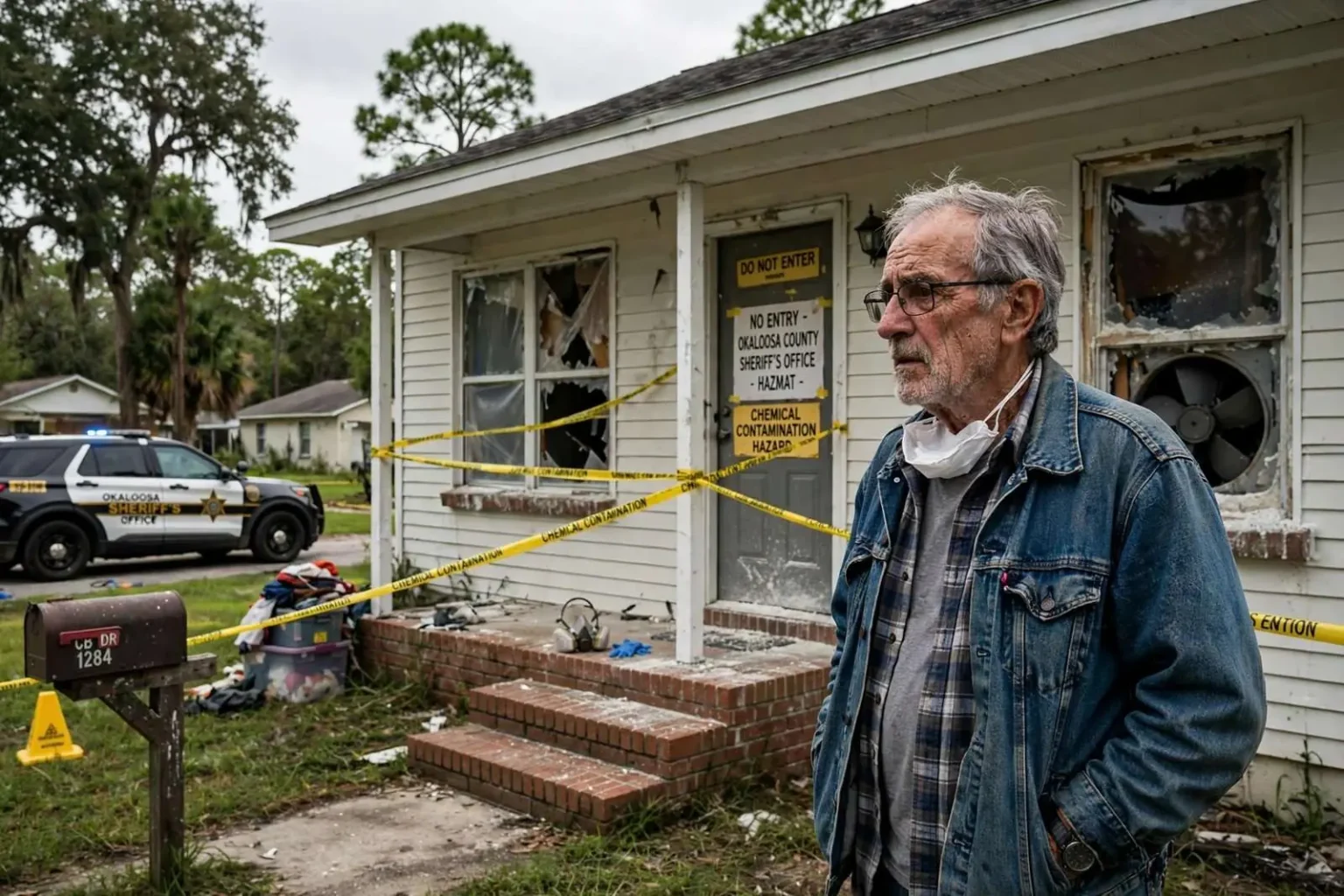
A 65-year-old Crestview man says he still cannot return to his home nearly a week after the Okaloosa County Sheriff’s Office fired tear gas through the windows, leaving the residence contaminated with the chemical residue that seeped into furniture, walls and vents. The standoff between a homeowner and the aftermath of a law enforcement operation has left Gary Johnson displaced from the house on CB Drive off Old Bethel Road, paying for a place to stay while his own home remains unlivable.
Johnson said he and others had to wear protective masks to enter the home, because the residue causes burning and itching in the nose and throat. Even masked, the exposure is punishing enough that extended time inside is impossible. Tear gas residue settles as a fine powder that clings to surfaces and re-enters the air with every disturbance, which is why contamination can linger long after the smoke has cleared and why professional remediation is often the only way to make a home habitable again.
He said the sheriff’s office originally told him he could return after 48 hours, but the irritation forced him back outside after just a couple of minutes. The gap between that timeline and the reality on the ground, days beyond a week with no clear date for return, is at the center of Johnson’s complaint, and it illustrates a problem that other homeowners in similar situations across the country have raised after police used chemical agents in residential neighborhoods.
The Operation and the Man Deputies Sought
The sheriff’s office said it had “solid information” that Johnson’s grandson, Tony Byrd, was inside on July 16, but Byrd was never found. Byrd is a person of interest in a July 8 Crestview murder and faces the agency’s warrants for trafficking methamphetamine. The operation against the home was aimed at taking a wanted man into custody without a prolonged standoff, a calculation that assumed the chemical agents would drive anyone inside out of the house quickly.
Johnson said Byrd was not at the home and that he has no contact with him. From the homeowner’s perspective, the operation damaged a house where the target was not present, leaving an elderly man with the cleanup bill and no path back inside. The sheriff’s office, for its part, has acknowledged the outcome while defending the decision, and the tension between those two positions is what has kept the case drawing attention in Crestview and across the county.
In a statement, the sheriff’s office defended the operation as “unfortunate but unavoidable” given the information it had. The agency’s position reduces to a straightforward argument: deputies acted on credible intelligence that a murder suspect and trafficking defendant was inside the residence, and the use of chemical agents to force an exit is a standard, accepted tactic precisely because it can end a standoff without gunfire. Had Byrd been inside, the agency’s reasoning goes, the operation would have achieved a bloodless arrest.
That argument does not, however, answer the question of who pays when the target is not there. Law enforcement agencies are generally protected by official immunity from many claims arising from operational decisions, and homeowners like Johnson are frequently left to pursue compensation through claims processes, insurance or, in some cases, litigation. Meanwhile the practical costs accumulate: hotel rooms or stays with relatives, meals out, lost belongings contaminated beyond use, and the remediation itself, which for tear gas contamination can run to thousands of dollars because soft goods like upholstery, mattresses and curtains typically cannot be cleaned adequately.
What Tear Gas Contamination Does to a Home
Tear gas, known chemically as a lachrymatory agent, works by irritating the eyes, skin and respiratory tract, and its residues are designed to persist. Decontamination of a residence involves ventilating, washing down every surface, and usually discarding porous materials that absorbed the compound. Professional remediation companies treat these jobs the way they treat chemical spills, because the irritant remains active on contact. Children, older adults and people with respiratory conditions are particularly vulnerable to lingering exposure, which is why a 65-year-old resident could not tolerate even a few minutes inside.
The search for Tony Byrd continued after the operation, tied to both the July 8 murder in Crestview that made him a person of interest and the methamphetamine trafficking warrants the sheriff’s office carried for him. When a suspect sought on violent charges is believed to be barricaded in a residence, agencies face a compressed set of choices: surround the home and negotiate, deploy chemical agents to force an exit, or wait out a potentially dangerous situation. Each choice carries risk, to officers, to neighbors and to the suspect, and commanders weigh the intelligence they have in real time. In this case, the agency chose the chemical option, firing canisters or projectiles through the windows of the CB Drive house, and the target was not among the occupants.
Neighbors on the rural road off Old Bethel Road experienced the operation in their own way, with the streets closed, the noise and the chemical plume drifting beyond the target house. Incidents like this one raise questions that departments across Florida have had to answer after similar operations: how intelligence is verified before force is used on a residence, what notice is given to a homeowner, and what responsibility follows when the premises are left contaminated. Johnson’s situation has become a local case study in those questions.
Crestview, the seat of Okaloosa County, sits in the fast-growing corridor of the Florida Panhandle between Pensacola and the military installations that anchor the region’s economy. The July 8 murder that made Byrd a person of interest had already unsettled the community before the raid on CB Drive, and the sight of a sheriff’s operation in a residential neighborhood days later kept the cases at the center of local conversation. The sheriff’s office has not said whether new leads have emerged on Byrd’s location since the operation.
For Johnson, the immediate issues remain practical: a home he cannot occupy, belongings he cannot safely handle, and a remediation bill that someone will have to pay. His account of being told 48 hours and lasting two minutes frames the dispute in human terms, an elderly man in a mask standing in his own kitchen, eyes and throat burning, walking back out the door. Whether the county, the agency or the homeowner ultimately bears that cost, the episode has become a stark example of the aftermath that chemical agent operations leave behind, on the people and houses where they occur.
Claims processes in Florida give citizens a route to pursue reimbursement from agencies for property damage, but the path is steep. A homeowner typically must file a formal claim within tight deadlines, and the agency’s insurer evaluates whether the damage resulted from negligence or from a lawful operational decision. Many such claims are denied on immunity grounds, leaving litigation as the remaining option, an expensive and slow prospect for a retiree. Cases in other states where police damaged or contaminated homes during operations have produced mixed outcomes, with some municipalities quietly paying for remediation and others contesting liability for years.
The sheriff’s “unfortunate but unavoidable” formulation captures the agency’s posture but also the dilemma at the heart of the case. If the operation was unavoidable given the information deputies had, then the harm to Johnson’s home was a side effect of reasonable policing, and the responsibility question becomes one of policy rather than fault. Advocates for homeowners argue the opposite, that agencies should budget for and own the cleanup when operations damage private residences, precisely so the cost of tactical choices is felt by the decision-makers rather than the innocent. A few jurisdictions have moved in that direction, creating restitution funds for property owners affected by law enforcement activity.
The specifics of this case will shape how the dispute resolves. Johnson’s grandson was never found inside, meaning the operation’s premise did not hold, but the sheriff’s office maintains its information was solid at the time deputies fired the chemical agents through the windows. The age of the homeowner, the duration of his displacement, the documented 48-hour guidance and the two-minute reality are the facts that any claims adjuster, journalist or juror would weigh. Meanwhile, on CB Drive off Old Bethel Road, a 65-year-old man remains out of his house, a week and more after the operation, waiting for the air inside to clear.
Community response in the Crestview area has included offers of temporary lodging and questions from neighbors about whether the agency will assist with the cleanup. Local coverage of the episode has kept attention on the gap between the guidance Johnson received and his experience inside the house, and officials have not said whether the county will review how contamination advisories are handled after future operations. For now the case stands as a reminder that the timeline given when the smoke clears is not always the timeline that follows.