Grand Jury Indicts Three in Deadly Crestview Motel Robbery
An Okaloosa County grand jury indicted three people on murder and armed robbery charges in a fatal May robbery at a Crestview motel.
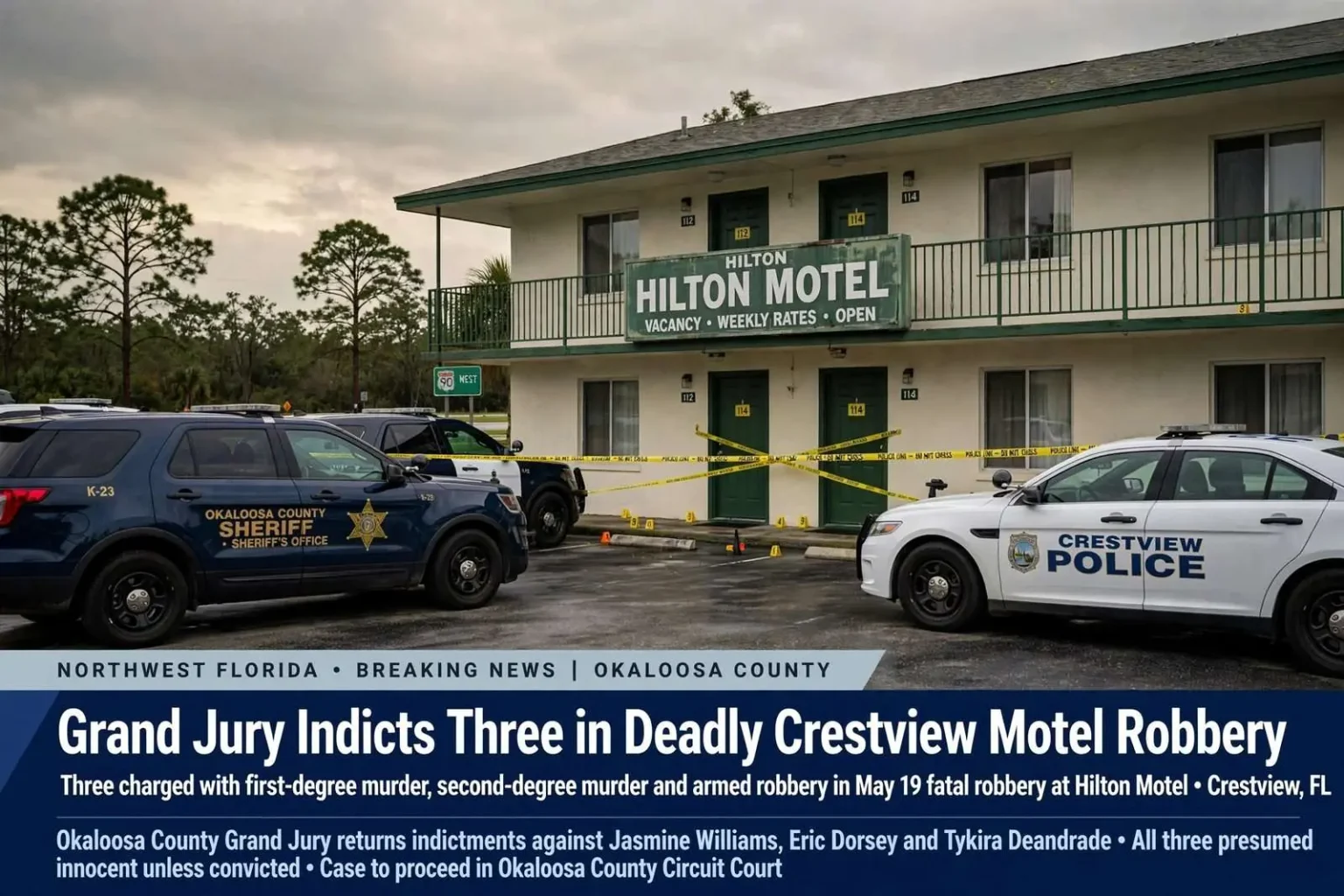
An Okaloosa County grand jury has returned murder and robbery indictments against three people in connection with a fatal robbery at a Crestview motel earlier this year. Jasmine Williams, Eric Dorsey and Tykira Deandrade each face charges of first-degree murder, second-degree murder and armed robbery, according to the indictment.
The state attorney’s office says the three took part in robbing a man who was staying in a room at the Hilton Motel on May 19. Prosecutors identified the victim as Kaylun Gray. During the robbery, according to the state attorney, Gray was able to shoot and kill a fourth suspect, Jakeith Edwards, who in turn shot and killed Gray.
The accounts above come from the indictment and prosecutors’ statements; none of the allegations have been proven in court, and all three defendants are presumed innocent unless convicted. An indictment by a grand jury is a finding that probable cause exists to bring charges — not a determination of guilt.
The setting: a Crestview motel robbery
Crestview sits at the northern edge of Okaloosa County, an inland hub along U.S. 90 and the CSX rail line that has grown rapidly as the Okaloosa County seat. Motels along the city’s main corridors serve a mix of traveling workers, families between housing, and visitors passing between Interstate 10 and the beaches to the south. Rooms rented by the week are common in the area, and local law enforcement has long identified the motel strips along the highway as recurring locations for robberies and drug-related calls.
The Okaloosa County Sheriff’s Office handles investigations in the unincorporated and incorporated areas of the county outside Crestview’s city limits, while the Crestview Police Department patrols inside the city. A fatal shooting inside a motel room triggers a standard protocol: the scene is sealed, detectives document the room and its evidence, and the results go to the state attorney’s office, which decides what charges to present to a grand jury.
That grand jury step is what produced the indictments against Williams, Dorsey and Deandrade. In Florida, a grand jury must review any charge of first-degree murder before an indictment can issue; the panel hears the prosecution’s evidence in secret, without defense counsel present, and votes on whether probable cause supports each count. The three defendants now each face first-degree murder, second-degree murder and armed robbery counts arising from the May 19 incident at the Hilton Motel.
Florida’s felony murder rule in cases like this
Florida law allows murder charges to be brought against participants in a robbery when a death results, even if another person fired the fatal shot. That principle — the felony murder doctrine — means a getaway participant who never touched a weapon can still face first-degree murder charges if a death occurs during the commission of a listed felony such as armed robbery.
The doctrine explains the unusual charging structure in this case. All three defendants are charged with both first-degree and second-degree murder, giving prosecutors alternative theories: the first-degree counts rest on the felony murder rule tied to the armed robbery, while the second-degree counts address the death that occurred in the exchange of gunfire. The armed robbery charge itself remains the underlying felony alleged to have set the fatal chain of events in motion.
Florida’s felony murder statute has been the subject of legislative refinement over the years, but its core operation in robbery cases has remained intact: when a life is lost during the perpetration of a violent felony, every participant answers for the death. Prosecutors in the First Judicial Circuit, which covers Okaloosa, Santa Rosa, Walton and Escambia counties, routinely use the theory in group-robbery homicide cases like this one.
The mutual exchange of gunfire described by prosecutors — Gray shooting and killing Jakeith Edwards as Edwards shot and killed Gray — places the case in a category Florida courts have confronted many times: a robbery that ends with the victim and a suspect each dead, and surviving participants charged with both the victim’s death and the death of their accomplice. In such cases, the victim’s act of shooting back does not immunize the other robbery participants from murder charges under the felony murder rule, because the death of an accomplice during the felony is itself attributable to all who joined the robbery.
Whether the state can ultimately prove its theory against Williams, Dorsey and Deandrade will be decided in circuit court, not by the indictment. Defense counsel will have the opportunity to challenge the evidence presented to the grand jury, the degree of each defendant’s participation, and the identification of who did what inside the motel room on May 19. Juries in the First Judicial Circuit have heard robbery-homicide cases before, and the distance between a grand jury’s probable-cause finding and a trial verdict is often substantial.
From indictment to trial
After indictment, the three defendants move through the standard felony track in Okaloosa County. Arraignment comes first, where each enters a plea to the counts. Pretrial proceedings then address discovery — the prosecution’s obligation to turn over its evidence — along with any motions to suppress or dismiss. First-degree murder cases in Florida proceed more slowly than ordinary felonies because of the sentencing stakes and the procedural requirements that attach to capital and life felonies.
First-degree murder in Florida carries a sentence of life imprisonment without the possibility of parole; the death penalty remains a legal possibility in the state, though its application in any given case is a separate decision made by the state attorney after review of statutory aggravating factors. Second-degree murder carries a maximum of life imprisonment as well, while armed robbery is a first-degree felony punishable by up to life under Florida’s sentencing laws.
The case will be handled in the Okaloosa County courthouse in Crestview, the same building where the grand jury returned its indictments. Okaloosa County’s docket has grown with the county’s population, and murder trials in the circuit are scheduled around the availability of witnesses, forensic results and the court’s calendar — typically taking a year or more from indictment to trial.
What the indictment means — and does not
For the victim’s family, the indictments represent the formal start of the justice process for a death that occurred in a Crestview motel room in May. Grand jury action confirms that prosecutors believe the evidence supports charges against all three defendants for their alleged roles in the robbery that ended with Kaylun Gray and Jakeith Edwards dead from each other’s gunfire.
For the defendants, the indictment is the beginning of their day in court. Each is presumed innocent, each will be represented by counsel, and the state bears the burden of proving every element of first-degree murder, second-degree murder and armed robbery beyond a reasonable doubt. The allegation that the three took part in robbing Gray at the Hilton Motel on May 19 — and the fatal exchange of gunfire that followed — will be tested witness by witness and exhibit by exhibit when the case reaches trial in Okaloosa County.
Crestview’s growth as the fastest-expanding city in Okaloosa County adds context to cases like this one. The city’s population has climbed past 27,000 as new subdivisions spread along its corridors, and with that growth has come increased demand on the Crestview Police Department, which added officers and resources in recent years to keep pace. Robberies and violent incidents at lodging properties along the city’s main commercial strips remain an enforcement focus, and fatal cases draw cooperation between city detectives and the Okaloosa County Sheriff’s Office.
How Okaloosa County juries see robbery-homicides
Northwest Florida juries have a long history with robbery-related homicides, and prosecutors in the region tend to present these cases with a straightforward structure: evidence establishing the robbery, evidence establishing the death, and the legal chain that connects every participant to both. Witness testimony from inside a motel room is often supplemented by surveillance video from the property, phone records among the participants, and forensic work from the Florida Department of Law Enforcement’s regional crime laboratory in Pensacola.
The grand jury that indicted Williams, Dorsey and Deandrade heard the prosecution’s account of those elements before voting. Grand jury proceedings in Florida are closed, and the transcript remains sealed while the case is pending, which means the public record of the panel’s decision consists of the indictment itself and the state attorney’s statements — the source of the account that Gray was killed during a robbery he attempted to resist, taking one of the four suspects with him.
The victim, the suspects, and the fourth man who died
The May 19 incident left two men dead: Kaylun Gray, the robbery victim identified by prosecutors, and Jakeith Edwards, the fourth suspect whom Gray shot during the encounter. Under Florida’s felony murder framework, Edwards’s death during the commission of the alleged robbery is likewise attributable to the robbery participants, which is why the surviving defendants face murder counts connected to the death of their own accomplice as well as the death of the victim.
That dual-charge structure — murder counts for both deaths, plus the armed robbery count — gives a trial jury a full menu of theories, and gives prosecutors room to present the case even if the evidence on one death or one defendant proves thinner than expected. Plea negotiations in multi-defendant murder cases frequently reshape the final charging picture long before trial, as defendants weigh cooperation against the risk of a first-degree murder verdict.
For now, the Okaloosa County indictment stands as the formal accusation: Jasmine Williams, Eric Dorsey and Tykira Deandrade, each charged with first-degree murder, second-degree murder and armed robbery for their alleged roles in the fatal robbery of Kaylun Gray at the Hilton Motel in Crestview on May 19 — a case that began with a motel-room robbery and ended with two men dead, three people indicted, and the question of what happened in that room now headed for the Okaloosa County courthouse.