Two Okaloosa County Deputies Killed in Shootout Near Crestview; Suspect Also Dead
Deputies Burton Lopez and Warren York died after a shootout near Crestview; suspect Joshua Cartwright was killed by pursuing deputies.
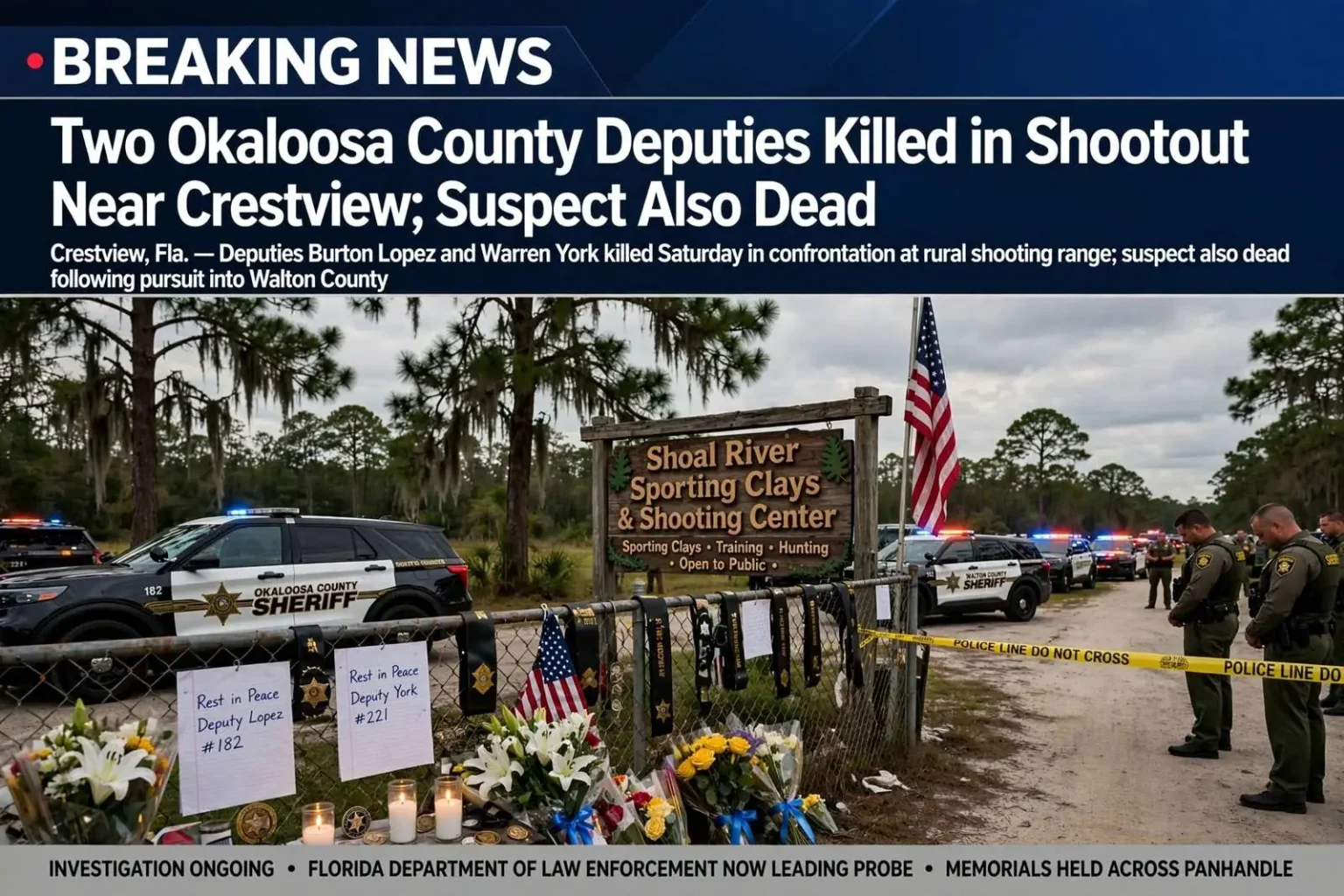
Two Okaloosa County sheriff’s deputies died after being shot by a suspect who was later killed by pursuing officers, a Saturday afternoon confrontation that shook law enforcement across the Florida Panhandle. The violence unfolded in a span of hours across two counties and left a rural community of roughly 30,000 people grieving alongside deputies who had answered what began as an ordinary weekend call.
Deputies Burton Lopez and Warren York were shot at around 1 p.m. Saturday as they responded to a call at the Shoal River Sporting Clays and Shooting Center near Crestview, according to sheriff’s office spokeswoman Michele Nicholson. The range, set along the Shoal River north of the city, is a sprawling rural property of fields, wooded courses, and clay-target stations — the kind of place where families and competitive shooters share the parking lot on a Saturday, and where a law enforcement call would normally involve noise complaints or a minor dispute rather than anything like what occurred.
Authorities identified the gunman as Joshua Cartwright. After shooting both deputies, Cartwright fled toward neighboring Walton County, where other deputies caught up with him. Officials said he was shot and killed when he refused to surrender. The pursuit carried officers down the corridors of U.S. Highway 90 and State Road 85 that connect Crestview to the communities to the south and west, and deputies from multiple agencies converged on the region as the search moved across jurisdictional lines.
Lopez and York were airlifted to Sacred Heart Hospital in Pensacola, where both later died from their wounds. The air transport to Pensacola — roughly 45 miles from Crestview — underscored the severity of the injuries, and hospital staff worked alongside sheriff’s office personnel as word of the shooting spread through the region’s law enforcement community.
Two Deputies Killed in Deadliest Incident in Years
The deaths marked one of the deadliest single incidents for Panhandle law enforcement in years, and flags across the region were lowered as officers from surrounding counties joined in mourning the two men. In the days that followed, delegations from sheriff’s offices in Santa Rosa, Walton, Escambia, and beyond appeared at vigils and processions, a customary showing of solidarity in the tight-knit world of Panhandle policing, where many deputies know one another across county lines through joint training, mutual aid, and shared radio traffic.
Investigators worked through the weekend to reconstruct the sequence of events that began with a routine call at the rural shooting range and ended with a manhunt across two counties. The Florida Department of Law Enforcement, which routinely assists local agencies in officer-involved shootings, joined the effort, as did prosecutors who would ultimately review whether the use of force that killed Cartwright was legally justified. Reconstruction teams walked the scene at the range, collected shell casings and physical evidence, canvassed for witnesses, and pieced together the movements of the suspect’s vehicle across county roads.
For the sheriff’s office itself, the incident triggered the difficult procedural aftermath that follows any line-of-duty death. Administrative leave is standard for deputies involved in a fatal encounter, not as discipline but as routine. Counselors were made available to staff, including the dispatcher and deputies who had been on the radio with Lopez and York in their final minutes. The office also faced the logistical work of honoring the fallen — funeral planning, honor guard coordination, and the coordination of law enforcement motorcades that typically draw hundreds of vehicles from across the state.
Deputies Face Growing Risks on Routine Calls
The shooting renewed long-running conversations about the risks deputies face on seemingly routine calls. Law enforcement trainers and county officials alike pointed to the Shoal River case as an example of how a call that begins without warning signs can escalate instantly, and why agencies invest in ballistic vests, rifle-rated armor, and training for active threats even in quiet rural jurisdictions. Okaloosa County’s population swells with tourists along its southern coastline, but its northern half around Crestview is farmland and forest, where response times are longer and deputies often arrive alone until backup can travel the distance.
In the wider region, the deaths resonated because Okaloosa County sits at the heart of a military and law enforcement corridor. Eglin Air Force Base and Hurlburt Field border the county, and many residents, reservists, and veterans serve or have served in uniform. Local officials noted the connection between the community’s military character and its response to the fallen deputies — flags on base, spontaneous memorials at the range’s entrance, and messages of condolence from commands across the Panhandle.
As the investigation progressed, the sheriff’s office released few details about the original call that brought Lopez and York to the range, citing the open investigation. What remained clear in the days after the shooting was the sequence — a Saturday afternoon, two deputies dispatched to a public business, a suspect who opened fire without warning, a chase across a county line, and a standoff that ended when the suspect would not give up. Each step would be examined in the official record, but for the deputies’ colleagues and families, the sequence was less a timeline than a loss that would shape the agency for years.
Community Rallies to Honor Fallen Deputies
Community response followed a pattern familiar from other Panhandle tragedies. Businesses in Crestview posted signs thanking deputies. Residents lined overpasses as processions passed. Schools observed moments of silence. The county commission and municipal governments from Destin to Mary Esther passed resolutions honoring the two men, and the state’s law enforcement community, already stretched by a summer of increased call volume, paused to acknowledge the cost paid by two of its own.
Sacred Heart Hospital in Pensacola, where both deputies were flown, is one of the region’s major trauma-capable facilities and has received airlifted patients from across the Panhandle for decades. For rural agencies like Okaloosa County’s, air transport is often the only way to move a critically wounded patient to a higher level of care quickly, given the distances involved and the limited trauma resources between Crestview and the coast. The decision to fly rather than drive, made within minutes of the shooting, reflected the urgency that deputies on scene conveyed over the radio.
The Shoal River corridor, where the shooting range sits, is among the most rural stretches of Okaloosa County. Cell coverage is inconsistent, traffic is light, and the nearest substations can be twenty minutes apart by road. Deputies working that part of the county routinely cover large territories alone, a staffing reality that sheriff’s offices across the Panhandle have acknowledged for years as they balance growing populations in the coastal south against vast, sparsely populated interiors. It is precisely in these areas that mutual aid agreements between neighboring counties carry the most weight, since the nearest backup may wear a different county’s badge.
How a Multi-County Investigation Unfolds
The multi-county pursuit that followed added a layer of complexity familiar to investigators across the region. When a suspect crosses jurisdictional lines, responsibility for the case splits between agencies: the sheriff’s office where the crime occurred leads the investigation into the deaths of the deputies, while the agency in whose territory the suspect was killed conducts its own review of that encounter. Both investigations feed into a broader review by state authorities, and the findings become part of the public record through the state attorney’s office. In cases where deputies from one county shoot a suspect in another, as happened here with the pursuit ending in Walton County, that split structure is standard practice and is designed to preserve impartiality in the review of the use of deadly force.
Line-of-duty deaths remain rare in absolute terms but have a disproportionate impact on agencies the size of Okaloosa County’s, where the roster of sworn deputies is measured in the low hundreds and nearly everyone knew the fallen officers personally. Research on law enforcement agencies that lose officers to violence documents effects that persist for years: heightened stress and attrition among staff, changes in how routine calls are dispatched and backed up, and in some cases long-term shifts in agency policy on how certain calls are handled. Support networks built around the families of fallen officers, including national and state foundations that assist with educational and living expenses, typically mobilize within days of an incident like this one.
The identification of both the deputies and the suspect within hours of the incident reflected modern practice in major law enforcement notifications. Once next-of-kin notifications were complete, the sheriff’s office moved quickly to release the names of Lopez and York, in keeping with the tradition of publicly honoring officers who die in the line of duty. The identification of Cartwright followed once investigators had confirmed his identity and his family had been notified — a sequence that protects due process and family privacy even amid urgent public interest.
Saturday afternoon, on a range that draws shooters of all ages, meant there were potentially dozens of civilian witnesses on or near the property when the shooting began. Statements from those witnesses, along with surveillance footage from the range and the suspect’s known movements, would have formed the backbone of the investigative reconstruction. In cases of this kind, investigators typically spend weeks reconciling physical evidence with eyewitness accounts before releasing any official narrative, which is why initial reports often leave specific questions unanswered even as the broad facts are confirmed.
For the Crestview community, the shooting range itself has long been a local institution — a venue for youth shooting sports, competitive leagues, and hunter safety courses, in a county where outdoor traditions run deep. The idea that such a place could become the site of violence against the very officers called to it added a particular shock for residents who knew the facility as a family destination. In the weeks that followed, conversations among local shooters and range members reportedly turned to the unpredictability of the incident and the fact that nothing in the range’s operation or the deputies’ approach could have anticipated it.