Crews Battle Early-Morning Fire at Laurel Hill Mobile Home Park
Fire was reported around 5 a.m. at Gant Mobile Home Park on New Ebenezer Road in Laurel Hill; the Okaloosa County blaze remains under investigation.
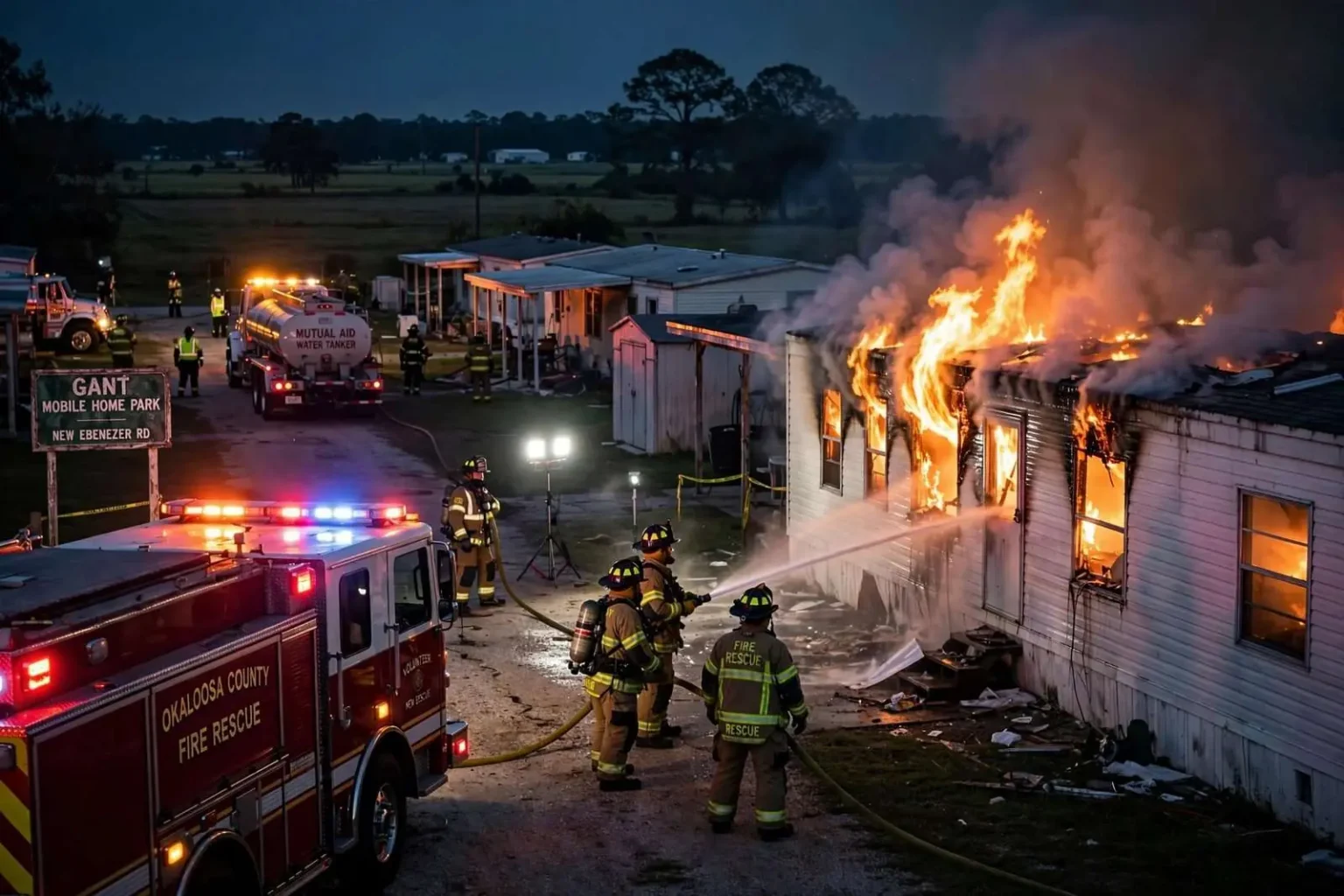
Fire crews raced to a mobile home park in the rural Okaloosa County community of Laurel Hill early on a June morning after flames were reported at Gant Mobile Home Park. The Florida Highway Patrol said the fire was reported around 5 a.m. at the park on New Ebenezer Road. Responders from area departments worked the scene in the dark, in a small farming town north of Crestview where volunteer coverage and mutual aid carry much of the load. Officials released few details in the immediate aftermath. The cause of the fire remained under investigation, with no confirmation yet on injuries or how many units were affected.
The 5 a.m. report meant crews arrived in darkness, working under portable lights in the hours before dawn. Early-morning fires in mobile home communities carry a set of challenges all their own: residents are asleep and may not have heard alarms or knocking, the light of flames against the night sky draws worried neighbors to the scene, and visibility limits what commanders can see of fire spread from unit to unit until daylight arrives.
Laurel Hill sits in the northern reaches of Okaloosa County, far from the beaches that define the county for most visitors. It is a small farming town — among the smallest incorporated communities in the county — surrounded by fields and pastureland, with a volunteer fire tradition typical of rural northwest Florida. The town lies north of Crestview, the county seat, along the rural stretch between the I-10 corridor and the Alabama line.
In communities of that size, a fire report does not summon the resources an urban department takes for granted. The nearest career-staffed stations are miles away, so rural volunteer departments respond first, and mutual aid agreements bring in neighboring departments from across northern Okaloosa County and, when needed, nearby Alabama counties. Water supply is a particular consideration in areas without dense hydrant networks; tanker shuttles, in which water-hauling trucks ferry loads from fill sites to the fireground, are a standard feature of rural firefighting across the region.
Fighting fire in a mobile home community
Mobile homes present distinct firefighting and life-safety challenges. Older units were often built with lighter materials and different compartment layouts than site-built houses, and fires inside them can reach flashover conditions faster than in conventional construction. In a park setting, units sit close together, so a fire in one home threatens the neighboring structures on both sides, and crews arriving first must make rapid decisions about which units to defend before the flames have a chance to spread down the row.
Mobile home communities in rural Florida are also home to many residents on fixed incomes, which shapes the aftermath when a fire strikes. Displaced families may lack insurance coverage for their belongings, and the nearest shelters and assistance organizations may be a drive away in Crestview or further south. Disaster-response volunteers who serve the Panhandle routinely step in after residential fires with emergency lodging, food, and clothing — assistance that matters as much in a community of a few hundred people as in a city many times that size.
The involvement of the Florida Highway Patrol in the initial reporting is typical for fires along rural roads, where FHP units may be among the first state officials to reach the scene and assist with traffic and scene control while fire crews work. County deputies and the county’s emergency management office also play roles in incidents of this kind, from road closures to coordinating the notifications that follow once the immediate danger has passed.
Once the flames are out, the investigation begins. Fire origin-and-cause work in rural Florida draws on the responding departments, the county fire marshal’s office, and, in significant incidents, the Florida State Fire Marshal, whose investigators are responsible for determining whether a fire was accidental or intentionally set. Investigators examine burn patterns, debris, appliances, and electrical systems, and they interview residents and witnesses — all of which takes longer when the scene spans multiple units in a park, and when crews have had to pull apart structures to reach hidden fire.
Officials in the immediate aftermath released few details: no confirmation on injuries, no count of how many units were affected, and no preliminary indication of the cause. That silence is not unusual in the first hours and days of a rural fire investigation, and it reflects caution as much as anything — numbers reported early sometimes change as crews finish overhaul and account for everyone in the affected structures, and agencies have learned to confirm before they announce.
Rural fire protection in northwest Florida
The Laurel Hill response illustrates how fire protection actually works across much of the Florida Panhandle. Outside the cities and the densely developed coastal strip, coverage depends on volunteer departments staffed by residents who train, respond to calls at all hours, and hold other jobs. Those departments are funded through a combination of fire assessment fees, county support, and fundraising, and their rosters rise and fall with the availability of volunteers — a challenge rural departments nationwide have faced for years.
Mutual aid agreements knit the region’s departments together. A working fire in northern Okaloosa County can draw apparatus from Crestview, from neighboring volunteer districts, and from just across the state line in Alabama, with the first-alarm response scaled up as conditions on the scene dictate. Commanders on a mutual-aid fire coordinate radio traffic across multiple departments’ channels, track incoming crews, and manage water supply across jurisdictions — a complex task made routine by years of joint training.
June mornings in northwest Florida bring their own operating conditions. The heat and humidity that define Panhandle summers tax crews wearing full protective gear, requiring rapid rotation of firefighters through rehab, plenty of drinking water on scene, and medical monitoring even when no one is injured. The pre-dawn start of this fire meant crews worked the first hours in cooler air, but by mid-morning, conditions on the fireground would have been demanding in the way they are for rural crews across the Gulf South every summer.
What residents can do
Fire officials across the Panhandle use incidents like this one to press a handful of messages aimed at mobile home residents. Working smoke alarms remain the single most important protection, and they should be tested monthly and replaced on the schedule printed on the unit. Space heaters, window air-conditioning units, and extension cords need clearance and proper outlets; cooking should never be left unattended; and residents should know two ways out of their home and a meeting place outside so crews know everyone is accounted for.
Residents of the park and the surrounding community with information about the fire — something seen or heard before the 5 a.m. report, a vehicle in the area, or photographs taken as flames appeared — were encouraged to pass it to investigators, since bystander photos and doorbell cameras increasingly contribute to origin-and-cause determinations in rural incidents where few formal witnesses are present.
As the investigation continued, the questions officials had not yet answered — the cause, the injury count, and the number of homes damaged or destroyed — remained open, and updates were expected from the responding agencies and the State Fire Marshal’s office as their work progressed. What the first hours established was the scale of the response itself: crews from multiple departments, working in the dark before dawn on New Ebenezer Road, in a small farming town whose volunteer firefighters and mutual-aid partners were the difference that morning between a contained fire and a community-wide disaster.
The aftermath of a mobile home park fire extends well beyond the extinguishment. Families whose units are damaged or destroyed need lodging, clothing, and food within hours, and in a town of Laurel Hill’s size, the county’s emergency management and volunteer organizations coordinate that assistance from Crestview and elsewhere. Neighbors typically open their homes first; formal assistance follows. Insurance adjusters, when coverage exists, and salvage and recovery work occupy the weeks that follow, and communities this size often organize benefit efforts — fish fries, supply drives, church collections — to help the affected families start over.
Fire officials also watch for the hazards a burned mobile home leaves behind. Structures damaged by fire can be structurally unsound, with weakened roofs and floors that will not bear weight, and utilities must be disconnected and verified before anyone re-enters. Children and pets are kept away from the scene; burned debris can contain sharp metal, asbestos in older materials, and chemical residue from burned household goods. Securing the scene against curiosity-seekers is a continuing task for responders in the days after a fire, along with patrol checks for hot spots that can rekindle.
For the volunteer firefighters who carried the response that morning, incidents in their own communities carry a personal weight that career firefighters in larger cities often describe differently. In a town the size of Laurel Hill, the volunteers on the first-due engine know the residents of the homes they protect — they may have gone to school with them, be related to them, or see them at church on Sunday. That connection is part of why rural volunteer service remains a tradition people take up, and why mutual aid flows so readily across district lines in northwest Florida: the departments know that the next call could be in their own streets, and that they will need their neighbors then.
The June fire at Gant Mobile Home Park on New Ebenezer Road remains under investigation, with officials working to confirm the details — cause, injuries, and the number of units affected — that had not been released as of the initial report. Updates are expected through the responding fire departments and state investigators as their examination of the scene continues. In the meantime, the response demonstrated the system that protects rural Okaloosa County working as it does every day: volunteers and mutual-aid partners, arriving in the dark, doing the work no single small town could do alone.