
Daphne and Foley to elect new mayors; Dauphin Island avoids a contest
Daphne and Foley will elect new mayors in the Aug. 25 municipal elections, while Dauphin Island avoids a contest with only one candidate per office.
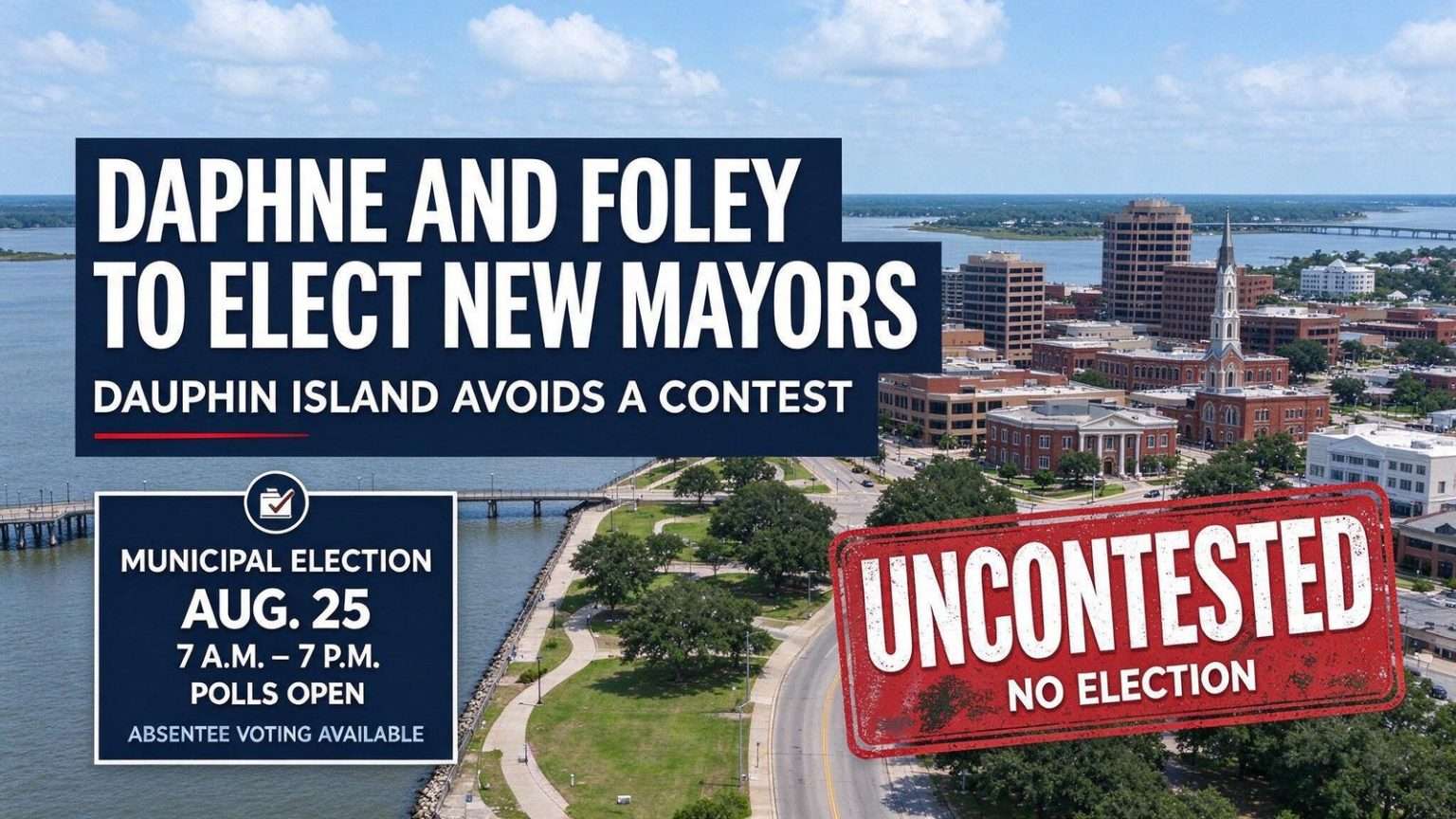
Voters in Daphne and Foley will head to the polls this month to choose new mayors, while residents of Dauphin Island will skip an election altogether after every office drew exactly one candidate. Municipal elections are set for Aug. 25 in several Alabama cities, and candidate qualification closed this week, locking in the field in each jurisdiction.
In Daphne, Mayor Dane Haygood is not seeking a third four-year term, opening the city’s top job for the first time in eight years. Four candidates are running to replace him: Steve Carey, Michael Hobbs, Robin LeJeune and Selena Vaughn. The winner will lead one of the fastest-growing cities on the Eastern Shore of Mobile Bay.
Foley will also change hands at city hall. Mayor John Koniar is not running for re-election after more than a decade in the job. Koniar was appointed to the post in 2006 and won full terms in 2008, 2012 and 2016. He will be succeeded by either Aaron D. Bika or former city councilman Ralph Hellmich, the two men who face each other in the race.
Dauphin Island, meanwhile, will not conduct an election at all. When qualification closed, only one candidate had qualified for each office, leaving every race uncontested. Longtime Mayor Jeff Collier returns for another term without appearing on a ballot, and the town’s council picture is already settled as well.
How Alabama’s municipal elections work
Alabama cities elect their governing bodies every four years, with municipal elections traditionally held in late August. Mayors and council members run in nonpartisan races, so candidates appear on the ballot without party labels, and the campaigns tend to turn on local issues: roads, drainage, public safety, growth and the cost of city services. Polls open at 7 a.m. and close at 7 p.m. on election day, and voters cast ballots at the polling places for their municipal wards.
Qualification is the step that determines who appears on the ballot. Would-be candidates must file qualifying papers with their city clerk by the state deadline and pay any required qualifying fee. Once qualification closes, the field is fixed and no new candidates can enter. A race with two or more names goes to the voters on Aug. 25; if no candidate wins a majority in a multi-candidate race, the top two finishers advance to a runoff later in the fall.
Uncontested races follow a different path. When only one candidate qualifies for an office, no election is held for that seat, and the lone qualifier simply takes office when the new term begins. That is what happened across the board on Dauphin Island this year, sparing the town the cost of staging an election and giving its incoming government an unusually early start on planning for the next four years.
The Aug. 25 balloting covers more than the mayor’s office in each city. Council seats across Daphne, Foley and Dauphin Island are also on the ballot this cycle, because municipal terms run concurrently. That means residents will shape the entire governing body — the mayor who runs day-to-day operations and the council members who approve budgets, zoning changes and utility decisions — in a single trip to the polls.
Daphne’s open seat
Daphne’s mayoral race is the widest-open contest on the Eastern Shore. Haygood has served two four-year terms, and his decision not to seek a third created the first open mayor’s race in the city in years. Four candidates responded: Steve Carey, Michael Hobbs, Robin LeJeune and Selena Vaughn. With four names on the ballot, an outright majority on Aug. 25 is far from guaranteed, and the race could extend to a fall runoff between the two leading vote-getters.
Whichever candidate emerges, the next mayor will inherit a city that has changed rapidly. Daphne sits along U.S. Highway 98 on the bluff side of Mobile Bay, connected to the Mobile metro by the Bayway and the Jubilee Parkway on the north end of the bay. Decades of residential growth have made it one of Baldwin County’s largest cities, and that growth brings familiar pressures: traffic along the Highway 98 corridor, school enrollment, stormwater drainage and the constant balancing of new subdivisions against the city’s older neighborhoods along the bayfront.
Daphne is known across the region as the Jubilee City, named for the rare natural phenomenon in which crabs, fish and other sea life crowd the shallow shoreline of Mobile Bay, an event that occurs reliably in only a few places on Earth. The waterfront, along with the city’s parks and its proximity to both Mobile and the beaches of south Baldwin County, has made Daphne a draw for families and retirees alike — and a city where the pace of development is the perennial political issue.
The City Council races on the same ballot will matter just as much to day-to-day governance. Council members vote on the city budget, annexations, zoning and the contracts that govern police, fire and public works services. With a new mayor coming in, the next council will be part of an entirely new administration learning the city’s operations at the same time, which makes the Aug. 25 vote a full reset for Daphne’s government.
Foley turns the page after a long tenure
Foley’s mayoral transition marks the end of one of the longer tenures in Baldwin County government. Koniar first took office in 2006 by appointment, then won election in his own right three times, in 2008, 2012 and 2016. His time in office spanned the city’s transformation into one of the region’s busiest retail centers, a stretch that included a nationwide recession, a recovery, and the steady northward march of growth from the Gulf beaches into south Baldwin County.
Foley sits at the crossroads of U.S. Highway 98 and Alabama Highway 59, the corridor that carries summer traffic from Interstate 10 down to Gulf Shores and Orange Beach. That position made the city a natural commercial hub: its shopping districts draw visitors from across the Gulf Coast, and its population has grown alongside the schools, churches and neighborhoods that serve them. City hall has also managed an active parks and civic presence that anchors the community between the busier beach cities to the south and the Eastern Shore cities to the north.
With Koniar stepping away, voters will choose between Aaron D. Bika and Ralph Hellmich, a former city councilman. Hellmich’s prior service on the council gives Foley voters a voting record to examine from his time in city government. With two candidates on the ballot, the Aug. 25 result will settle the race outright, because a two-candidate contest always produces a majority winner short of an exact tie.
The next mayor will take office as Foley continues to absorb growth that shows no sign of slowing. New rooftops in the area feed the city’s schools and its tax base, but they also bring demands for widened roads, extended utilities and more public safety staffing. Managing that expansion — while keeping the city’s identity distinct from the beach resorts to the south — will be the central job of the incoming administration.
Dauphin Island’s quiet cycle
On Dauphin Island, election night will be the quietest in the region. Only one candidate qualified for each office, so no election is necessary, and the town’s government for the next four years is already determined. Mayor Jeff Collier, a longtime leader of the island town, returns for another term, providing continuity at the top of a small barrier-island government with a full plate of coastal issues.
The council picture there is a mix of continuity and change. Gene Cox, Earle Connell and Clinton Collier remain on the council, keeping three experienced members in place. Trey Alderman and Rich Colberg join the council, replacing Wayne Strickland and Shirley Robinson, who chose not to run. The incoming body will be sworn in with the rest of Alabama’s municipal governments when new terms begin in the fall.
Dauphin Island occupies a unique place in Alabama local government. The barrier island at the mouth of Mobile Bay is home to Fort Gaines, the Audubon Bird Sanctuary and the annual Alabama Deep Sea Fishing Rodeo, and it is linked to the mainland by the Dauphin Island Bridge and to Fort Morgan by the Mobile Bay Ferry. Town government deals year-round with questions that barely register elsewhere: beach renourishment after storms, hurricane preparedness and evacuation, the seasonal tourism economy, and the health of the fisheries and bird habitat that draw visitors to the island in the first place.
An uncontested cycle does not mean an uneventful term ahead. The island’s leaders face the same long-running challenges that have shaped recent years — protecting a narrow, storm-exposed community, maintaining the bridge and ferry connections that are its lifelines, and managing a tourism season that swells the population each summer. With the election settled before it began, Collier and the returning and new council members can turn to those questions immediately rather than waiting out a campaign.
What it means for residents
For voters in Daphne and Foley, the Aug. 25 election is the main event of the municipal calendar. City halls across Alabama typically see only a fraction of turnout in municipal elections compared with statewide votes, which means a relatively small number of neighbors will effectively decide who runs each city for the next four years. Absentee voting is available through the city clerk’s office for voters who qualify, and election officials encourage residents to confirm their polling places before election day.
The stakes are concrete. The mayor and council that take office this fall will write the next city budgets, set police and fire staffing, approve or deny the subdivisions and commercial projects that come before planning commissions, and negotiate the state and federal relationships that bring road and infrastructure money to Baldwin County. In fast-growing cities, those decisions compound: a zoning vote or a utility extension approved this year shapes traffic and school crowding for a decade.
Dauphin Island residents, for their part, will watch the Aug. 25 elections elsewhere in the county knowing their own government is set. The island’s continuity in office is notable in a year when several Baldwin County cities are changing leadership at the top, and it means the town will have an experienced administration in place heading into the next hurricane season.
Once the votes are counted and any runoffs are decided, Alabama’s new municipal governments take office in the fall, with organizational meetings to follow at city halls across the county. In Daphne, the next mayor will be one of four names now on the campaign trail; in Foley, it will be Bika or Hellmich; on Dauphin Island, it will be the same leadership the town already knows. For a county growing as quickly as Baldwin, the month’s elections will help decide who manages that growth for the next four years.