
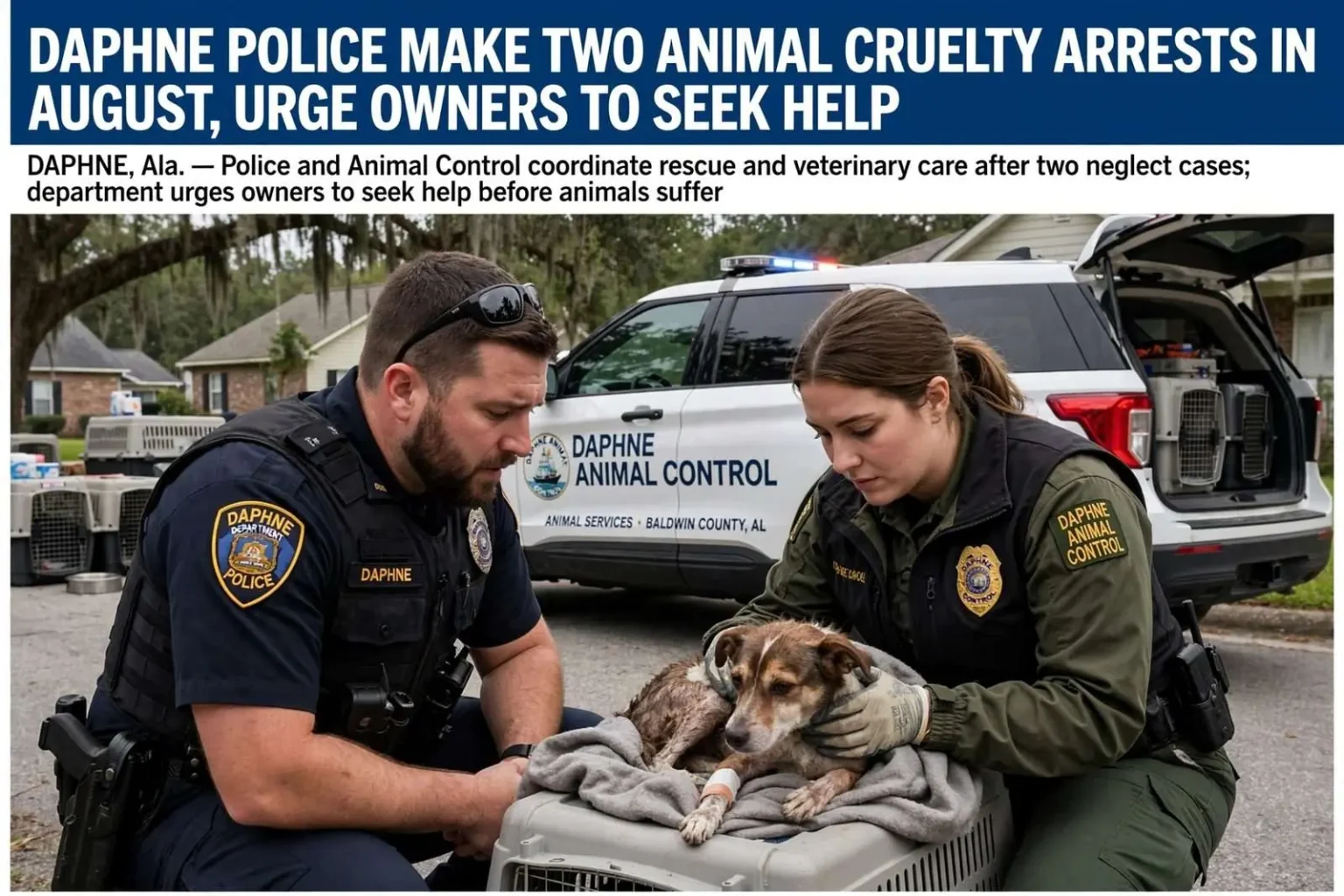
DAPHNE, Ala. — Daphne police have made two separate arrests this month in animal neglect cases and are reminding pet owners that failing to properly care for an animal is a crime. The back-to-back cases — one involving dogs found malnourished inside an apartment, the other involving dogs suffering from untreated skin disease — prompted a blunt message from the department: help is available for owners who cannot cope, but prosecutors will pursue those who let animals suffer.
The arrests came eight days apart and unfolded in different corners of the city, but they share a pattern familiar to animal control officers everywhere: animals in plain decline, discovered after conditions inside a home crossed the line from hardship into neglect. Both cases are now moving through the courts, and the dogs at the center of them are receiving the veterinary care their owners did not provide.
The first case: two dogs found malnourished
In the first case, officers arrested 35-year-old Brandi Heathco on Aug. 4 at a local apartment after finding two dogs described as “extremely malnourished” and living in “deplorable conditions,” with one dog locked in a kennel inside a closed bedroom. The physical state of the animals and the condition of the apartment left little ambiguity for the officers on scene, who documented what they found and moved the dogs out of the environment.
Both animals are being treated by a veterinarian for multiple, serious medical conditions. Severe malnutrition in dogs is rarely a single-day event — it accumulates over weeks and months, and recovery requires supervised refeeding, testing for underlying illness and sustained treatment for the complications starvation produces. The dogs’ care now falls to the system that seized them, with veterinary staff managing conditions that proper feeding and shelter would have prevented.
The second case: mange, mites and urine scald
Less than a week later, on Aug. 9, officers arrested 22-year-old Sadie Crapps and charged her with two counts of animal cruelty after neglected dogs were found at her home suffering from severe mange, mites and urine scald. The conditions describe a prolonged lack of basic care: mange and mite infestations are treatable parasitic conditions that worsen dramatically without veterinary attention, and urine scald — skin damage caused by an animal lying in its own waste — signals an environment where no one was cleaning or tending to the animals at all.
Crapps also faces a separate felony charge for methamphetamine possession, adding a drug count to the animal cruelty charges from the same arrest. The combination is not unusual in neglect cases investigated nationally, where untreated animals often come to an officer’s attention in the course of another call — but Daphne police described this case on its own facts, with the dogs’ visible condition supporting the cruelty counts.
Recovery and Animal Control’s role
All of the seized dogs are receiving veterinary care through coordination between the Daphne Police Department and Daphne Animal Control. That partnership is the operational heart of every case like this: police make the arrest and document the evidence, while Animal Control takes custody of the animals, arranges treatment and manages their placement as the court process unfolds. Recovery from mange, malnutrition and urine scald is achievable with sustained care, which is exactly what the coordination exists to deliver.
The department commended Animal Control staff for their “compassion, professionalism, and commitment to the welfare of these pets.” The praise carries a practical point — the officers and technicians who seize neglected animals do work that is emotionally and physically demanding, and the condition they encounter is often far worse than the report that brought them there.
The department’s message to pet owners
“We encourage anyone unable or unwilling to properly care for an animal to seek help from family, friends, a rescue organization, Animal Control, or another appropriate service,” police said in a statement. “There are moral options available, but allowing an animal to suffer is not one of them.” The two-part message is aimed squarely at the gap between the two outcomes the department sees: owners who reach out before an animal is in crisis, and cases that end in an arrest report.
That outreach exists for real reasons. Animal owners in Baldwin County who fall behind on care — whether through poverty, illness, addiction or simple overwhelm — have options short of the criminal court system: family and friends who can take an animal in, rescue organizations that take surrendered pets, municipal animal control facilities that accept animals from owners who cannot keep them, and veterinary clinics that can address medical conditions before they become emergencies. Every one of those paths ends with a living animal in a better situation; the alternative, as the department’s statement made plain, ends in charges.
Animal cruelty as a criminal offense in Alabama
The department emphasized that animal cruelty is a criminal offense and said it will continue to pursue charges in cases involving neglected or mistreated animals. Alabama’s animal cruelty statutes treat intentional and criminally negligent mistreatment of dogs and cats as crimes, with felony-level provisions available in the most serious cases, and misdemeanor cruelty charges — like the counts filed in this month’s Daphne cases — covering the neglect and mistreatment officers document in the field. The law’s reach includes the failure to provide necessary food, water, shelter and veterinary care, which is precisely the conduct described in both of this month’s arrests.
For Baldwin County law enforcement, the statutes give officers a clear mandate. Daphne sits in one of Alabama’s fastest-growing counties, and calls involving animal welfare rise with the population: welfare checks that turn up starving pets, complaints from neighbors about animals left outside, and discoveries made during responses to unrelated calls. The department’s statement signals that these cases are treated as criminal work, not nuisance calls — evidence is documented, charges are filed, and the cases proceed to court.
What the cases mean for the community
Two arrests in a single month is a heavy stretch for one city, but the department’s public framing suggests the point of the announcements is preventive. Pet owners facing hardship are being told, explicitly, that surrendering an animal carries no shame, while owners who choose to let an animal deteriorate are being told that the outcome is a criminal charge and the loss of the animal anyway. The arithmetic of the message is deliberate: there is no version of neglect that ends well for the animal, and the state has decided there should be no version of it that ends well for the owner either.
Neighbors and witnesses also play a role in cases like these. Neglect discovered by police is almost always neglect first noticed by someone next door — a dog that stopped being walked, an apartment where animals cried for days, a yard where an animal’s condition visibly worsened. Reporting those observations to Daphne Animal Control or the police department puts the intervention system in motion months, in some cases, before an animal reaches the state of the dogs seized this month.
The dogs themselves remain the cases’ living evidence — recovering under veterinary care while the charges against their former owners move forward. Their treatment will take weeks, in some respects months, but both cases arrived in time: the animals were seized, the conditions were documented, and the people responsible are answering for it. The department’s message, for a community of pet owners on the Eastern Shore, is that the standard is simple — care for the animal, or hand it to someone who will. As the statement put it, there are moral options available, and the Daphne Police Department intends to keep the fourth option — allowing an animal to suffer — off the table entirely.
The two arrests also underline how differently neglect can present. In the Heathco case, the crisis was nutritional — animals visibly starving inside an apartment, one of them confined so completely that its decline could proceed unnoticed. In the Crapps case, the crisis was dermatological and environmental — animals suffering through treatable parasites and waste-soaked conditions over an extended period. Officers responding to animal calls learn to read both: the dog that is skin and bones, and the dog that is covered in sores. The law treats them the same way, and this month Daphne did too.
For the city’s animal welfare infrastructure, two cases in eight days is a real load. Veterinary treatment for starved and parasitized animals runs to substantial expense, and the coordination between the Police Department and Animal Control exists precisely to spread that work — custody, transport, treatment records, placement — across the two agencies. The department’s public commendation of Animal Control staff was directed at that effort, which continues daily long after the arrests make the news.
The Eastern Shore context matters as well. Daphne’s growth has brought with it more households, more pets and, inevitably, more cases where owners cannot or will not meet an animal’s needs. Baldwin County’s municipalities each handle animal control within their borders, and Daphne’s arrangement — Animal Control working directly alongside police on cruelty cases — reflects the approach more cities have adopted as animal welfare has shifted from a nuisance-services function to an enforcement one. The August cases show the system operating as designed: a complaint or discovery leads to officers on scene, animals in custody, charges filed and care arranged within a day.
The department’s closing emphasis — that it “will continue to pursue charges in cases involving neglected or mistreated animals” — is effectively a standing notice to the city’s pet owners. The August arrests demonstrate the policy in practice: two cases, two weeks apart, both ending in criminal charges rather than warnings. Owners in Daphne who find themselves unable to feed, house or treat an animal now know the department’s answer to the situation, and they know the alternatives — family, friends, rescues, Animal Control — are all still open, and all still moral.


