Daphne Police Detective Paul Blakely Marks Nearly Eight Years of Service
Daphne Police Detective Paul Blakely, who has served the city for nearly eight years, is being recognized for his work in the Criminal Investigations Division, on the SWAT team and with the ALEA ICAC Task Force.
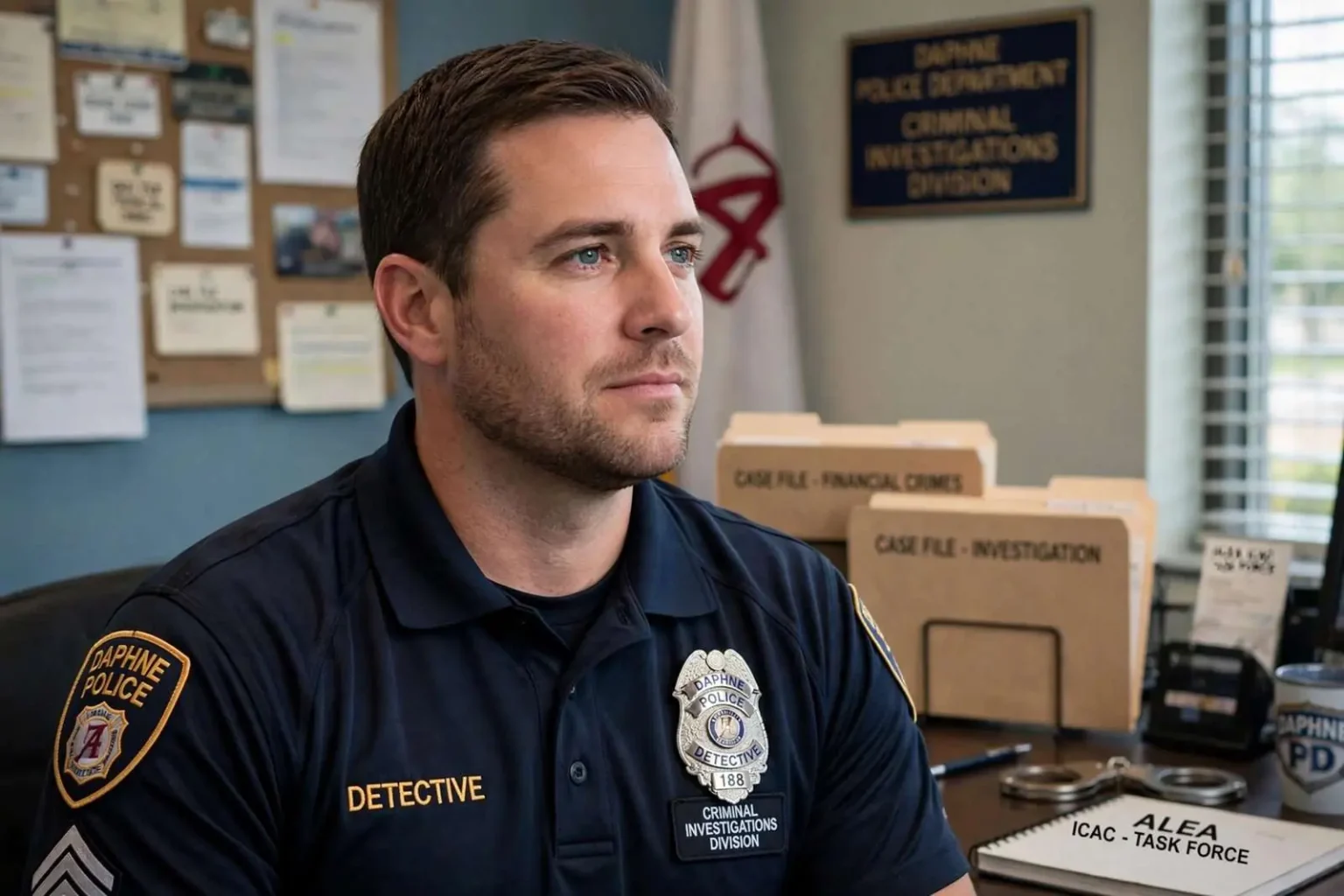
The Daphne Police Department is recognizing Detective Paul Blakely, who has served the city of Daphne for almost eight years and now works in the department's Criminal Investigations Division. Daphne sits along the eastern shore of Mobile Bay in Baldwin County, and its police department relies on detectives like Blakely to follow through on cases after patrol officers make initial contact. Blakely set out to build a career in law enforcement and applied with several departments before he was hired by the Daphne Police Department. He spent his first five years with the department working as a patrol officer, a role that put him directly in the community responding to calls and building relationships with residents.
From Patrol to Investigations After several years on patrol, Blakely transitioned into his current role as a detective, where much of his work now takes place away from the public eye, from his desk or over the phone, as he builds cases rather than responding to incidents in real time. He investigates a wide range of offenses, including financial crimes, property crimes and crimes against persons, and he regularly collaborates with surrounding law enforcement agencies as well as federal partners on cases that cross jurisdictional lines. Blakely also serves as a task force officer with the Alabama Law Enforcement Agency's Internet Crimes Against Children Task Force, known as ALEA ICAC, which investigates internet-based crimes targeting children.
In addition to his investigative duties, he is a member of the Daphne Police Department's SWAT team and serves as a peer support member, offering support to fellow officers navigating the stresses of the job. Finding Meaning in the Work Blakely said the people he works with, along with the citizens he serves, are among the things he appreciates most about his job. "The support we receive from our citizens makes Daphne the ideal place for anyone to serve as a police officer," he said. He said the most meaningful part of his job is the opportunity to bring closure to a victim, regardless of the type of case involved.
That focus on victims is central to the work of the Criminal Investigations Division, which handles cases long after the initial response has ended and an investigation has begun. Outside of work, Blakely enjoys working out, cooking and playing video games, and he spends time with his wife and two daughters. When he is looking for lunch in Daphne, his favorite spot is Daruma's. City officials thanked Blakely for his dedication to the community, and extended that thanks to the entire Criminal Investigations Division for the work its members do every day to support victims and help keep Daphne safe. The Criminal Investigations Division In a municipal police department, the Criminal Investigations Division is the unit that takes over cases once the initial patrol response is complete.
Patrol officers handle the first contact – arriving at a scene, taking statements, making arrests when warranted, and writing initial reports. Detectives then follow through: reviewing those reports, collecting additional evidence, conducting interviews, coordinating with prosecutors, and building cases that can withstand scrutiny in court. For a department the size of Daphne's, the division is small, which means each detective carries a varied caseload rather than specializing in a single type of offense. That is why Blakely works on financial crimes, property crimes and crimes against persons all within the same role. The work is slow by design. Investigations unfold over weeks or months, and much of the detective's time is spent on documentation, research and communication rather than on dramatic fieldwork.
Background and Context
The satisfaction of the role, as Blakely describes it, lies in the slower process of bringing a case to resolution for the victim. That focus is a defining feature of the division's purpose. ALEA ICAC and task force work The Alabama Law Enforcement Agency's Internet Crimes Against Children Task Force, known as ALEA ICAC, is a multi-agency collaboration that investigates internet-based crimes targeting children. Task forces of this kind bring together investigators from local departments, state agencies and federal partners, and they operate with specialized training and resources that individual departments would find difficult to maintain independently. Serving as a task force officer means that Blakely participates in that broader network, bringing his local investigative experience to cases that often cross jurisdictional lines.
The collaboration with federal partners reflects the reality of modern criminal investigation: the internet does not stop at city or county boundaries, and neither can the response. SWAT and peer support roles Membership on the Daphne Police Department's SWAT team and service as a peer support member represent two very different but equally important parts of Blakely's professional life. The SWAT team is a specialized tactical unit that responds to high-risk situations, including armed confrontations, hostage incidents and other events where standard patrol resources are insufficient. Peer support, by contrast, is an internal program in which officers offer emotional and practical support to colleagues dealing with the stress and trauma of police work.
Both roles depend on trust among officers and a willingness to take on responsibilities that go beyond the standard duties of the investigative division. Peer support is a growing practice within American law enforcement, as departments recognize that the psychological demands of policing – exposure to violence, trauma and the weight of victim cases – require structured support systems rather than informal resilience alone. Serving as a peer support member means being available to colleagues in a structured, confidential capacity, which is a formal extension of the same commitment to colleagues and to the community that Blakely describes as central to his work. Daphne in context The Daphne Police Department, like other municipal departments along Alabama's Gulf Coast, serves a growing community.
Daphne's population has expanded with the broader growth of Baldwin County, and with that growth comes a wider range of incidents that a police department must respond to – from property crimes and traffic concerns to more complex cases that require specialized investigative skills. The recognition of a detective such as Blakely reflects the department's emphasis on the slower, deeper work of investigation, which is what allows the community to see responses to crimes that extend beyond the initial emergency call. The call to serve, as Blakely puts it, depends on support from citizens. That is a common theme in police-community relationships along the eastern shore, where departments tend to be closely tied to the communities they serve.
A detective who has spent nearly eight years in a single department, first on patrol and then in investigations, has had time to build the relationships – with both residents and fellow officers – that make the work sustainable. What the work of an investigator actually involves The daily work of a detective in a division like Daphne's Criminal Investigations Unit involves a mix of tasks that are not always visible to the public. It includes reviewing case files, contacting witnesses, coordinating with other agencies for records or surveillance, preparing reports for prosecutors, and appearing in court when a case reaches trial.
Background and Context
For cases involving internet crimes against children – Blakely's work with ALEA ICAC – the process also includes reviewing digital evidence, working with specialized forensic tools and coordinating with federal investigators. The variety of the work is part of what makes the role both demanding and engaging. Outside of the formal duties, the relationships within the department matter. The peer support role, the collaboration with SWAT members and the cooperation with patrol officers all depend on the kind of familiarity that develops over time. Blakely's eight years with the Daphne Police Department have given him the kind of institutional knowledge – about the community, the department's procedures and the people involved in individual cases – that is difficult to replace quickly.
That continuity is a significant part of why the department recognizes his work. Why the recognition matters Recognitions such as this one serve multiple purposes within a police department. For the individual officer, it is acknowledgment of years of work that often proceeds without public visibility. For the department, it highlights the value of specialized roles – investigation, task force collaboration, tactical response and peer support – that might otherwise receive less attention than patrol and emergency response. And for the community, it provides a point of connection: residents can see the names and roles of the officers who work on the cases that affect them directly, rather than knowing only the public-facing functions of the department.
The closing message of the recognition – thanks to Blakely and to the entire Criminal Investigations Division – reflects that broader purpose. Investigative work is rarely completed by a single person; it depends on cooperation with other officers, with other agencies and with the community itself, through witness cooperation and victim participation. By extending thanks to the division as a whole, the department is emphasizing that the work Blakely does is part of a collective effort, one that requires many hands to bring each case to a meaningful conclusion.