Daphne police officer charged with indecent exposure at Fairhope pool
A Daphne police officer is off the force after being charged with indecent exposure at the Hollowbrook pool in Fairhope, the police chief confirmed.
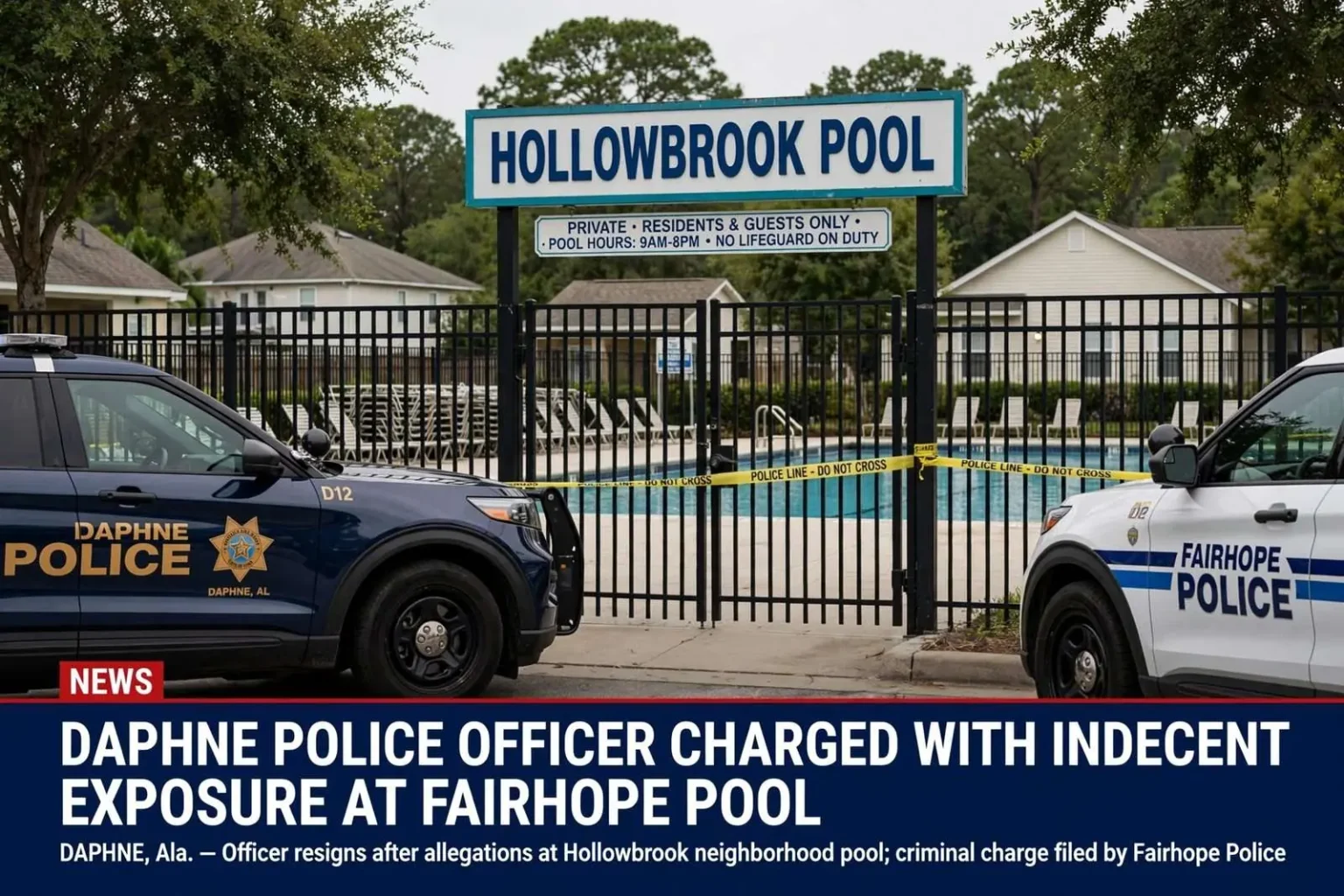
DAPHNE, Ala. — A Daphne police officer is no longer with the department after being accused of exposing himself to a woman at a neighborhood pool in Fairhope, in a case that spans two of Baldwin County’s largest police agencies. Fairhope Police Chief Stephanie Hollinghead confirmed that Joshua Turner has been charged with indecent exposure in connection with the incident, which was reported at the Hollowbrook neighborhood pool in Fairhope.
The Daphne Police Department confirmed that Turner is no longer a member of the force. According to the department, he resigned after the allegations were made against him, ending his employment as the criminal case moved forward in Baldwin County. The charge of indecent exposure stems from an accusation that Turner exposed himself to a woman at the neighborhood swimming pool, a report that Fairhope police investigated after it was made.
The case places two Baldwin County departments at the center of a single matter. Fairhope police handled the investigation and the charge, while Daphne police confronted the employment questions raised by allegations against one of their own officers. The resolution on the employment side came quickly by the standards of officer-misconduct cases: rather than a suspension pending a lengthy internal review, the department announced that Turner had resigned once the allegations surfaced.
The Hollowbrook neighborhood is a residential subdivision in Fairhope, one of the many established neighborhoods in a city that has grown rapidly along the eastern shore of Mobile Bay. Neighborhood pools are common features in Baldwin County subdivisions, serving as gathering places during the long Gulf Coast summer, and incidents at such facilities are handled like any other reported crime — through the municipal police department with jurisdiction over the location, in this case Fairhope.
The charge of indecent exposure in Alabama
Indecent exposure is a criminal offense under Alabama law, and the specifics of the charge depend on the circumstances and location of the incident. In its basic form, the offense involves exposing one’s body in a public place or in view of others in a manner that offends public decency. The charge in this case, confirmed by Chief Hollinghead, alleges that the act occurred at the neighborhood pool where the woman reported it.
For a law enforcement officer, a criminal charge of any kind carries professional consequences beyond the criminal case itself. Police officers in Alabama are subject to state certification standards administered through the peace officers’ certification process, and an arrest — let alone a conviction for an offense involving alleged sexual misconduct — triggers review of an officer’s status. Departments also conduct internal investigations of officer conduct, but in this case the officer’s resignation removed the employment question before a termination process could play out.
Resignation in the face of allegations is a familiar pattern in officer misconduct cases, and it has consequences for accountability. An officer who resigns avoids the administrative process that could result in formal termination and the disciplinary record that accompanies it, but it does not shield him from the criminal charge, which proceeds in the courts regardless of employment status. Prosecutors handle the criminal matter on its evidence, and the case will move through the Baldwin County court system like any other criminal prosecution.
The Daphne Police Department’s public confirmation of the resignation reflects the position municipal departments in Baldwin County have generally taken on officer misconduct: acknowledging the employment action directly rather than leaving questions unanswered. Daphne, one of the fastest-growing cities in Alabama, fields a police department responsible for a growing population along the Bay’s eastern shore, and the credibility of the force depends in part on how it handles allegations against its own personnel.
Fairhope, where the incident was reported, is a city of more than 20,000 residents on the eastern shore of Mobile Bay, known for its bluff-top park, its arts community, and its rapid residential growth. The city’s police department, led by Chief Stephanie Hollinghead, handles law enforcement for the city’s neighborhoods, parks, and public facilities. Neighborhood pools like the one at Hollowbrook fall within that jurisdiction, and reports originating at such facilities are investigated by Fairhope officers regardless of where the accused may live or work.
That jurisdictional point matters in cases involving off-duty conduct by officers from other cities. A Daphne police officer accused of a crime in Fairhope is, from Fairhope’s perspective, an ordinary suspect: the investigation follows the evidence and the location, and the charging decision rests with investigators and prosecutors in Baldwin County, not with the suspect’s home department. The employer’s role is separate — determining whether the officer can continue to serve — and in this case Daphne resolved that question through resignation.
Baldwin County’s court system will now handle the criminal case. Indecent exposure cases turn on the testimony and evidence from the scene, and the charge, while a misdemeanor in its typical form, is one that courts treat with seriousness when it involves allegations of exposing oneself to an unwilling person. A conviction can carry jail time, fines, and — for anyone — a record that follows the defendant; for a former police officer, the professional consequences extend to any future in law enforcement, since agencies must disclose criminal history in their hiring processes.
How communities process allegations against officers
Cases in which a police officer is accused of a crime against a resident draw particular scrutiny, and both departments involved handled the public communication directly. Fairhope’s chief confirmed the charge, and Daphne’s department confirmed the resignation and the timing — after the allegations were made. That transparency is the pattern recommended in policing standards: when an officer is accused of criminal conduct, the agencies involved are expected to acknowledge the facts they can confirm and let the investigation and courts handle the rest.
For residents of the Hollowbrook neighborhood, the report of the incident and the arrest that followed raise the questions any neighborhood faces after a disturbing report at a shared facility: who was watching, what was seen, and what happens next. Neighborhood pools in Baldwin County subdivisions are typically governed by homeowners’ associations, and incidents at such facilities often prompt HOA boards to review policies on supervision, hours, and access — measures that address the facility itself even as the criminal case addresses the individual accused.
The woman who reported the incident is protected by standard practices in cases involving alleged sexual misconduct. Police departments generally withhold identifying details about reporting parties in such cases, and the name of the person who came forward has not been made public. Advocates for reporting parties in these cases emphasize that prompt reporting is what allows police to act quickly, and the timeline in this case — a report, an investigation, a charge, and a resignation — shows the sequence working as designed.
Turner’s criminal case remains pending in Baldwin County, and the outcome will be determined in court. What has already been resolved is the employment question: the Daphne Police Department has confirmed that the department and the officer have parted ways, with the resignation coming after the allegations became known. The case stands as an example of how allegations against an officer from one Baldwin County city can be investigated and charged by another, with each agency handling the piece that falls within its responsibility.
The structure of police employment in Baldwin County gives cases like this one their particular shape. The county’s municipal departments — Daphne, Fairhope, Gulf Shores, Foley, Spanish Fort, Robertsdale, and others — each hire and discipline their own officers, while the Baldwin County Sheriff’s Office covers the unincorporated areas and provides support to the municipalities. Officers can move between departments during their careers, and background checks at hiring include review of any criminal history. An arrest on a criminal charge, however, is the responsibility of the arresting agency to investigate and the district attorney to prosecute, regardless of the suspect’s occupation.
Police officers in Alabama are also accountable to the state’s certification framework. Law enforcement certification through the state’s peace officer standards process is what allows an individual to serve as an officer, and serious criminal charges can lead to suspension or revocation of certification independently of any department’s decision. Decertification follows convictions for certain offenses, and even a pending charge follows an officer through the system, since employing agencies are required to report officer separations and the circumstances around them.
The speed of the resignation in this case also spares both departments the internal process that would otherwise follow. Departments confronting allegations against an officer typically place the officer on leave while an internal affairs investigation runs parallel to the criminal case, a process that can take months. By resigning, the officer ended that process on the employment side, though the department’s records of the allegation and separation remain part of his employment history and are subject to disclosure requirements in any future law enforcement employment.
For the Fairhope investigators who handled the report, cases involving an officer from another agency carry an added consideration: avoiding any appearance that the suspect’s occupation influences the handling of the case. The standard practice is to treat the investigation as they would any other, following the evidence from the initial report at the Hollowbrook pool through to the charge. Chief Hollinghead’s public confirmation of the charge signaled the department’s position that the case would be handled like any other criminal matter in the city.
The Hollowbrook incident is also a reminder of the role residents play in cases of this kind. Reports made promptly, with details about what was seen and when, are what allow police to identify suspects and move from report to charge — a sequence that in this case ended with a charge confirmed publicly by the chief and a resignation confirmed publicly by the accused officer’s own department. Both agencies have indicated the matter now rests with the courts, where the criminal case against Turner will run its course like any other case in Baldwin County.