
Dauphin Island Cleanup From Tropical Storm Barry Could Stretch Into Midweek
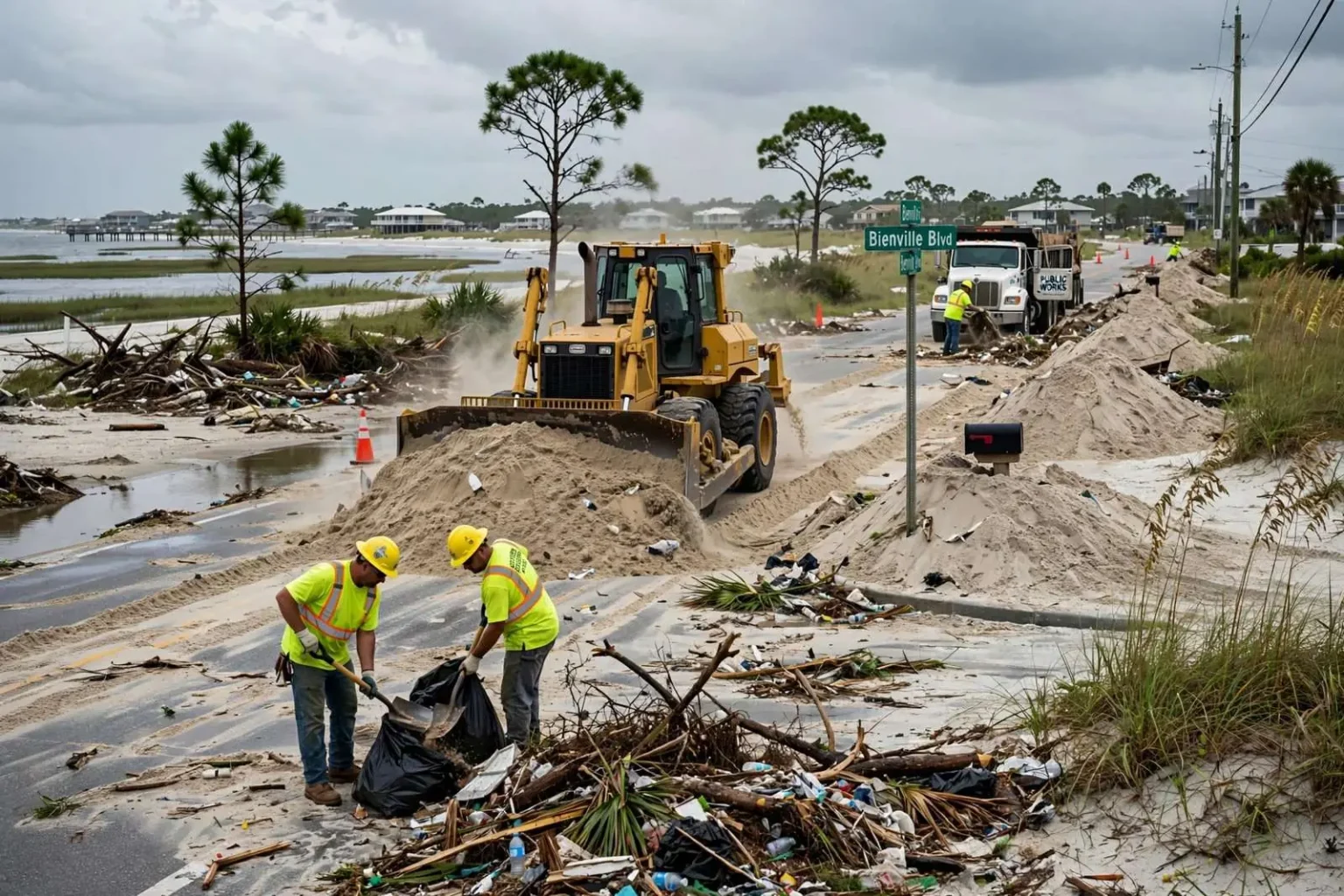
Bulldozers and public works crews clear sand drifts up to four feet tall from Dauphin Island roads after Tropical Storm Barry.
Dauphin Island dodged the worst of Tropical Storm Barry, but visitors and residents are still navigating the aftermath — with cleanup expected to continue for another day or two. The barrier island, which sits at the mercy of every Gulf storm that pushes water into Mobile Bay, was left awash in sand and floodwater after the system rolled past, and crews have been working around the clock to restore normalcy.
The storm’s calling cards were visible across the island: bulldozers pushing mounds of sand off the main road while public works crews in bright yellow shirts collected everything from scattered debris to piles of trash. The familiar post-storm choreography played out block by block, as heavy equipment moved sand drifts back toward the beach and town crews cleared what the wind and water had scattered.
Barrier islands like Dauphin Island are built and rebuilt by storms, and even glancing blows leave their mark. The island’s low elevation — much of it just a few feet above sea level — means that storm surge and wave overwash routinely push Gulf water and sand across the main road, the island’s central artery and the only route on and off the island for most residents and visitors.
Vacations Delayed, Then Back On
For some vacationers, Barry delayed the start of their trips. Whitney Cole’s family from Ohio tried to reach the island Saturday but found roads flooded, forcing them to spend the night in Mobile before finally making it across.
“Now it’s so beautiful, we’re lucky to be here — it’s nice now,” Cole said.
The detour through Mobile is a familiar one for would-be island visitors after coastal storms. When water covers the causeway and the island’s roads, travelers have no choice but to wait out the flooding on the mainland, often with vacation plans hanging in the balance. For Cole’s family, the one-night delay ended in relief as they finally crossed onto the island to find their beach getaway waiting.
Others took the unusual scene in stride. Alicia Eustice, visiting from Arkansas, said seeing a tropical system’s aftermath was a novelty compared to back home.
“It makes it eventful, kind of neat… where we come from we see tornados and we don’t experience tropical depressions,” she said.
For inland visitors like Eustice, the damage left behind by a tropical system — sand drifts taller than a mailbox, floodwater standing in yards — can seem almost exotic. For the people who live and work on the island, it is simply part of the cost of life on the Gulf, one that gets tallied and paid after every storm that passes.
Despite pools of floodwater and drifts of sand standing up to four feet tall, crews worked through the weekend to clear the island as quickly as they could. Town officials estimated the cleanup would stretch into midweek, with the heaviest work concentrated along the main road where the bulldozers had been pushing sand since the storm passed.
The task facing Dauphin Island’s public works crews is a recurring one. The town’s small staff shoulders an outsized job every time a tropical system sends water across the island, moving sand that residents consider both a nuisance and, ultimately, the island’s most precious resource. Rather than haul it away, crews typically push it back toward the beach and dune lines where it can rebuild the natural buffer that protects the island in the next storm.
A Storm the Island Could Absorb
Barry, which came ashore in Louisiana as a Category 1 hurricane before weakening to a tropical storm as its remnants moved inland, spared Dauphin Island the catastrophic damage that stronger systems have delivered over the years. Islanders remember well what a direct hit can do: Hurricane Katrina in 2005 devastated the island, and Hurricane Georges in 1998 and Hurricane Ivan in 2004 each left behind destruction that took months to repair.
Against that history, Barry’s residue of sand, debris and standing water reads as a lucky outcome — a storm the island could absorb. No injuries or widespread structural damage were reported, and the primary effects were localized flooding and the massive sand deposits along the roadways.
The island’s economy, which depends heavily on summer tourism, felt the storm’s impact in delayed arrivals and shortened vacations rather than cancellations. Vacation rentals, bait shops, restaurants and the popular public beach all rely on the July traffic that Barry interrupted, and every day of cleanup is a day of lost business for some of the island’s roughly 1,300 year-round residents who make their living from visitors.
Tourism officials and property owners have long stressed that the island rebounds quickly from minor storms, and this weekend was no exception. Within days of the storm’s passage, the beaches were open again, the ferry and bridge routes were running, and vacationers like the Cole family were settling into trips that had gotten off to a soggy start.
For the crews in yellow shirts, the work continues into midweek. Every pile of debris hauled away and every drift of sand pushed back toward the water brings the island closer to the postcard version of itself that visitors expect — until the next storm tests it again.
Getting to Dauphin Island is part of its charm and part of its vulnerability. The island sits at the western end of Mobile Bay, connected to the mainland by the Gordon Persons Bridge and the long causeway across the bay’s southern rim. When tropical systems churn the Gulf, that single link can flood or close, cutting the island off exactly when residents may need to get out — or when visitors are trying to get in. Cole’s family experienced that isolation firsthand, cooling their heels in Mobile while water covered the route.
The town’s layout magnifies the effect of storm sand. Bienville Boulevard, the main road, runs the length of the island, and when overwash buries it, essentially everything on the island is inaccessible — homes, rentals, the elementary school, the Sea Lab and Estuarium that draws school groups and tourists year-round. Clearing that road is therefore the first priority for crews after any storm, and the bulldozers seen working through the weekend were concentrated exactly there.
Dauphin Island’s relationship with sand is more complicated than a simple cleanup story. The island constantly reshapes itself, with sand migrating from its beaches into its roads after storms and back toward its shoreline in calmer times. East-end residents have watched the island’s western tip grow and shrink with successive hurricanes, and engineers have debated for years how best to nourish and stabilize the beaches that serve as the town’s first line of defense. Each storm’s sand deposits, then, are both a problem to clear and a reminder of the fragile geology that keeps the island above the Gulf.
What Visitors Can Expect
For travelers planning trips to the island in the days after a storm, local officials generally advise checking road conditions before crossing the causeway. Public works teams prioritize reopening access, but standing water in low-lying streets and piles of sand along shoulders can linger for days, as Barry’s midweek cleanup timeline illustrates.
The Alabama Gulf Coast’s hurricane season runs from June through November, with the statistical peak in late summer, and Dauphin Island’s history includes dozens of tropical systems that have shaped — and reshaped — the town. Longtime residents keep a practiced eye on the tropics each summer, knowing that the difference between a nuisance storm like Barry and a destructive one can be a matter of a few dozen miles in a storm’s track.
Mobile Bay itself acts as a funnel during tropical events, pushing surge into the bay’s upper reaches while wind-driven water piles onto the seaward faces of the island’s beaches. That dynamic is why the island can flood even from storms making landfall far to the west, as Barry did in Louisiana — the worst effects for the island came not from wind but from water and sand moved by distant winds.
By early the following week, the island was well on its way back. Sand drifts along the main road were shrinking as the bulldozers made pass after pass, debris piles at the curb were disappearing into waiting trucks, and the vacation rhythm of the island — beach mornings, boat ramps busy at dawn, bait shops restocking — was reasserting itself over the storm’s temporary disorder.
Public works employees who cleared the island after Barry did so with the practiced efficiency of a crew that has done this before. Small towns on the Gulf Coast cannot wait for outside help to arrive for routine storm cleanup; they depend on their own crews, their own equipment and the patience of their neighbors. The yellow shirts that became a familiar sight through the weekend were, in a sense, the most important storm response Dauphin Island needed — not dramatic, just relentless.
Storm debris collection follows a familiar pattern in the town. Residents drag branches, damaged fencing and storm-scattered belongings to the roadside, and crews work street by street until the piles are gone. In the case of Barry, the debris load was moderate, which allowed the town to focus much of its energy on the sand removal that dominated the visual landscape of the cleanup.
The four-foot sand drifts reported along the road were high enough to bury mailboxes and park cars axle-deep in places. Photographs shared by visitors showed children climbing the dunes that had formed in the middle of the street — a scene that captured the strange beauty residents and tourists alike have come to associate with the island’s post-storm days.
Local officials reminded visitors that the island’s beaches, parks and public facilities reopened on a rolling basis as cleanup progressed, and that the weeks after a storm often offer some of the best fishing and birding of the summer, as the island’s wildlife areas settle into their post-storm rhythms.
For the Coles of Ohio, the Eustices of Arkansas and every other visitor who arrived to find bulldozers rather than beaches, the storm became part of the vacation’s story — a night in Mobile, a morning of detours, and then the island they came for. For Dauphin Island itself, Barry was one more entry in a long ledger of Gulf storms: inconvenient, costly, survivable — and, by midweek, mostly a memory as the last sand drifts came off the main road.


