University of South Alabama Mobile
Dauphin Street Vault Adds 400-Meter Race to Fifth Year of Downtown Mobile Pole Vault Party
The Dauphin Street Vault marks its fifth year in downtown Mobile by adding a 400-meter road race alongside its signature street-level pole vault competition, with Olympian Trey Hardee making a guest appearance.
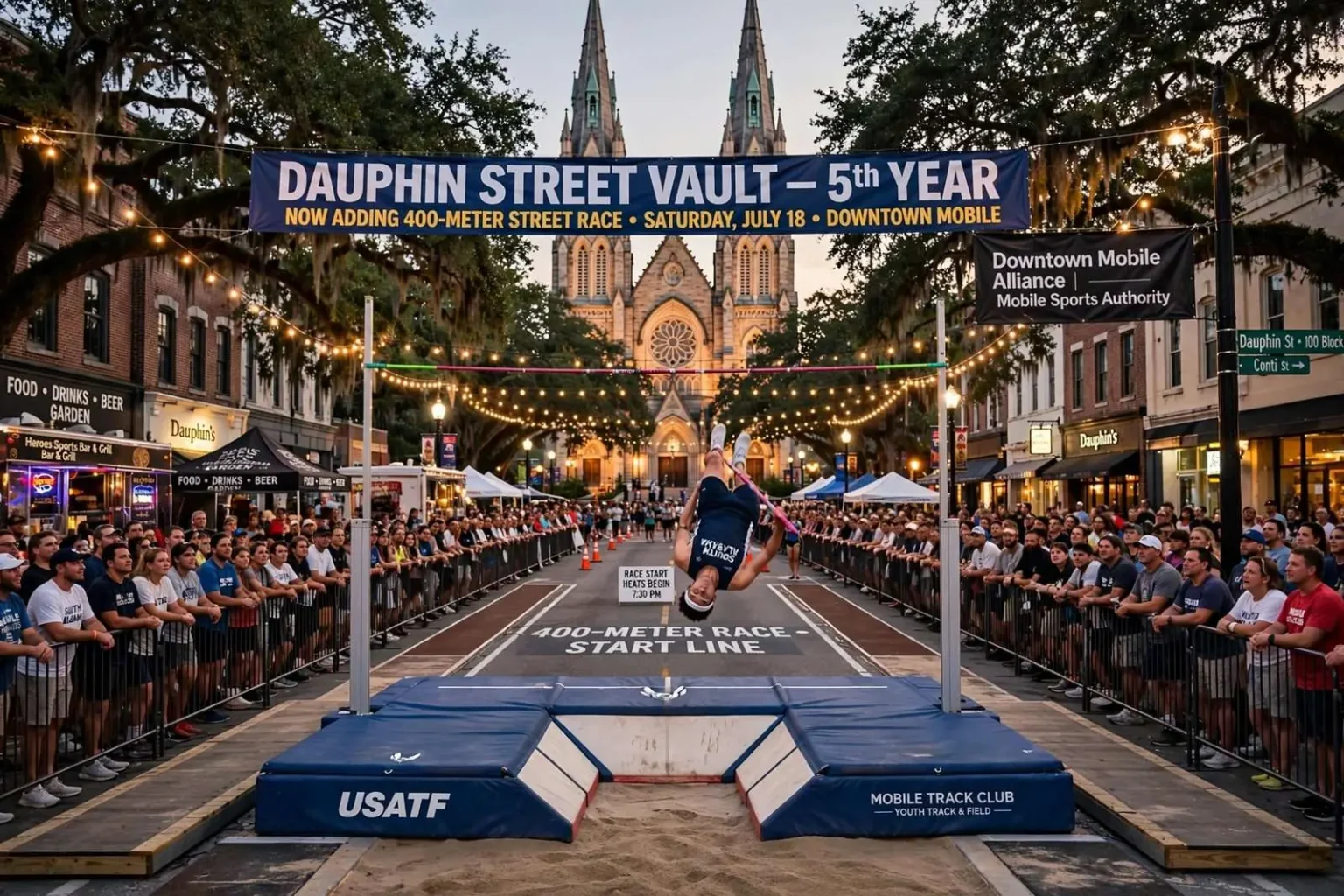
When the Dauphin Street Vault first launched in 2011, the concept seemed like an odd mismatch: take pole vaulting, a sport usually contested in hushed, controlled settings, and drop it into the middle of a rowdy downtown Mobile street party complete with rock music and a screaming crowd. Five years later, the event is not only still going strong, it’s expanding, with a 400-meter street race joining the competition for the first time this Saturday, July 18.
“Our motivation back in 2011 was for this to be cool,” said Thomas Fowlkes, one of the event’s founders. “Then it grew. It was an unintentional success.” The competition takes over a section of Dauphin Street just past Cathedral Square, where crews build two wooden vaulting runways to allow continuous action throughout the evening. Unlike a traditional track meet, where field events tend to draw a more subdued, attentive crowd, the Dauphin Street Vault turns each attempt into a moment for the crowd to erupt.
“One of the main missions is to promote the sport,” Fowlkes said. “Vaulting is an underappreciated sport in general. It actually is the sexiest event in all of track and field. So we put it right in the middle of the street, right in front of everyone’s eyes. It’s a great environment, especially when you throw in 1,000-plus spectators and some great competitors.”
From Experiment to Downtown Tradition
The Dauphin Street Vault began as an experiment by a small group of Mobile track enthusiasts who wanted to bring field events out of the stadium and into the community. The inaugural event drew curious onlookers and a handful of regional vaulters, but word spread quickly through Alabama’s tight-knit track and field community. By year three, the event had outgrown its original footprint and secured sponsorship from local businesses eager to associate with the unique spectacle.
The format has remained remarkably consistent: two runways constructed from pressure-treated lumber and industrial-grade padding, professional-grade standards and boxes, and a raised landing pit that meets NCAA and USATF specifications. What changes each year is the caliber of athletes. The 2015 edition featured competitors from SEC programs including Alabama, Auburn, and LSU, along with several post-collegiate athletes chasing Olympic qualifying marks.
Fowlkes, a former vaulter himself at the University of South Alabama, credited the event’s staying power to its accessibility. Spectators stand within feet of the runway, close enough to hear the vaulter’s breathing and the snap of the pole. There are no bleachers separating fans from athletes, no ticket gates, no press boxes. The event runs on a shoestring budget supported by the Downtown Mobile Alliance, the Mobile Sports Authority, and a rotating cast of local sponsors including engineering firms, restaurants, and medical practices.
The Venue: Cathedral Square to Dauphin Street
The course layout takes advantage of Mobile’s historic downtown grid. The vaulting runways are positioned on Dauphin Street between Conti and St. Francis streets, with the landing pits oriented toward Cathedral Square Park. This placement creates a natural amphitheater effect, with the park’s mature live oaks and the Cathedral Basilica of the Immaculate Conception providing a distinctive backdrop. The street closure extends four blocks, allowing space for vendor tents, food trucks, and a beer garden operated by a local brewery.
Cathedral Square itself has undergone significant revitalization since the vault began. The park, which anchors Mobile’s historic church district, was renovated in 2012 with new lighting, irrigation, and pedestrian pathways — improvements that coincided with the event’s growth. City planners have cited the Dauphin Street Vault as a catalyst for broader downtown activation, demonstrating how a single annual event can anchor a corridor’s identity.
Economic Impact on Dauphin Street Corridor
The event has become a boon for businesses along that stretch of Dauphin Street. “It’s one of the best single days of the year for some of the businesses on that block,” said Carol Hunter of the Downtown Mobile Alliance, an organization focused on redevelopment in the area. “The Dauphin Street Vault is the kind of unexpected event that works so well downtown, because of the vibrant street scene and the ease of walking to dining and shopping. Hundreds of vaulters, their families and local spectators fill the street, restaurants and hotel rooms at a time of year when business is less robust.”
David Rasp, owner of Heroes Sports Bar and Grill, which sits directly on the course, estimates his single-day revenue during the vault exceeds a typical weekend by 40 to 50 percent. Similar spikes have been reported by neighboring establishments including The Blind Tiger, Dauphin’s, and the various eateries around Cathedral Square. The Downtown Mobile Alliance has tracked the event’s economic footprint since 2013, noting consistent growth in hotel occupancy for the Friday and Saturday nights surrounding the competition.
A 2014 study commissioned by the Mobile Bay Convention and Visitors Bureau estimated the vault’s direct spending impact at approximately $280,000 for the weekend, including hotel rooms, restaurant meals, transportation, and retail. The study noted that roughly 35 percent of attendees came from outside Mobile County, with significant contingents from Baldwin County, the Mississippi Gulf Coast, and the Florida Panhandle. The event’s July timing — traditionally a slow period for Gulf Coast tourism between the Fourth of July rush and the late-summer family vacation window — makes it particularly valuable to the hospitality sector.
New 400-Meter Race Adds Track Element
The addition of the 400-meter street race represents the first significant format change since the event’s inception. Organizers worked with the City of Mobile’s special events office and Mobile Police Department to design a course that starts near the vaulting runways, proceeds down Dauphin Street past Government Street, loops through the Cathedral Square district, and finishes back at the vaulting venue. The race will be run in heats, with the final scheduled during a break in the vaulting action.
“We’ve always had runners in the crowd asking why we don’t have a race,” Fowlkes said. “The 400 is the perfect distance — long enough to be a real race, short enough to fit in our window, and it uses the same street closure we already have. It brings track athletes into an event that’s been field-only, and that cross-pollination is exactly what we want.”
Registration for the inaugural 400-meter race opened in June and filled its 80-slot capacity within two weeks. Entrants include high school state champions from Alabama and Mississippi, collegiate runners from Spring Hill College and the University of South Alabama, and several masters athletes. The winner’s purse of $500, funded by a new sponsorship from a local orthopedic practice, is modest by road racing standards but significant for a street event of this scale.
Community Roots and Future Growth
The Dauphin Street Vault’s organizers operate as a nonprofit committee under the umbrella of the Mobile Track Club, with all proceeds directed toward youth track and field programs in Mobile County. Since 2012, the event has contributed more than $45,000 to middle school and high school programs for equipment, travel, and facility improvements. The committee’s long-term goal includes expanding the vault to a two-day format with a youth clinic on Friday and the elite competition on Saturday.
Mobile’s track community views the event as a rare bright spot in a sport that struggles for visibility outside Olympic years. Alabama has produced Olympic medalists in the pole vault, including 2012 silver medalist Brad Walker, who grew up in nearby Ridgeland, Mississippi, and trained extensively on the Gulf Coast. Walker has appeared at the Dauphin Street Vault twice as a guest commentator and has advocated for more street-level field events across the Southeast.
The event has also inspired similar street vaults in other cities. Organizers in Pensacola, Florida, launched the Palafox Street Vault in 2014 modeled directly on Mobile’s format, and conversations have taken place with groups in New Orleans, Baton Rouge, and Birmingham about replicating the concept. Fowlkes has shared the event’s operational playbook — including runway construction specs, insurance requirements, and sponsorship decks — with interested parties at USA Track and Field’s annual convention.
The logistics of staging a world-class field event on a public street are substantial. Each year, the city’s public works department coordinates the delivery and placement of 40 tons of sand for the landing pits, 2,000 feet of fencing for crowd control, and temporary lighting sufficient for evening competition. The Mobile Fire Department stations an EMS unit on site, and the police department assigns a dedicated patrol detail for the duration of the street closure. All costs are absorbed by the event’s nonprofit budget, which operates on approximately $35,000 annually.
“When kids see pole vaulting on a street corner with music playing and people cheering, it changes what they think the sport is,” Fowlkes said. “It’s not just something you do at a track meet in a singlet. It’s something you can do anywhere there’s a runway and a pit. That accessibility is how you grow the sport.”
For this year’s edition, organizers have added a youth exhibition vault on Friday evening, allowing middle school athletes to try the event on lowered standards with coaching from USA Track and Field certified instructors. The exhibition is free and open to the public, part of a deliberate push to make the sport more visible to the next generation of Gulf Coast athletes.