Baldwin Jury Convicts David Coombs of Capital Murder
After a nearly three-week trial in Bay Minette, a Baldwin County jury deliberated just 75 minutes before convicting David Coombs of capital murder in the 2009 robbery and shooting of a Pensacola gold dealer.
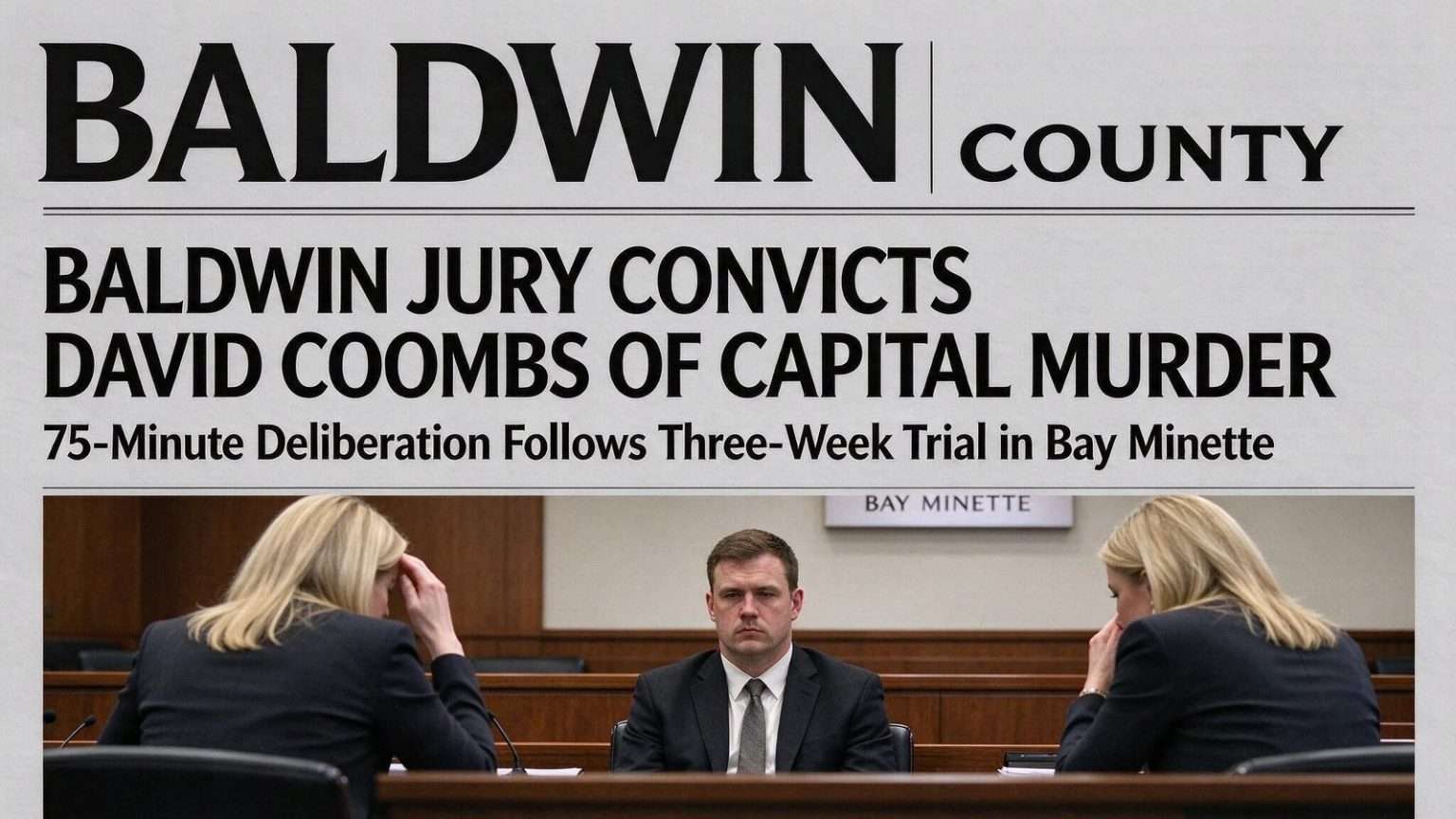
A Baldwin County jury deliberated for just 75 minutes before finding David Coombs guilty of capital murder in the 2009 robbery and shooting death of a Pensacola gold dealer, capping a trial in Bay Minette that had lasted nearly three weeks. Coombs, 35, was convicted of shooting 57-year-old William Grunden in the back of the head after luring him to a deserted, wooded location in the Wilcox area and stealing thousands of dollars from him. Prosecutors presented evidence that Coombs went on a spending spree and repaid debts in the hours and days following the killing.
The verdict brought to a close a case that had lingered in the Baldwin County court system for years, moving from investigation through indictment to one of the most closely watched trials of the term. Capital murder — charged here because the killing occurred during the course of a robbery — is the most serious offense in Alabama’s criminal code, and trials of that grade draw extraordinary preparation on both sides: months of witness work, forensic evidence, and the layered legal arguments that accompany any case where the potential penalty is life without parole or death.
A Swift Verdict
The speed of the jury’s decision stood in contrast to the length of the trial. After weeks of testimony and evidence, jurors needed little more than an hour to reach a unanimous conclusion, an outcome prosecutors took as validation of the case they had assembled. Baldwin County District Attorney Hallie Dixon, who served as lead prosecutor, praised the collaboration behind the result. “This is the way it is supposed to work,” she said, crediting phenomenal teamwork among law enforcement agencies and her office. That cooperation, she said, made it possible to present a large volume of information to the jury in a way that helped them reach their decision quickly.
Short deliberations in long trials often signal that the evidence lined up cleanly for jurors, and prosecutors said this case had that character. Witnesses, financial records, and the physical evidence from the scene combined into an account of the crime that left, in the state’s telling, little room for an innocent explanation. The defense’s challenge was formidable by design: capital cases place the burden on the state to prove not just the killing but the aggravating circumstances — here, the robbery — that elevate the charge, and prosecutors built their presentation around connecting both.
Evidence of a Spending Spree
Central to the prosecution’s case was the trail Coombs left in the aftermath of the crime. By documenting how he spent money and settled debts immediately after Grunden’s death, prosecutors connected the defendant to the theft that accompanied the killing. Financial evidence of that kind is often the most persuasive in robbery-murder prosecutions, because it ties the defendant to the proceeds at the precise moment they came into existence and undercuts any claim that the money arrived innocently.
The account of the crime, a victim lured to an isolated, wooded area and shot from behind, underscored the calculated nature of the offense as the state described it. Grunden, a gold dealer from Pensacola, had been drawn across the state line to the Wilcox community in northern Baldwin County — a rural crossroads area where a deserted meeting spot could be arranged and where, prosecutors argued, the plan was always to take the money rather than trade for it. The jury’s rapid verdict suggested that the evidence had left little room for doubt.
A Second Capital Conviction
The case marked the second capital murder conviction Dixon had won since taking office at the start of the year. For a district attorney who had campaigned on restoring aggressive prosecution to the office, the back-to-back results carry both legal and political weight, demonstrating to local law enforcement and to the community that the office will take the hardest cases to trial and see them through. Capital prosecutions demand enormous resources — co-counsel, investigators, expert witnesses, and weeks of courtroom time — and securing a conviction in the second such trial of a new administration signals institutional capability.
The teamwork Dixon credited reflects how cases of this magnitude actually get built. Sheriff’s investigators, agencies across the state line in Florida, forensic specialists, and prosecutors’ offices on both sides of the border had to align their work for a trial spanning nearly three weeks, and the prosecutor said that alignment was the difference the jury felt. Cases that cross state lines — as this one did, from a Pensacola victim to a Baldwin County crime scene — depend on that cooperation to move evidence and witnesses smoothly between jurisdictions.
What Comes After a Capital Verdict
A guilty verdict in an Alabama capital case does not end the proceeding; it begins its most consequential phase. The trial moves into sentencing, where the jury hears additional evidence about the crime and the defendant and weighs whether the aggravating circumstances — the robbery that accompanied the killing — outweigh the mitigating factors presented by the defense. The jury’s recommendation is then certified to the court, and the judge enters the final sentence under the framework Alabama law prescribes for capital cases, with the possible outcomes ranging from life imprisonment without the possibility of parole to the death penalty.
Whatever sentence is imposed, the case will remain in the court system long after the verdict. Capital convictions carry automatic appellate review through the Alabama Court of Criminal Appeals and the state supreme court, followed by post-conviction proceedings that routinely stretch capital cases across a decade or more. For Grunden’s family, the verdict delivered the answer the trial was convened to provide — who killed him and why — but the final chapter of the legal process is still years away.
The 2009 Killing That Started It All
The crime that brought the case to Bay Minette dates to 2009, when Grunden, a 57-year-old gold dealer based in Pensacola, disappeared into a meeting in the rural Wilcox area of northern Baldwin County and never returned. Gold dealers of that era worked a trade built on personal meetings and cash, traveling with valuable inventory and meeting buyers in informal settings — a business model that made them targets in communities on both sides of the state line. The investigation that followed Grunden’s death spanned years, crossing county and state boundaries before Coombs was charged and brought to trial.
The lapse of time between the killing and the verdict is its own measure of the system’s demands. Evidence aged, witnesses moved, and the case had to be reassembled for a jury that had no memory of the original headlines. That prosecutors could present a three-week case built on events that unfolded years earlier — and convince jurors in 75 minutes — speaks to the durability of the financial trail and the physical evidence the state assembled, and to the diligence of the investigators who preserved it from the beginning.
For Baldwin County, the verdict closes one of the region’s most serious pending cases with a conviction, and for the Pensacola man’s family, it provides the legal resolution that years of waiting had not. The sentencing phase will determine the punishment, but the jury’s answer on guilt — reached with remarkable speed — established the account of Grunden’s final hours: lured to a wooded clearing in Wilcox, shot from behind, and robbed of thousands of dollars by a man who spent the proceeds before the week was out.
Inside the Three-Week Trial
Trials of this length test a courtroom’s endurance. Over nearly three weeks in Bay Minette, the state presented its witnesses one by one — investigators who worked the scene, experts who analyzed the ballistics and the financial records, and witnesses who placed Coombs with Grunden in his final hours. The defense, meanwhile, worked to pick apart each thread, probing the passage of time since the 2009 killing, the chain of custody of the evidence, and the inferences prosecutors asked jurors to draw from money that moved through the defendant’s hands.
The challenge for jurors was to hold the full picture in view at once: a meeting arranged in a rural clearing, a shot from behind, thousands of dollars in stolen gold trade money, and a suspect whose spending began almost immediately. When they finally got the case, the 75 minutes they spent deliberating suggested they had assembled that picture early — and saw no combination of doubts that added up to reasonable ones.
Capital cases also carry a procedural weight that ordinary murder trials do not. The jury was instructed on the capital charge because the killing occurred during a robbery, one of the aggravating factors Alabama law uses to elevate a homicide, and their verdict form reflected that finding. The same jury, having found the capital standard met, will be called on in the sentencing phase to weigh the evidence for and against the ultimate punishments available under Alabama law.
Gold Dealers and a Dangerous Trade
The victim’s profession sits at the center of the story the jury heard. In the years around 2009, record gold prices turned gold buying into a booming small business across the Gulf Coast, with dealers advertising for coins, jewelry, and scrap and often meeting sellers in parking lots, hotel lobbies, and private homes. The trade’s reliance on cash and portable valuables made practitioners tempting targets, and dealers in the Pensacola and Baldwin County region worked with a heightened awareness of the risk. Grunden’s death was a chilling illustration of that risk realized.
Prosecutors argued that it was precisely Grunden’s profession that made him vulnerable to a lure — a buyer or seller with thousands of dollars in gold to move would travel to meet a promising contact, even to a deserted rural spot across the state line. The robbery that accompanied the killing was what elevated the charge to capital murder, and the trial evidence connecting Coombs to that robbery — the money, the debts repaid, the spending in the days after — formed the spine of the state’s case from opening argument to verdict.
With the verdict returned, the case now passes to sentencing, where the same jury that found Coombs guilty will weigh what the law allows. Dixon’s office, having secured its second capital conviction of the year, said the result reflected the work of many hands — investigators, deputies, and prosecutors — and the standard she promised to bring to the office: that the hardest cases deserve to be taken to trial, and taken to trial well.