Davidson High Students Get Hands-On Look at Cyber Careers at USA Computing Camp
The University of South Alabama's annual computing camp gives incoming Davidson High freshmen hands-on lessons in programming and cyber defense.
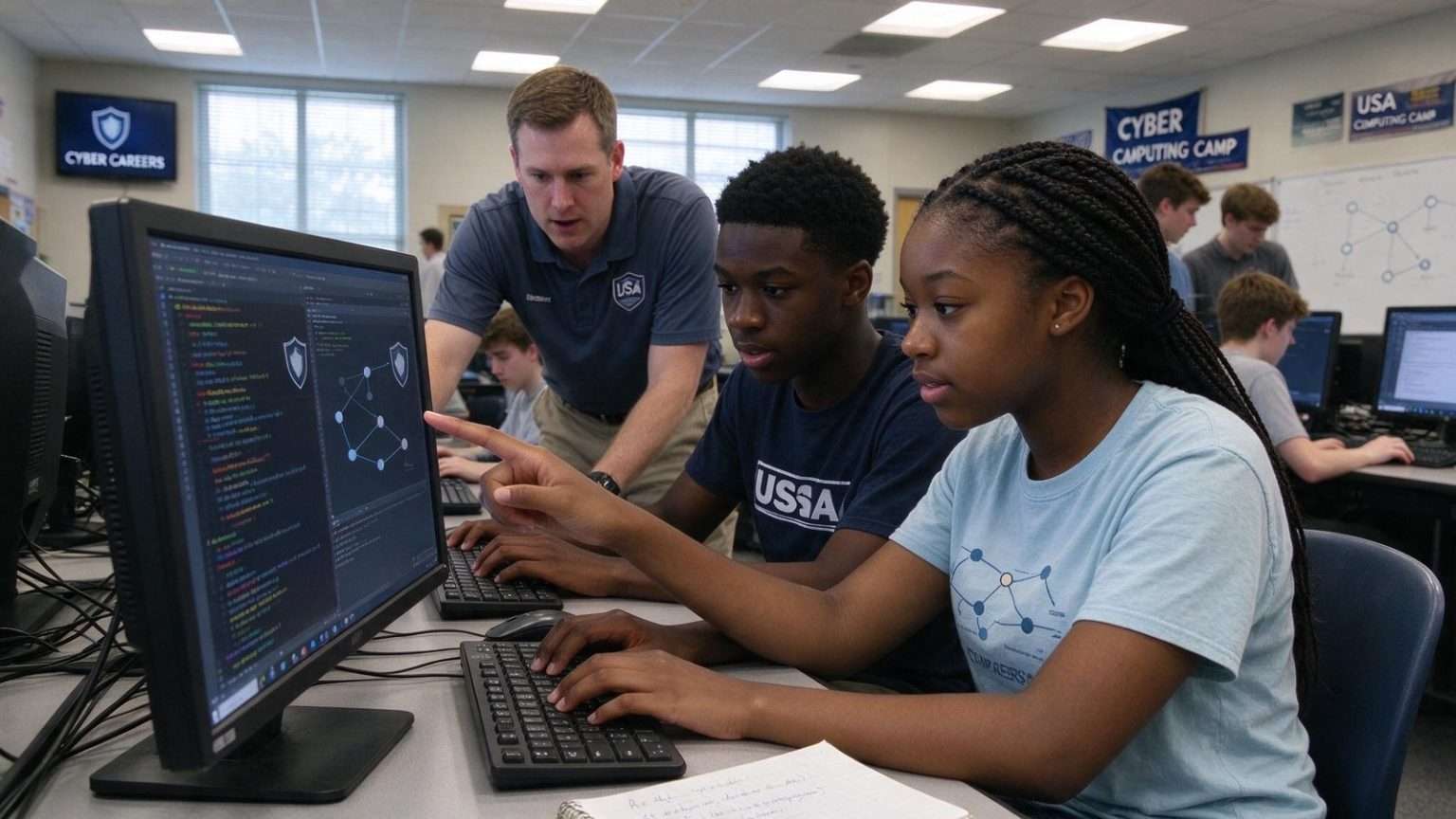
While much of their summer vacation slips by outside, a group of incoming freshmen at W.P. Davidson High School is spending part of it indoors, hunched over keyboards and learning what a career in computing could actually look like. The University of South Alabama is once again hosting its annual computing camp for students who have just finished middle school and will walk into Davidson as ninth graders this fall. The camp, which has been based at Davidson since it began in 2015, kicked off its week-long run on Tuesday, giving the teenagers a low-stakes chance to test whether the field suits them before they ever set foot in a high school computer class.
The premise behind the camp is simple: reach students early, before they have locked in their course selections or written off technology as something meant for other people. By the time most students encounter serious computing instruction, they have already decided whether they see themselves in the field. Camp organizers at South Alabama want to intervene before that door closes, especially for students who have talent but no exposure to what modern computing work involves. A week of hands-on activities, team exercises, and guided problem solving gives them a realistic sample of the work without the pressure of grades.
Davidson High School, located in west Mobile, has built a reputation over the years as a school with strong career and technical offerings, and the partnership with the university has become a fixture of that identity. Because campers come from the student body that feeds Davidson, the material they pick up in July carries directly into coursework, clubs, and activities during the school year.
For the university, the camp is also a recruiting pipeline in the broadest sense. The School of Computing at South Alabama has worked for years to broaden the pool of local students who arrive on campus interested in technology majors, and middle school is where that effort has to start. Students who discover at thirteen or fourteen that they enjoy writing code or analyzing a network are far more likely to take the right high school courses, then pursue a degree, then take a job in the region. The camp is one of the most visible pieces of that long game.
Cybersecurity Demand Drives the Curriculum
Organizers point to cybersecurity as one of the region’s most in-demand fields, with far more job openings than qualified applicants to fill them. That imbalance is not unique to the Gulf Coast — it reflects a national shortage that has persisted for years — but it is especially relevant in a metro area whose economy has been diversifying toward aerospace, shipbuilding support, healthcare, and data-intensive industries, all of which need people who can secure networks and respond to intrusions. Employers ranging from defense contractors to hospitals to municipal governments compete for the same small pool of trained professionals, and salaries reflect the competition.
The camp’s lessons cover programming languages and core computer skills, but the standout element — the one returning students talk about most — is an unusual approach to ethics. Rather than presenting security as a list of rules, instructors teach students to think like malicious hackers so they can understand how attacks actually work. The logic is straightforward: a defender who has never seen an attack unfold from the attacker’s side tends to build defenses that look good on paper and fail in practice. Students who have written a simple exploit themselves, or watched one walk through a deliberately vulnerable machine, grasp why patching, password hygiene, and network segmentation matter in a way no lecture can produce.
“How they do things, how they program, in order to kind of teach them how to build defensive software and networks to defend against those kinds of attacks,” said Dr. Todd McDonald, director of USA’s Center for Forensic Information Technology and Security. “It’s kind of like, with great power comes great responsibility.”
McDonald’s center sits at the intersection of computing and forensics, and that framing shapes how the material is taught. The point is not to produce fourteen-year-old intruders; it is to build the mental model that real security professionals use. Ethical hackers, penetration testers, and incident responders all begin by understanding offensive techniques, then channel that knowledge into defense. Introducing that dual perspective to students before high school is unusual, and it is part of what distinguishes the South Alabama camp from a typical summer technology session built around games or basic web design.
The “great power, great responsibility” framing also lands differently with teenagers than a dry discussion of computer crime laws might. Students in the age group are already surrounded by technology they use without understanding, and the camp gives them a first structured look underneath the surface. Instructors report that the moment a student realizes the same skill can be used to protect people or to harm them is often the moment the subject stops being abstract. Ethics is not a bolt-on unit in the camp; it is woven through the exercises.
Why Early Exposure Matters in a Growing Field
The timing of the camp is deliberate. Students entering ninth grade are about to make course choices that shape their high school trajectories, and those choices cascade into college admissions and career options. A student who discovers an aptitude for computing at camp can enroll in the right classes at Davidson, join related student organizations, and arrive at graduation with years of accumulated experience. A student who never gets that early exposure may not encounter the field until college, if then — and by that point many of the peers who started earlier have a substantial head start.
The regional job market gives that early start real value. Cybersecurity roles consistently rank among the hardest positions for Gulf Coast employers to fill, and the shortage extends across the skill spectrum, from entry-level analyst positions to senior engineering roles. Organizations in Mobile and Baldwin counties — utilities, ports and logistics operators, healthcare systems, schools, and government agencies — all carry security obligations that require trained staff. When local employers cannot hire locally, positions either go unfilled or go to candidates recruited from outside the region. Programs like the camp are an attempt to grow the local pipeline from the ground up.
Hands-on work is the backbone of the week. Rather than sitting through lectures, campers cycle through exercises that mirror real computing tasks: writing small programs, taking machines apart at the logical level, examining how data moves across a network, and working through scenarios in which something has gone wrong and must be diagnosed. Team-based challenges add a competitive element that keeps the energy up through long summer afternoons, and instructors from the university circulate constantly, answering questions and nudging groups that stall. The format borrows as much from summer STEM camps as from university teaching, but the material underneath is genuine computer science and security fundamentals.
That structure also serves a second purpose: sorting. Not every camper will fall in love with the field, and that is fine — a week of honest exposure is better than four years of assumptions. Some students discover that they enjoy the problem-solving but not the persistence debugging requires. Others find exactly the opposite. Either outcome is useful, because both are arrived at with real information rather than television portrayals of what technology work looks like. Counselors and instructors can then point interested students toward the specific courses and activities at Davidson that match what they learned about themselves during the week.
Sponsorship Keeps the Davidson Camp Free
The Davidson camp is free to participants through sponsorship by AMS Calvert, the industrial gases and chemical facility in the Mobile area whose support removes the cost barrier that often keeps summer programs out of reach for many families. Sponsorship matters more than it might appear. A week-long technology camp with paid registration can run into hundreds of dollars in other markets, and even modest fees are enough to screen out students whose families cannot easily absorb them. By covering the cost, the sponsor ensures that the camp reaches students based on interest rather than household budget — which is precisely the goal for a program trying to widen the talent pipeline.
Corporate sponsors have their own reasons for investing. Advanced manufacturing and chemical operations increasingly depend on industrial control systems that require security protection, and companies in those sectors understand better than most that the future workforce has to come from the communities around their facilities. Supporting a computing camp for rising ninth graders is a long-horizon investment: today’s camper is, ideally, tomorrow’s local graduate and applicant. It is also a visible signal to the students that regional employers see them as part of the area’s economic future rather than a labor force to be imported later.
South Alabama also runs other computing camps for teens across the summer, though those carry a registration cost. The wider slate of offerings reflects sustained demand from parents looking for productive summer options and from the university’s own effort to build regional interest in computing careers. Together, the camps give Mobile-area families a range of entry points into the field — some free, some paid, some aimed at beginners and others at students already writing code on their own. The Davidson camp remains the anchor of the series, both because of its longevity since 2015 and because of its deliberate focus on the students about to enter one high school with one coherent pipeline behind it.
What happens after the camp ends matters as much as the week itself. Students who leave interested have concrete next steps available: the right courses at Davidson, technology-oriented clubs and competitions during the school year, and a university partner a short distance away that offers degree programs feeding directly into the region’s employers. The camp’s organizers have long emphasized that the goal is not to fill a single week but to change a trajectory — to make computing feel like an ordinary, achievable path for Mobile students rather than something that happens elsewhere. Each year’s cohort feeds that goal, and the program’s persistence since 2015 suggests the model works well enough to keep running.
For the students themselves, the week often produces something less measurable but just as important: confidence. Many incoming freshmen arrive at camp having never written a line of code, and discovering that they can build something that works — even something small — changes how they see themselves relative to the subject. That confidence carries into the classroom in the fall, where students who believe they belong in a computer class are far more likely to enroll in the next one. In a field where the workforce shortage starts with young people never considering the career at all, that first spark of belonging may be the most valuable output of the entire week.
A Model Other Schools Are Watching
The partnership structure behind the camp — a university supplying the expertise, a high school supplying the location and the students, and a corporate sponsor supplying the funding — has drawn attention from educators elsewhere in the region who would like to see similar arrangements in their own communities. Replicating it requires all three pieces to align, which is precisely why it remains relatively rare. Davidson’s long relationship with the university and the sponsor’s local presence made this version possible, and the program’s track record since 2015 gives it credibility when new partners consider starting something similar. For now, the camp continues its summer rhythm: one week, one cohort of rising freshmen, and an early answer to the question of whether a career in computing might be waiting for them.
By the time the week wraps up, the students will have written their first programs, pulled apart their first network problems, and looked at security from both sides of the equation — the attacker’s and the defender’s. Some will walk away certain they have found their field. Others will simply file the experience away and return to their summer. Either way, the camp will run again next summer, reaching the next group of students at the decision point between middle school and high school.