Deadly Crash at Eight Mile Intersection Renews Calls to Fix ‘Very Dangerous’ Crossing
After two Baker High teens died at University Blvd and U.S. 45 in Eight Mile, residents demand lights and a traffic signal at the dangerous crossing.
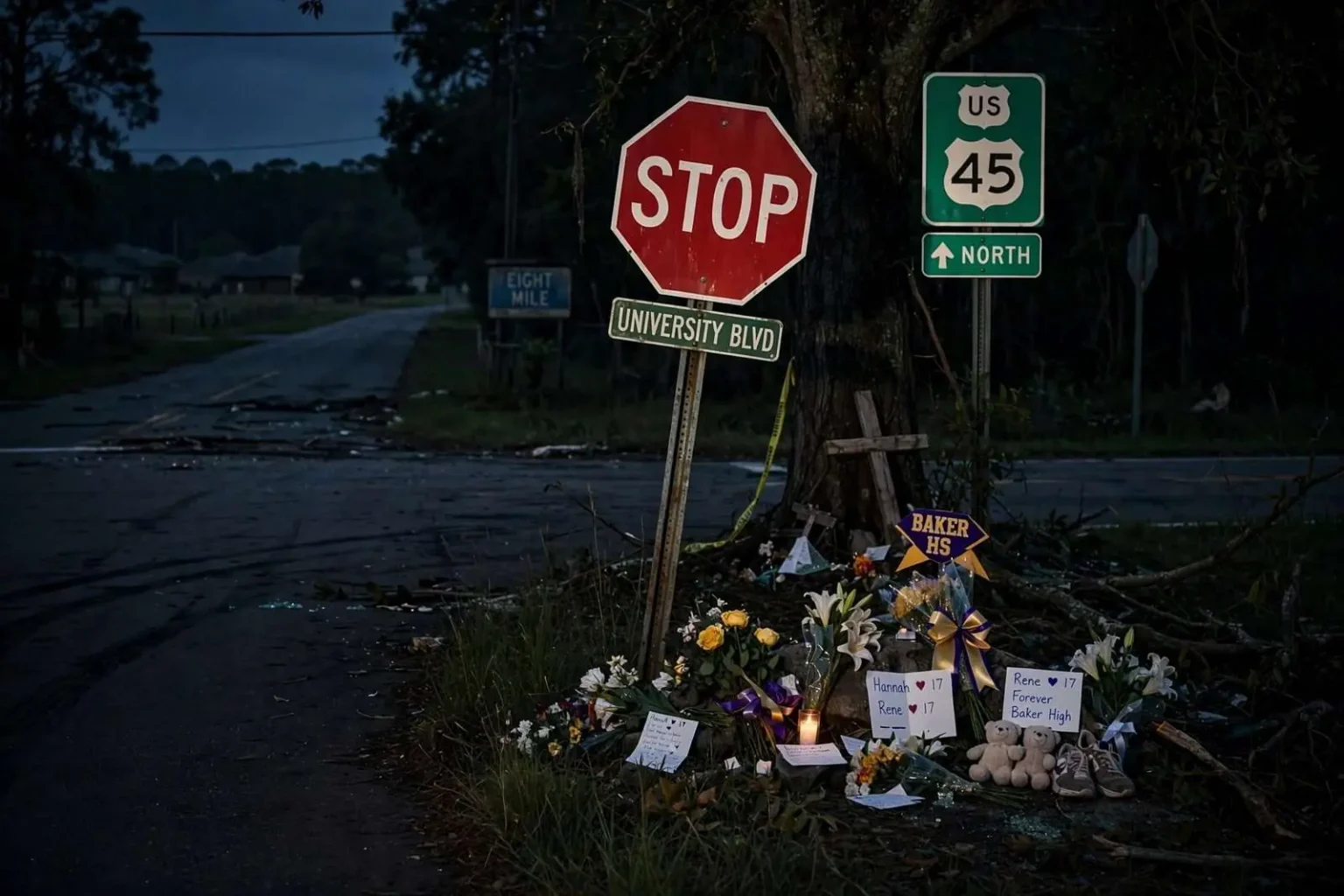
The deaths of two teenage girls at a poorly lit Eight Mile intersection have neighbors demanding safety improvements they say are years overdue. The crash along University Boulevard has turned a corridor that residents have long complained about into the focus of a community push for streetlights, signals and study — and it has put a name and a face on dangers locals say they have documented for years.
Prichard police said 17-year-olds Hannah Wright and Rene Nguyen, both students at Baker High School, were driving on University Boulevard on the evening of March 12 when their car failed to stop at a stop sign and struck a tree head-on near the intersection with U.S. 45. Both died in the crash, which occurred along a stretch of road that neighbors describe as difficult to navigate even in daylight and treacherous after dark.
The cause of the March 12 crash remained under investigation with toxicology results pending. Investigators have not said what factors contributed to the failure to stop, and authorities had not announced any determination as of the most recent reports on the case. Wright was laid to rest the following Sunday, as her school community and her neighborhood continued to grieve.
Neighbors: the crossing has grown more dangerous
Residents who live near the junction say it has become increasingly hazardous as development has spread through the area. Tamara Shack, an Eight Mile resident, said oncoming traffic is nearly impossible to see until it is too late, and that traffic has surged since Blount High School and new subdivisions were built nearby — with University Boulevard feeding into two major highways.
She and other neighbors describe drivers speeding through the area and a stop sign that is difficult to see at night because the stretch has no streetlights. The combination — fast through-traffic, new subdivision entrances, school traffic and unlit approaches — is the profile, residents argue, of an intersection engineered for a quieter era and left behind as the community around it grew.
Shack would like lighting along the road and a signal at the crossing. Her requests mirror what traffic engineers call the standard treatments for intersections with visibility problems: illumination that makes signs and pedestrians visible at night, and signalization where volumes on crossing streets reach thresholds that a stop sign can no longer safely manage.
The corridor and the schools that feed it
University Boulevard threads through Eight Mile, connecting residential neighborhoods to U.S. 45, the historic artery that runs north from Prichard through the community toward Mount Vernon. The road’s profile changed as Blount High School drew student drivers and parents onto the corridor daily, and as new subdivisions added turning movements that the intersection was never designed to handle.
Teenage drivers add another layer to the corridor’s risks. Baker High School students travel routes like this one daily, and safety advocates note that inexperienced drivers are disproportionately involved in nighttime crashes — particularly on unlit roads where a stop sign offers the only instruction at a crossing with fast-approaching traffic.
Numerous crashes have been reported at University Boulevard and U.S. 45 over the years, according to residents who have kept informal count of the incidents they hear about from their porches. Those accounts — fender benders, intersection collisions and near misses — have circulated in the community long before the March 12 crash gave them a wider audience.
Official response has lagged
Prichard police did not respond to requests for crash statistics for the corridor, leaving residents without an official count of incidents at the crossing. The absence of data complicates the push for upgrades: traffic engineers typically justify signals and other improvements with documented crash histories and volume counts, and families pressing for change say the records should be part of the case, not missing from it.
As of the reporting, no plans for safety upgrades had been announced for the intersection. That silence has frustrated neighbors who say they have raised the crossing with officials before — after earlier crashes, near misses and complaints about speeding — only to watch the issue recede until the next emergency.
Residents say the fix they describe is not exotic. Streetlights along the unlit stretch, a signal or enhanced signage at the crossing, and speed enforcement through the corridor are measures used on hundreds of roads across Alabama, and Shack argues that the only question is whether they arrive before or after the next crash.
Eight Mile and the roads that shaped it
Eight Mile takes its name from the historic distance marker that measured the community’s position north of downtown Mobile, and it grew along U.S. 45 as one of the string of communities connecting Mobile to Prichard and the rural stretches beyond. Like many unincorporated and small-city communities in Mobile County, it experienced waves of residential growth that brought subdivisions, schools and traffic to roads laid out for a much smaller population.
The community’s roads tell the story of that growth. University Boulevard was built to serve neighborhoods and, later, school campuses, feeding drivers toward the U.S. 45 corridor that remains the area’s commercial and commuter spine. As Blount High School opened nearby and new subdivisions filled in the surrounding acreage, the volume of daily trips on the corridor climbed — along with the turning movements at its intersections.
Residents describe a familiar Gulf Coast pattern: growth arrives, roads stay the same, and the intersection absorbs the difference until a crash forces the issue. Traffic engineers recognize the phenomenon as well — intersections that performed acceptably at low volumes can develop crash patterns as development changes the mix of through-traffic, turning vehicles and pedestrians.
What safety upgrades typically require
The improvements neighbors want follow a well-worn path in transportation practice. Streetlight installation along a dark corridor requires a funding source and often a partnership between a municipality and the utility; a signal at a stop-controlled intersection usually demands an engineering study documenting traffic volumes, sight distances and crash history before installation is approved.
Those requirements are why data matters so much to the families pressing for change. A documented crash history at University Boulevard and U.S. 45 would strengthen the engineering case for a signal, which is why the absence of police statistics for the corridor — after requests that went unanswered — has become part of the residents’ grievance.
Speed management is the third element of the neighbors’ requests. Enforcement along the corridor, speed-feedback signs and traffic calming measures are the customary tools used to slow through-traffic on residential connectors, and residents argue that the corridor’s mix of student drivers and fast commuters makes those measures as important as any signal.
Grief and advocacy in the wake of the crash
The March 12 crash has mobilized the community in ways earlier incidents did not. Neighbors who had complained individually are now speaking with one voice, and the deaths of two high school students — friends and classmates to hundreds of local families — gave long-running frustrations a urgency that meetings and petitions had lacked.
Baker High School’s community absorbed the loss of two students in a single night, and the grief that followed Wright’s funeral the Sunday after the crash has shaded every conversation about the intersection since. Residents say the push for improvements is framed, deliberately, as something that might spare another family the same phone call.
Advocates for road safety point out that crashes like this one rarely have a single cause, and that infrastructure is one of the few factors a community can change proactively. Lighting a dark road, signaling a dangerous crossing and slowing through-traffic do not prevent every tragedy, but they change the odds on the exact conditions — night, poor visibility, fast traffic, a stop sign that blends into the dark — that residents describe on University Boulevard.
The investigation into the crash continues, and its conclusions may address speed, impairment or other factors. What the community is asking for lies outside that file: lights, a signal and attention for an intersection they say has been dangerous for years — and which, since March 12, no longer needs an argument to make the case.
Who fixes a road like this
Responsibility for corridor improvements in a case like Eight Mile’s typically falls across more than one agency. Municipalities handle city streets and often fund lighting; county and state authorities control the major highways that intersect them, and U.S. 45’s status as a federal route means any signal or geometric change at its junctions passes through state review. Residents pressing for upgrades usually find themselves navigating exactly that divided map of jurisdiction.
The history of similar efforts in Mobile County shows both the difficulty and the possibility. Intersections across the region have received signals, lighting and redesigns after sustained community advocacy backed by crash data, and the families and neighbors leading this push say they intend to supply the documentation that engineering studies require — even if they have to compile it themselves.
The corridor’s school traffic gives the argument additional weight. Routes that carry student drivers and school buses are routinely prioritized in safety programs, and the presence of Blount High School and the Baker High School students who travel these roads daily is central to the case residents are making for the crossing.
What neighbors want remembered
For the families who live along University Boulevard, the days since the crash have been spent in a rhythm of funerals, memorials and conversations about the road. Hannah Wright was laid to rest the Sunday after the crash, and the community’s attention has turned to ensuring her name and Rene Nguyen’s are attached to change rather than to another anniversary of the same conditions.
Shack’s requests — lighting along the road and a signal at the crossing — are modest by the standards of infrastructure spending, and she says neighbors are prepared to keep asking until the answers change. The toxicology results and the investigative findings will eventually complete the official record of March 12, but the residents’ record already exists: years of complaints, a surge of traffic that came with growth, and an unlit intersection where oncoming headlights arrive too late to matter.
The stretch of University Boulevard near U.S. 45 remains, for now, as it was on the night of the crash — dark, fast and signed only by a stop sign that neighbors say disappears into the night. The community’s demand is that it not stay that way, and the deaths of two seventeen-year-olds have made that demand impossible to dismiss as background noise.