Defense Secretary Esper Visits NAS Pensacola to Outline New Vetting Procedures
Defense Secretary Mark Esper visited NAS Pensacola to outline vetting procedures for foreign nationals training on U.S. bases after the Dec. 6 attack.
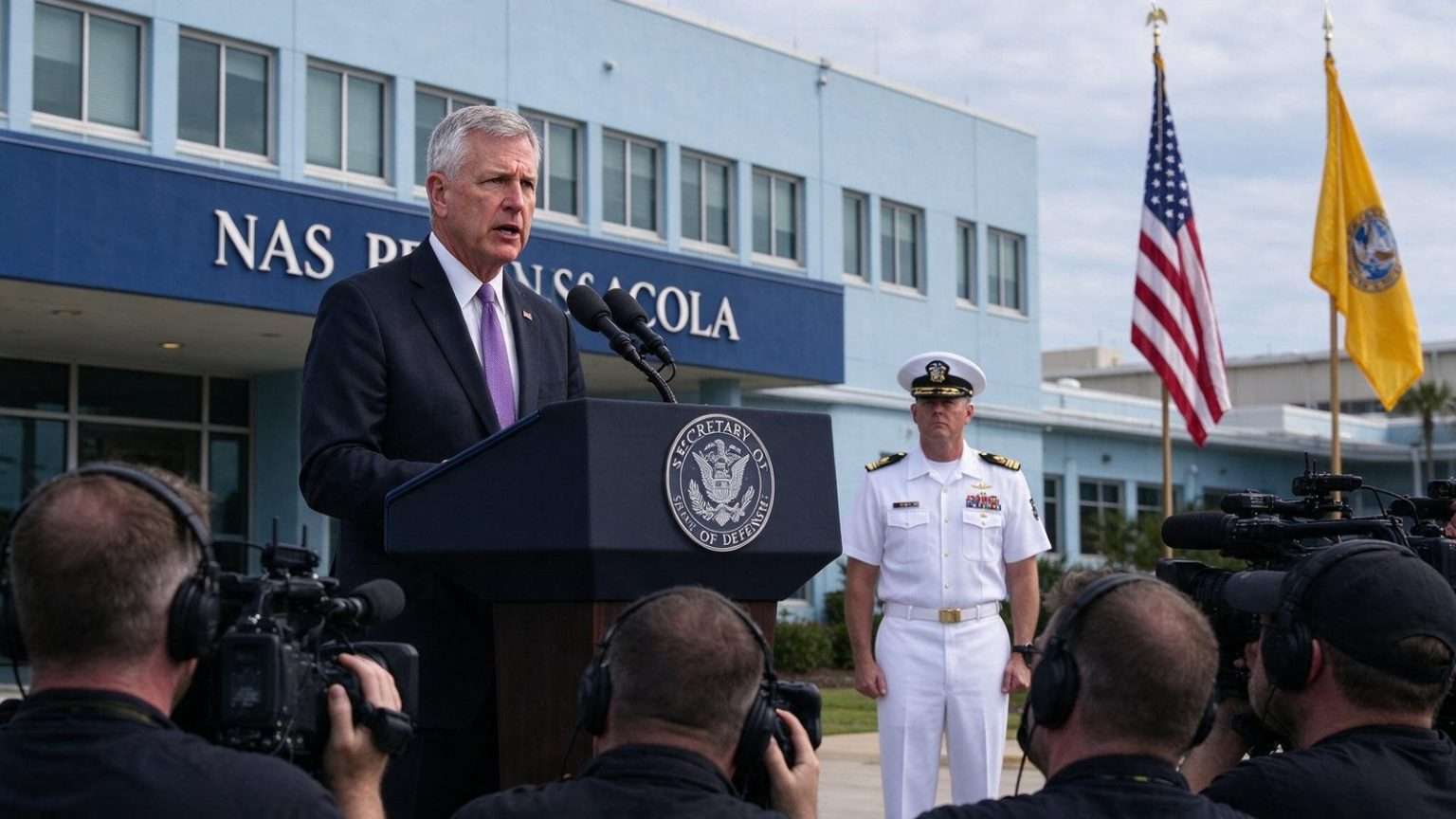
U.S. Secretary of Defense Mark Esper visited Naval Air Station Pensacola on Wednesday for the first time since the Dec. 6 terrorist attack there, using a brief on-base news conference to outline how the Pentagon is responding — and, just as notably, to leave a number of questions unanswered. Esper spoke with reporters for about six minutes and fielded few questions, leaving many issues unresolved even as he described the direction of the military’s new security posture.
The visit carried heavy symbolism. NAS Pensacola, the Navy’s premier aviation training base and the home of the Blue Angels, had been shaken weeks earlier when a shooting on the installation killed members of the naval aviation community and wounded others, an attack carried out by a foreign military trainee assigned to the base. The Pentagon’s response — revisions to how foreign nationals are vetted before training on American installations — has been watched closely in Pensacola, where thousands of international students have trained alongside American aviators for decades.
One of the most immediate questions for the community concerns physical security, and Esper’s answer left local discretion in charge. Physical screening at the entrances to U.S. military bases, he said, will be left to the discretion of each installation. That is a matter of direct consequence at NAS Pensacola, where parts of the base — including the National Naval Aviation Museum and the Pensacola Lighthouse — are open to the public, and where any tightening of entry screening affects tourists, retirees, and residents who cross the gates daily.
Changes for foreign trainees
The core of Esper’s message concerned the foreign trainee programs that brought the attacker to the base in the first place. He said he shared with base commanders revisions to vetting procedures for foreign nationals training on U.S. military bases, along with a weapons policy change and updated credentials for foreign students. He did not provide specifics on any of the three.
The vetting overhaul, however, he described in broader terms. “The vetting changes will be far more comprehensive,” Esper said. “It’ll look at every aspect of their background. It’ll look at social media and it will also involve continuous monitoring once they’re here in the United States.”
The three elements of that description mark a significant expansion of scrutiny. Background reviews that examine “every aspect” of a trainee’s history reach beyond the standard security checks that international military students have traditionally undergone. Screening social media adds a layer that existing vetting generally had not included. And continuous monitoring — surveillance that does not end once a student arrives and in-processes — extends the government’s attention across the full length of a training pipeline that can run a year or longer.
What the weapons change means
The weapons policy change Esper referenced addresses one of the most scrutinized aspects of the December attack: the shooter’s access to a firearm on base. Under the policies in place at the time, foreign trainees on U.S. installations were subject to rules that differed from those governing American personnel, and the specifics of what changed — which weapons, whose authorization, what storage requirements — were not detailed during the six-minute appearance.
Similarly, the updated credentials for foreign students point to how the base identifies and tracks its international trainees day to day. Credentialing touches everything from gate access to range privileges to entry into restricted training areas, and revising it suggests a re-examination of what a foreign student’s identification permits — and how quickly any change in status can be reflected in the passes they carry.
Base commanders, Esper said, were briefed on the changes directly. That emphasis on local implementation matters in Pensacola, where the training command processes successive classes of American and international students and where the practical details — how vetting results are communicated, what triggers removal from a program, how installation access adapts — will determine whether the policy revisions change daily life on the base.
The open gates question
No element of the post-attack review touches Pensacola residents more directly than entrance screening, because NAS Pensacola is unusual among major installations: much of it welcomes the public. The National Naval Aviation Museum, one of the Gulf Coast’s leading tourist attractions, sits inside the gates, as does the Pensacola Lighthouse, and visitors pass through base entry points by the busload on ordinary weekdays. School groups, retirees attending ceremonies, and families visiting the base beach all fold into the same entry lanes as the thousands of personnel who work and train there.
Esper’s answer — that physical screening at base entrances will be left to the discretion of each installation — means the decision about how far that screening goes rests with the commanders at NAS Pensacola rather than with a uniform Pentagon mandate. Local discretion cuts both ways. It allows commanders to calibrate security to the realities of a base that hosts tourists by the hundreds of thousands a year, but it also leaves open the possibility of longer lines, ID checks, and visitor restrictions that would reshape how the public experiences the base.
For the surrounding community, the museum and lighthouse are not amenities but institutions — anchors of the tourism economy in Pensacola and the living face of the Navy’s century-long history in the city. Any sustained change to public access would register far beyond the fence line, in hotels, restaurants, and the habits of locals who consider the base part of the town’s identity. That is the context in which installation-level discretion will be exercised, and the questions Esper did not take up on Wednesday remain the ones residents are asking.
Six minutes and many silences
The brevity of Esper’s appearance drew its own attention. Six minutes of remarks and few questions taken left substantial ground unaddressed: the specifics of the vetting revisions, the content of the weapons policy change, the future of the international student program’s size and composition, the timeline for implementation, and the broader review of how the attack itself unfolded — how the shooter passed successive layers of screening before the December morning he opened fire in a classroom building.
Those unanswered questions extend beyond Pensacola. The international military student program brings trainees from allied nations to bases across the country, and decisions made after the NAS Pensacola attack affect the entire enterprise — how many students come, from which countries, under what vetting, and with what privileges once in training. Defense officials have balanced the program’s diplomatic and interoperability value against security concerns raised by the attack, and the six-minute news conference offered direction rather than detail on where that balance lands.
What the secretary did offer was a clear statement of philosophy. Comprehensive background vetting, social media screening, and continuous monitoring compose a posture that treats foreign trainee security as a constant process rather than a one-time gate — an acknowledgment, implicitly, that the screening that admitted the December shooter was insufficient, and that the response must follow students through their entire time in the United States.
The base and the city move forward
NAS Pensacola’s role in American military history gives the review particular weight. The base is the cradle of naval aviation, the training ground for the Navy, Marine Corps, and Coast Guard flight officers who pass through its classrooms and airframes every year, and the home of the Blue Angels. Its international student program has trained aviators from allied nations for generations, building the relationships that joint operations later depend on.
The December attack pierced that routine, and the months since have been devoted to the question Esper’s visit addressed: how to preserve the mission while closing the vulnerabilities the attack exposed. The revisions briefed to base commanders — vetting, weapons policy, credentials — are the Pentagon’s first public framework for that balance. The details left unstated on Wednesday will emerge in implementation, gate by gate and classroom by classroom.
For Pensacola, the secretary’s first visit since Dec. 6 served as both an acknowledgment of the community’s loss and a progress report on the response. The comprehensive vetting he promised, the discretion he left to installation commanders, and the specifics he withheld together sketch the path ahead: a base still open to the students and visitors who define it, watched more closely than ever, under policies whose real shape will be decided not at the Pentagon podium but at the gates of NAS Pensacola itself.
What continuous monitoring looks like in practice
The most consequential phrase in Esper’s remarks was also the least familiar: continuous monitoring of foreign students once they are in the United States. In practice, the concept points to a standing obligation rather than a checkpoint — records that remain open after arrival, behavior and status reviewed on an ongoing basis, and information sharing among the services, base commands, and federal agencies responsible for tracking international trainees. The goal is to detect the kind of deterioration that one-time vetting cannot, since a student cleared before enrollment may present a very different profile a year later.
The social media component raises the same logic one layer earlier. Screening online activity before a trainee ever boards a plane extends vetting into a space where radicalization, in the cases that have driven this policy debate, left traces that traditional background checks missed.
For the thousands of international students who train honorably at American installations every year, the changes carry practical implications: deeper pre-arrival scrutiny, closer attention during training, and credentials that reflect their monitored status. The Pentagon’s challenge is to tighten the system without starving it, a balance Esper’s remarks promised rather than explained.
Installation discretion and the lessons of access
The decision to leave entrance screening to each installation’s discretion reflects a long-running tension in military security policy. Central mandates are consistent but blunt; local discretion is adaptive but uneven. Bases like NAS Pensacola — with public museums, historic sites, residential areas, and gated training zones sharing the same footprint — face questions that a closed installation never confronts: how to screen a tourist family differently from a credentialed dependent, or a ceremony attendee from a contractor’s delivery driver.
Commanders at Pensacola now hold the authority to answer those questions as they see fit. The options available to installations range from enhanced ID checks and visitor registration to changes in which gates handle public traffic and at what hours. None were announced Wednesday, and none may be announced at all — discretion, by definition, allows commanders to adjust as conditions warrant rather than by public decree.
The December attack necessarily colors every one of those calculations. The shooter passed through the normal routines of an international trainee — enrollment, credentials, base life — before turning a weapon on fellow students and instructors. The security review that followed examined each layer of that routine, and the entrance screening question is the most visible remainder of it, the piece that meets every visitor at the gate.
The unanswered questions that remain
Esper’s six minutes left the region with a direction and a wait. The vetting changes will be comprehensive; the weapons policy has changed; foreign student credentials are being updated. When each takes full effect, what the new credentials look like, which elements of a background review can disqualify a trainee, how social media screening is performed, and what continuous monitoring means for privacy and due process — none of that was offered for public examination.
Also unaddressed was the question hovering over the visit itself: the long-term future of the Saudi and broader international training presence at NAS Pensacola, which paused and reshuffled in the aftermath of the attack. The base’s training mission, the fleet readiness it supports, and the local economy built around it all depend on decisions that remain in progress.
What Pensacola received on Wednesday was an outline from the top of the department: more comprehensive vetting, deeper screening, continuous attention, and local control over the gates. The community that lived through Dec. 6 — the families of the fallen, the sailors who survived it, the residents who watched their base close its gates to gawkers and mourn its dead — will measure that outline against the one certainty Esper offered: that the changes, when they arrive in full, are intended to ensure nothing like it happens again.