
Demolition Begins on Historic Old Providence Hospital Building in Mobile
Demolition has begun on the old Providence Hospital building on Springhill Avenue in Mobile, saving USA Health millions in upkeep.
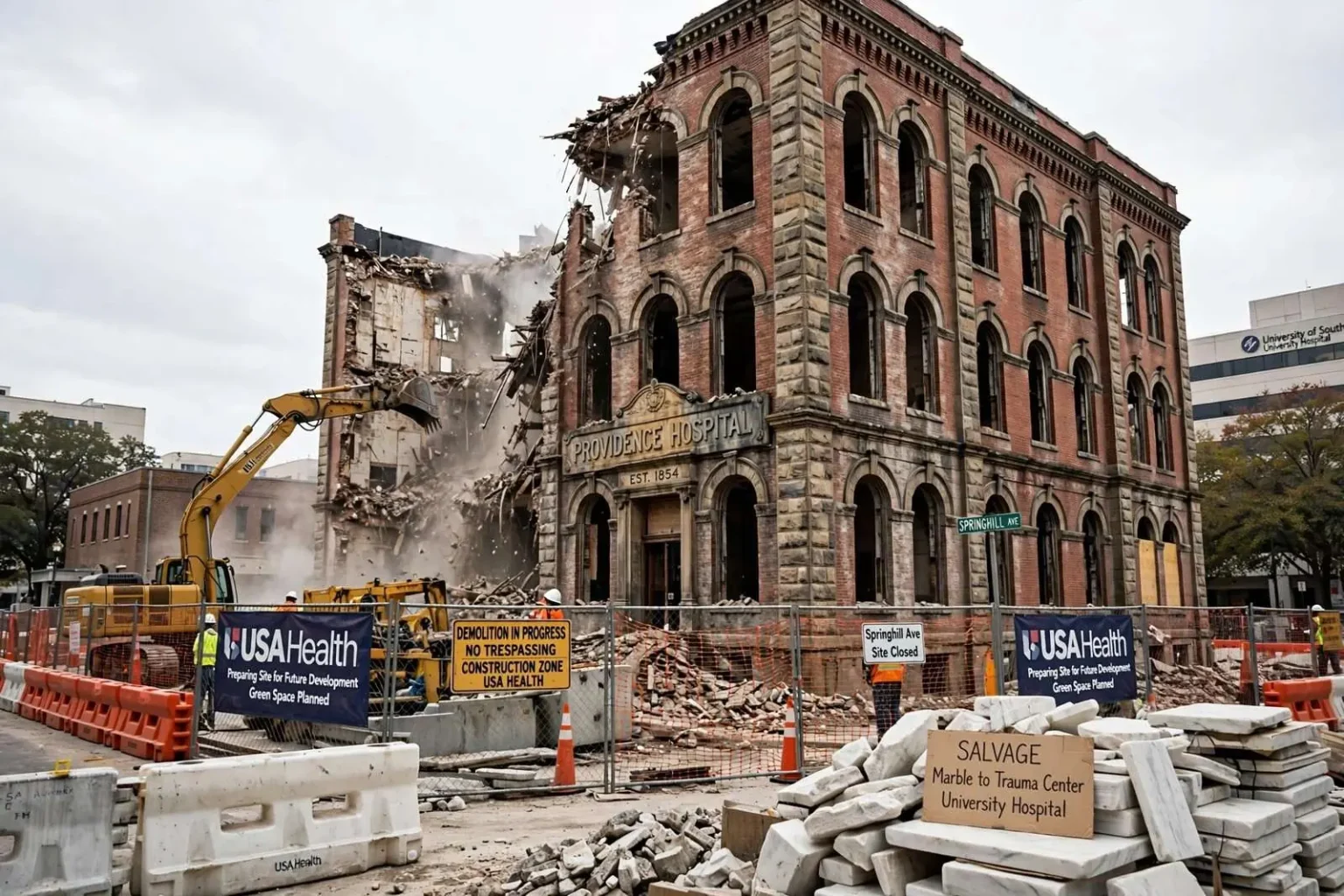
A familiar landmark on Springhill Avenue is coming down. Demolition is underway on the old Providence Hospital building in Mobile, a structure the University of South Alabama has owned since the 1980s, and the work marks the end of a building that served Mobile patients and their families for generations before its final years as mostly vacant office space.
Over the years the building housed family clinics, office space, and most notably a VA clinic that brought thousands of veterans through its doors for appointments and care. After the VA relocated to newer facilities, the building sat largely empty, and USA Health officials decided to bring it down rather than continue carrying the cost of maintaining a vacant structure.
The decision reflects the arithmetic that every health system faces with aging buildings: an empty hospital building is not free. Heating, cooling, security, insurance and maintenance costs continue on a vacant structure, and a building constructed for hospital use is expensive to maintain even when no patients walk its halls.
Site Left Ready for Development
What will eventually replace the building remains undecided. “We currently are the fastest growing health system in the state of Alabama,” said Sam Dean, hospital administrator at University Hospital. “There’s a lot of options, a lot of things we’re thinking about. Nothing I can speak to yet.”
In the short term, crews will leave the foundation underground and cap the site with green space once demolition is complete — a choice that turns a vacant building into usable open land while the health system weighs its options. “We’ll leave the site ready for development,” Dean said. The approach gives USA Health flexibility: the site can hold a new medical facility, parking, or whatever use the health system’s growth demands, without the delay and expense of tearing out old construction first.
The Springhill Avenue corridor has long been part of Mobile’s medical landscape, and the old Providence building stood within reach of the University of South Alabama’s growing complex of hospitals, clinics and academic facilities. Keeping the parcel in active inventory — cleared and ready — positions it for whatever the health system’s expansion requires.
Savings and Salvage
Tearing down the vacant building is expected to save USA Health between $1 million and $2 million a year in upkeep costs while positioning the health system to move quickly when a future use is chosen. Those annual savings compound: over a decade, the demolition pays for itself several times over, and the money that went toward maintaining empty rooms becomes available for patient care and the health system’s expansion.
Some of the property’s history will live on. Workers are salvaging marble from the building that will be incorporated into the new trauma center at University Hospital, carrying material from the old Providence halls into the facility where the region’s most serious emergencies are treated. The salvage work preserves a physical link between the generations of care delivered on Springhill Avenue and the health system that has grown up around them.
Full demolition of the old Providence Hospital was expected to take about six months, with exterior work beginning in November. Neighbors along Springhill Avenue will watch the skyline change gradually as crews dismantle the structure section by section, and the site that has been part of the corridor’s identity for decades will become green space awaiting its next purpose.
A Building’s Long History of Care
Providence Hospital’s place in Mobile’s history runs deep. The institution was founded in the 19th century by religious sisters who built Mobile’s early healthcare infrastructure, and the Springhill Avenue building carried that legacy through decades in which it delivered babies, treated the sick and trained the nurses and physicians who spread across the Gulf Coast. For many Mobile families, the building’s halls hold personal history — the ward where a grandparent recovered, the maternity wing where a parent was born, the emergency room that served the neighborhood for years.
The University of South Alabama’s acquisition of the building in the 1980s folded it into what would become USA Health, the academic health system that now includes University Hospital, Children’s and Women’s Hospital, and a growing network of specialty clinics. In its later years, the old Providence building shifted from inpatient care to outpatient functions: family clinics, administrative offices and, most significantly, the VA clinic that served the region’s veterans.
The VA clinic’s presence made the building a regular destination for thousands of veterans across southwest Alabama, who came for primary care, mental health services and specialty appointments. When the VA moved to newer, purpose-built facilities, the building lost its anchor tenant, and the remaining office use could not justify the maintenance costs of a structure built to hospital standards — systems sized for surgical suites and patient wards do not scale down cheaply.
What the Demolition Means for Springhill Avenue
For the Springhill Avenue corridor, the demolition changes a landmark but not the neighborhood’s direction. The avenue remains tied to Mobile’s medical economy, and USA Health’s continued growth along and around the corridor ensures the property stays in productive institutional use. The six-month demolition timeline means construction traffic, dust and noise for neighbors in the near term, followed by the quieter sight of green space where a building stood.
The green-space interim also serves the neighborhood practically. Cleared, capped land eliminates the security concerns that follow vacant buildings — break-ins, fires, vandalism — and improves the appearance of a block that has watched the structure empty out. Cities across the country have used the same approach with surplus institutional property: demolish, cap, green, and wait for the right plan rather than rushing a bad one.
The Health System’s Growth Trajectory
Dean’s description of USA Health as the fastest growing health system in the state of Alabama frames the demolition as a growth decision rather than a retreat. The system has been expanding clinical services, recruiting physicians, and adding facilities to serve a region where patients have historically traveled to New Orleans, Pensacola or Birmingham for specialized care. Every facility decision, including what happens to a cleared site on Springhill Avenue, is weighed against that expansion.
The marble salvaged from the old Providence building will find its home in the new trauma center at University Hospital — a facility whose construction is itself part of the growth story. Trauma centers anchor regional emergency networks, receiving the most severe cases from across southwest Alabama and the panhandle, and the new center represents the kind of high-acuity investment that vacant-building demolition helps fund. That the old building’s materials will stand inside it is a detail that bridges Mobile’s medical past and its present.
For now, the work on Springhill Avenue proceeds through the months of the demolition schedule, with exterior work beginning in November and completion expected about six months out. When the crews finish, Mobile will have traded a vacant landmark for a cleared, development-ready site — and a piece of the old Providence Hospital, salvaged in marble, will be embedded in the trauma center where the health system’s future is being built.
The economics of the demolition are worth spelling out, because they explain why health systems across the country make the same choice. A vacant hospital building carries fixed costs regardless of occupancy: utilities sized for clinical operations, security patrols, roof and mechanical maintenance, insurance, and code compliance. Between $1 million and $2 million a year in upkeep, as USA Health expects to save, is money that buys equipment, funds clinics or offsets the cost of care — and it was being spent on empty rooms. Once demolition is complete and the site is capped with green space, those recurring costs drop to groundskeeping.
Demolition also removes uncertainty from the health system’s planning. A structurally aging building constrains what a site can become; cleared land does not. By leaving the foundation underground, crews preserve some of the site’s development value while eliminating the liability, and USA Health retains the option to build on the parcel without first demolishing anything — a schedule advantage the administrator described as leaving the site ready for development.
What Neighbors Will See Over Six Months
The demolition schedule — full work expected to take about six months, with exterior work beginning in November — means the corridor will host an extended, phased operation rather than a sudden one. Crews typically begin with interior salvage and abatement, removing the marble and any materials requiring special handling, before moving to structural teardown. The exterior phase beginning in November will be the most visible stage, as the building’s walls come down section by section and heavy equipment works the site.
For residents and businesses along Springhill Avenue, the six months will bring truck traffic, noise during work hours and the gradual disappearance of a structure many have known their whole lives. The end state — the foundation left underground and the site capped with green space — will return the block to a quiet, open condition while the health system’s plans develop.
From Providence to USA Health
The story of the building mirrors the story of healthcare consolidation in Mobile. Providence’s religious founders built one of the city’s original hospitals, serving the community for more than a century before the University of South Alabama acquired the property in the 1980s and integrated it into the public academic health system that grew into USA Health. The old building’s later life — clinics, offices, the VA clinic — represented the transition from inpatient hospital care to the outpatient model that dominates modern medicine.
When the VA moved out, the building’s cycle was complete: built for inpatient care, repurposed for outpatient services, and finally rendered obsolete by facilities designed for how healthcare is delivered now. The marble heading to the new trauma center is the one continuous thread — material from Mobile’s earliest era of hospital care embedded in the region’s newest investment in emergency medicine.
Nothing about the future use has been announced, and Dean was explicit that the options remain under discussion with nothing he could speak to yet. What is certain is the trajectory: USA Health, by its own administrator’s description the fastest growing health system in Alabama, now holds a cleared site in a medical corridor it intends to keep growing into, with $1 million to $2 million a year freed up to fund whatever comes next. The old Providence Hospital’s demolition is, in that sense, less an ending than a transfer of possibility — from a building that no longer served to a site ready for whatever the health system builds there.


