Demopolis Police Seek Tips in 2017 Killing of Shannon Sharell Steele
Demopolis police continue to investigate the December 2017 shooting death of 29-year-old Shannon Sharell Steele, found in an apartment on Queensbury Lane.
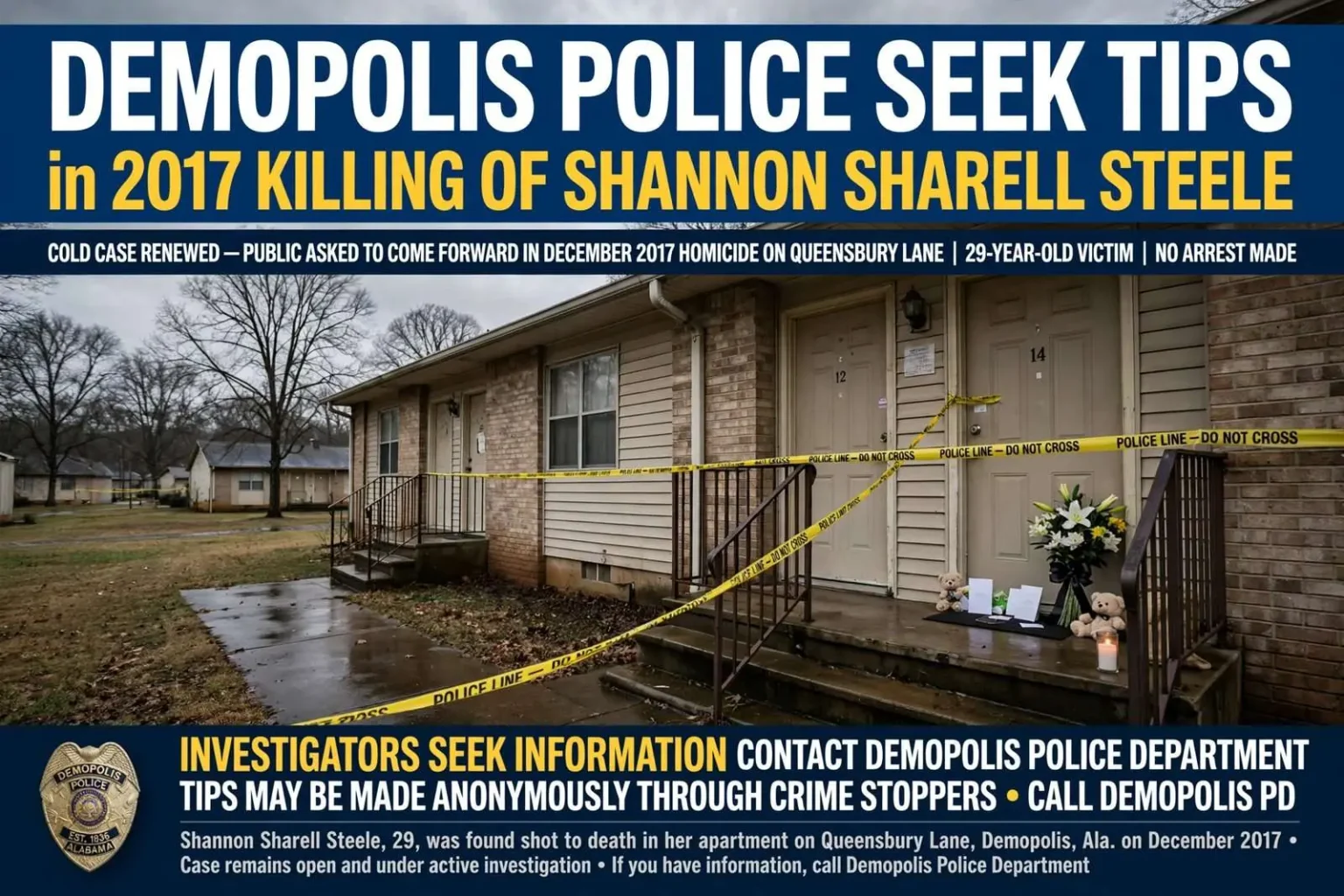
DEMOPOLIS, Ala. — Investigators with the Demopolis Police Department are asking the public for help solving a cold case that has haunted the city since December 2017: the murder of Shannon Sharell Steele. Steele, who was 29 years old, was found shot to death inside an apartment on Queensbury Lane, and in the years since, no arrest has been announced in her killing.
The circumstances of the discovery remain among the most striking details of the case. According to authorities, a Demopolis police officer had arrived at the apartment to serve papers on someone when he was greeted at the door by a toddler, who told the officer that someone had killed his mother. The child’s words led to the discovery that Steele had been shot to death inside the residence.
What might otherwise have gone unnoticed that day instead became a homicide investigation. Officers secured the scene, detectives were called in, and the state resources typically available to small-city departments in cases of this kind became part of the broader effort to identify who was responsible. Despite years of work, the case remains under investigation, and police have not named a suspect.
A city confronted by an unsolved killing
Demopolis, the largest city in Marengo County, sits at the confluence of the Tombigbee and Black Warrior rivers in west-central Alabama, a community of roughly 7,000 residents where violent crime is rare enough that a homicide resonates for years. Queensbury Lane is a residential street in the city, and neighbors in the area have lived with the knowledge that the person responsible for Steele’s death has never been publicly identified.
Cold cases like Steele’s present a familiar set of challenges for a department the size of Demopolis PD. Witnesses may move away, memories fade, and physical evidence requires laboratory analysis that can take months or years to complete. Investigators often say that the passage of time can also work in their favor, as relationships change and people who were reluctant to come forward in the immediate aftermath of a killing become willing to talk years later.
That is why detectives periodically return to old cases and renew their public appeals. The department’s message to the community in Steele’s case has been consistent: anyone with information, no matter how small or seemingly insignificant it may seem, is encouraged to contact the Demopolis Police Department.
Why tips still matter years later
In unsolved homicides, investigators routinely emphasize that a single piece of information can break a case open. A name overheard in conversation, a vehicle seen in the neighborhood that December night, a change in someone’s behavior after the killing — each of these can give investigators the thread they need. Tips that arrive long after the crime are not dismissed; they are added to the file and evaluated against the evidence already collected.
Residents of Marengo County and the surrounding region who remember anything about the case, or who heard anything in the weeks and months after Steele’s death, can contact the Demopolis Police Department directly. Callers who wish to remain anonymous may also pass information through regional crime stoppers programs, which allow people to submit tips without revealing their identities and, in some jurisdictions, to qualify for rewards when information leads to an arrest.
For Steele’s family, the years since December 2017 have meant living without answers about who shot the 29-year-old in her own apartment. Advocates for cold case victims’ families often note that the burden of an unsolved killing falls heaviest on those left behind, who must cope not only with the loss but with the uncertainty of never knowing whether the person responsible will ever be held accountable.
Anyone with information about the death of Shannon Sharell Steele is asked to contact the Demopolis Police Department. The case remains open and under active investigation.
The way the Steele case began — with a uniformed officer on a routine assignment and a child at the door — has made it one of the more widely remembered unsolved killings in the region. Police work that starts with serving papers rarely turns into a homicide investigation, and the detail has been repeated in coverage of the case since it first broke, a reminder of how suddenly the ordinary can become tragic.
Serving papers is a routine function of court systems across Alabama. Notices, summonses, and civil documents must be delivered to the people named in them, and in smaller cities that job often falls to police officers or sheriff’s deputies as part of their daily rounds. The officer who knocked on the door of the Queensbury Lane apartment that day had no way of knowing what waited inside, and the child who answered changed the course of the visit in a single sentence.
Responding officers treated the scene as a homicide from the outset. The apartment was secured, detectives began canvassing the neighborhood for anyone who had seen or heard anything, and the state’s crime laboratory was brought in to process the evidence collected at the scene. In the years since, investigators have continued to revisit the file as new information has come in.
How west Alabama departments work cold cases
Small and mid-sized police departments across west Alabama, including Demopolis, rely on a mix of local detectives and state-level support when homicides go unsolved. The Alabama State Bureau of Investigation, part of the Alabama Law Enforcement Agency, can assist local agencies with major case reviews, and the Alabama Department of Forensic Sciences handles the laboratory work that underpins most modern homicide prosecutions.
Reviews of cold cases in the region have occasionally produced arrests years or even decades after the crime, as advances in forensic techniques allow older evidence to yield results that were not possible when the case first broke. DNA analysis in particular has transformed the handling of cold case evidence, and investigators across the state continue to resubmit evidence from unsolved homicides as laboratory capabilities improve.
Demopolis police have not announced any such developments in Steele’s case, but the department’s renewed public appeal is a standard and meaningful step. Public appeals serve two purposes: they remind potential witnesses that the case is still active, and they signal to anyone who might be involved that the passage of time has not closed the file.
What the community can do
Residents with information about the Steele case can reach the Demopolis Police Department through its regular dispatch line or in person at the department’s offices in Demopolis. Tips can also be made anonymously, and investigators stress that people do not need to be certain that what they know matters — that judgment belongs to the detectives working the case.
People who lived near Queensbury Lane in December 2017, who worked with or knew Steele, or who recall conversations from that period are all potential sources of information. Even details that seem trivial, such as seeing an unfamiliar vehicle or hearing an argument, can corroborate other evidence or point investigators in a direction they have not considered.
The Demopolis Police Department continues to investigate the death of Shannon Sharell Steele. Anyone with information is encouraged to come forward.
December 2017 marked a period when law enforcement agencies across west Alabama were emphasizing community cooperation as the foundation for solving violent crime. In cities the size of Demopolis, where officers often know the neighborhoods they patrol personally, the relationship between investigators and residents carries particular weight. Detectives cannot be everywhere, and the information that solves a case in a small city frequently comes from the people who live on the street where it happened.
Statewide, Alabama has struggled with a backlog of unsolved homicides, a problem that affects jurisdictions large and small. Each unsolved case represents a victim whose family continues to seek answers and a community that carries the unresolved grief of a violent death that has gone unanswered. Departments that keep cold cases in public view — through periodic appeals like the one Demopolis police have renewed — are acting on the well-documented experience that tips can arrive at any time, sometimes years after the crime.
For the neighborhood on Queensbury Lane, the case has been part of daily life since that December morning. Residents who saw the initial response remember it, and some who were reluctant to talk to investigators in the early days may now be in a different position to help. Investigators understand that dynamic, which is part of why the department continues to ask.
The toddler’s account and its significance
The detail that a young child told the officer someone had killed his mother underscores how the case came to light only by chance. Had the officer been dispatched to a different address, or had the papers been served at a different time, the discovery might have come later still. Investigators treat chance discoveries of this kind with care, documenting exactly what was said and by whom, because such moments often contain the only immediate window into what happened inside a residence.
Children who are present at violent scenes become part of the state’s protective and investigative response, with child welfare officials involved alongside police. The care of young survivors of homicide scenes is handled quietly, away from public attention, and the details of what happened to the child who answered the door that day have not been made public.
What is public is the core of the appeal: Shannon Sharell Steele was 29 years old, she was found shot to death in her apartment on Queensbury Lane in December 2017, and the person responsible has not been arrested. The Demopolis Police Department remains the point of contact for anyone who knows anything about the case, and the department’s standing request is simple — call, tell detectives what you know, and let them determine its value.