Deputy Injured in Fiery Bayway Crash Wins $2 Million Jury Verdict
Mobile County Deputy Admire Gant won a $2 million verdict after an 18-wheeler hit his patrol car on the Bayway at over 60 mph in 2018.
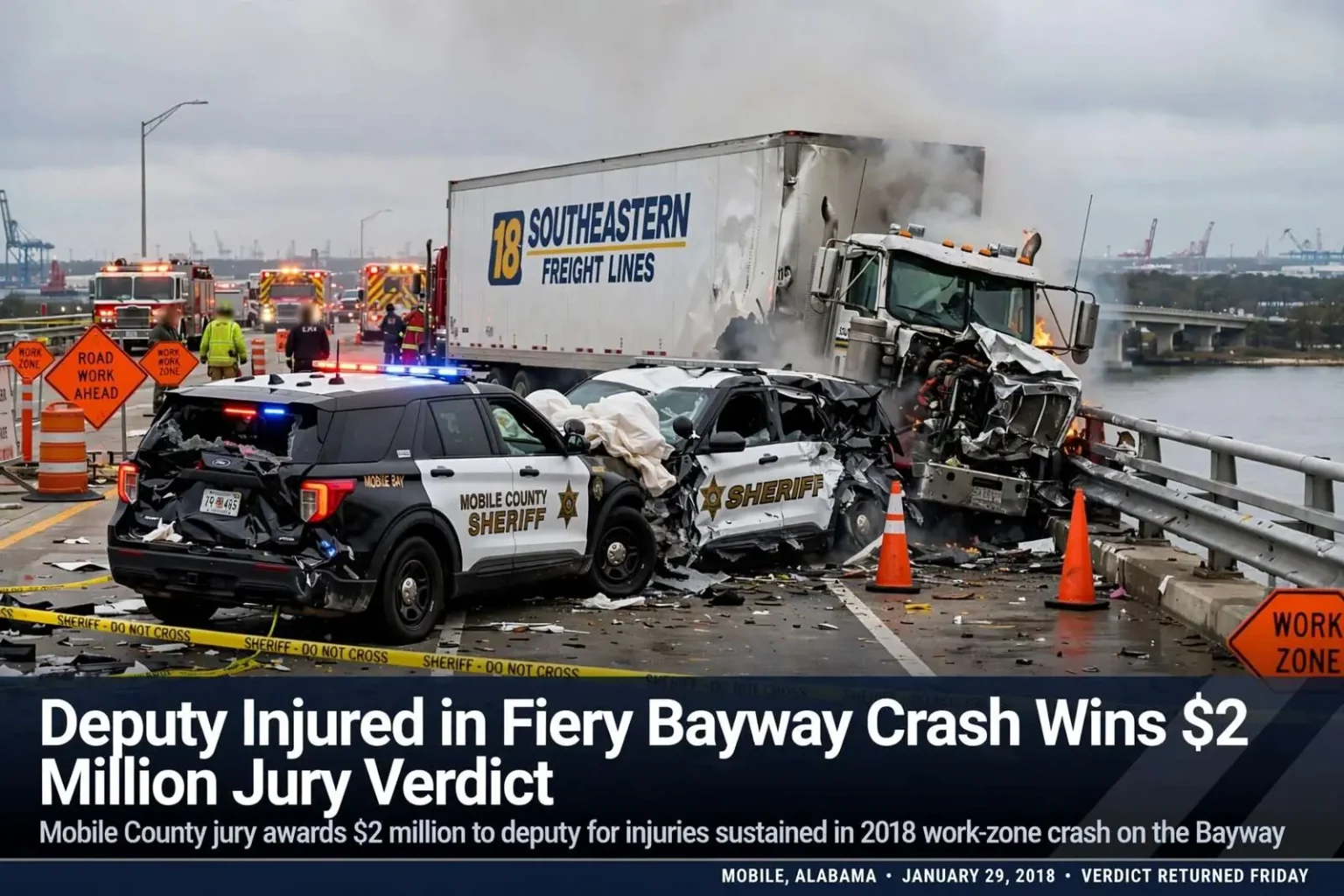
A Mobile County jury has awarded $2 million to a sheriff’s deputy who was badly hurt when an 18-wheeler slammed into his patrol car on the Bayway in 2018. The verdict, returned Friday in Mobile County Circuit Court, closed out a case that traced back to one violent morning on one of the busiest stretches of roadway in southwest Alabama, and it put a jury’s number on injuries that have followed the deputy ever since.
Deputy Admire Gant was working security behind a road crew on January 29, 2018, when a tractor-trailer operated by Southeastern Freight Lines crashed into the back of his service vehicle at more than 60 mph, setting the truck ablaze. The assignment Gant was performing is one of the least glamorous and most necessary parts of highway work: positioning a patrol car behind a work zone to shield road crews from live traffic. The vehicle behind him is supposed to absorb an impact exactly like the one that came — and on that morning it did, at a cost to the deputy inside.
Crashes of this type happen in seconds. A commercial truck traveling at highway speed covers a football field’s length in roughly four seconds, which is why rear-end collisions into work zones are so often catastrophic and why traffic law treats work zones with heightened penalties. The physics of an 80,000-pound tractor-trailer striking a stopped patrol car leaves little margin, and that Gant survived at all is the remarkable part of the story his attorneys laid out for jurors.
A close call on the Bayway
Gant managed to walk away from his wrecked patrol car, and his first act was to check on the truck driver — who had also escaped injury. The two men then watched together as the big rig exploded in flames behind them. That sequence, described in the account of the case released by Gant’s attorneys, is the detail that stays with people: two men who should by any reasonable expectation have been killed standing together on the shoulder, watching the truck burn.
The Bayway — the elevated span of the Bill Finch Bridge approach carrying Interstate 10 traffic across Mobile Bay — is one of the most unforgiving work environments in the region for anyone stopped on or near the roadway. Traffic across the bay is heavy around the clock, trucks make up a large share of it, and shoulders and work zones offer minimal protection. Road crews and the officers assigned to protect them work every day with live traffic a few feet away, and the crash that injured Gant is the scenario those assignments exist to manage.
The fire that consumed the tractor-trailer added another layer of danger to the morning. A commercial truck fire on an elevated bridge approach is a serious incident in its own right, threatening the roadway, the response crews, and any secondary collisions. That both drivers were out of their vehicles before the fire took hold is the reason the January 29, 2018 crash is remembered as a story of survival rather than a far worse one.
Permanent injuries behind a walk-away crash
According to a release from Gant’s attorneys with Cunningham Bounds, the crash aggravated an existing back condition, leaving the deputy in need of multiple epidural procedures. The pattern is common in high-energy rear-end collisions: even when nothing is broken, the force transmitted through the seat can do lasting damage to the spine, and pre-existing conditions that a person managed for years can become disabling after a single impact. Jurors heard evidence about the collision and its lasting physical toll before siding with Gant on the $2 million award.
Epidural procedures — injections targeting inflamed nerves in the spine — are not a one-time fix but a repeating course of treatment, each one carrying its own recovery time, risk, and cost. For a working deputy, back injuries are career-defining: the job demands time in a patrol vehicle, physical intervention, and readiness for sudden exertion, and a damaged spine erodes exactly the capacities the work requires. The jury’s award reflected both the medical costs already incurred and the long arc of treatment still ahead.
How the verdict came together
The verdict came down Friday in Mobile County Circuit Court, where jurors weighed the evidence about the crash and its aftermath. Cases like this one turn on questions a jury is well suited to answer: what the truck driver was doing in the moments before impact, whether the commercial carrier’s practices contributed, and how severe and permanent the injuries really are. The $2 million award indicates jurors found the harm to Gant substantial and the case for responsibility persuasive.
Commercial trucking cases also bring a distinct body of evidence into the courtroom. Tractors and trailers are equipped with electronic control modules that record speed and braking data in the moments before a crash; drivers keep logs subject to federal hours-of-service rules; and carriers maintain maintenance and training records. All of that material becomes part of the record in litigation, and juries in truck cases routinely hear a level of technical detail far beyond a typical traffic collision.
The verdict also reflects the wider context in which the crash occurred. Southeastern freight traffic across the Bayway and through the Mobile area has grown steadily with the port and the region’s logistics economy, which means more heavy trucks on the same corridors where road crews and their protective details work. Every work-zone crash on those corridors is examined with that growth in mind, and the Gant verdict adds to the case law that governs how carriers and their drivers are held accountable on Alabama highways.
Work-zone safety and the people who stand guard
The image of a patrol car parked behind a road crew is so ordinary on Alabama highways that it is easy to forget it is a safety system. The car and its flashing lights are there to give drivers something to react to — a visible warning line between live traffic and workers who have no barrier but paint stripes. Law enforcement agencies assign those details knowing the patrol car is the designated sacrifice in a rear-end crash; the system works when drivers slow down and react, and it fails violently when they do not.
Statistics on work-zone crashes make the point consistently: the majority of people injured in work-zone collisions are drivers and passengers, not workers — and the officers and crews protected by the barrier car are exposed to exactly the kind of high-speed rear-end impact that injured Gant. Federal and state safety campaigns have pressed the message for years: slow down in work zones, put the phone down, and treat the patrol car with flashing lights as the emergency scene it is. Alabama law requires drivers to move over or slow down for stopped emergency and service vehicles, and the Gant case is a demonstration of what happens when a driver fails to meet that standard with fatal force, even if not fatal in the end.
The human stakes extend beyond the injured officer. Deputies injured in the line of duty face medical treatment, lost duty time, and hard decisions about whether they can continue in the profession — and their families absorb the uncertainty alongside them. Verdicts like this one are the civil system’s mechanism for putting the cost of that harm on the party found responsible, and they also serve a wider signaling function: carriers, drivers, and insurers see what a work-zone collision ultimately costs, which is precisely the deterrent effect such litigation is designed to produce.
The Bayway’s long record of hard mornings
Anyone who drives I-10 across Mobile Bay knows the Bayway’s character: low walls, minimal shoulder, wind off the bay, and a nearly constant procession of trucks. It is a beautiful stretch of road and a demanding one, and it has accumulated decades of crashes — fog pileups, rear-end collisions, and the everyday fender-benders of a corridor carrying far more traffic than it was designed for. Long-running plans to rebuild and widen the span have been debated for years precisely because the Bayway’s limitations are so visible to the region that depends on it.
Work zones concentrate those risks. Lane shifts, slowed traffic, and workers on the roadway change the reading drivers must make, and the corridor’s congestion leaves little room for error. The January 29, 2018 crash that injured Gant happened in that environment, at more than 60 mph, against a stopped patrol car placed there to protect a road crew — a collision that was, in a grim sense, the system functioning as designed: the patrol car took the impact so the workers did not.
For Mobile County, the case is also a reminder of what local juries see regularly. The region’s position as a Gulf logistics hub — port, rail, and interstate corridors all converging — means trucking litigation is a staple of the local courts, and the verdicts returned there shape how carriers operate across the Southeast. Jurors in Mobile know the Bayway personally, which gives their judgments on cases like this one a grounded quality: they are ruling on a road they drive.
What comes after the verdict
A jury award is not the end of the road. Post-trial motions and possible appeals are standard in significant verdicts, and the practical resolution of the case — payment, settlement, or reversal — can take additional time. But the finding itself matters immediately: a Mobile County jury has declared, in the most formal way available, that the crash on January 29, 2018, and the injuries that followed, were the responsibility of the party that caused them.
For Gant, the award recognizes a morning he is unlikely to forget — the impact, the walk away from his wrecked patrol car, the check on the truck driver who shared the shoulder with him, and the fire that followed. It also recognizes the quieter years since: the epidural procedures, the management of an aggravated back condition, and the professional cost of injuries that never fully release their grip. Jurors heard that story and put a number on it.
For everyone who drives the Bayway — and every deputy or road worker who will ever stand behind flashing lights on it — the case leaves behind the same lesson the safety campaigns repeat: the few seconds of attention that keep a truck from plowing into a work zone are worth more than any verdict. The $2 million answer arrived seven years after the crash. The better outcome remains the one where the question never has to be asked.