DeSantis declares Florida state of emergency over COVID-19
Florida Gov. Ron DeSantis declared a state of emergency over COVID-19, setting up a unified command and emergency refill and licensing provisions across.
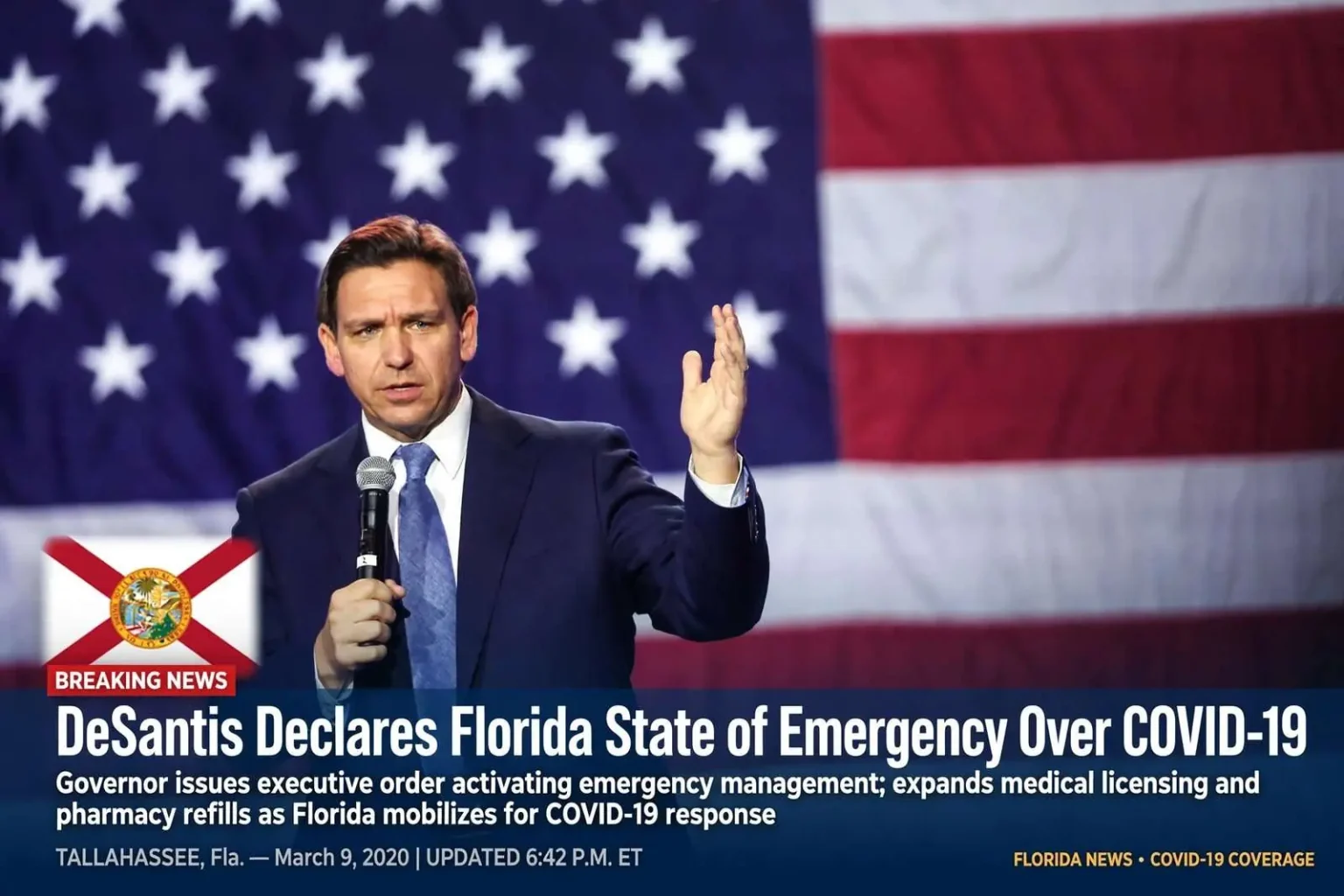
Florida Gov. Ron DeSantis issued an executive order Monday declaring a state of emergency in response to Coronavirus Disease 2019 (COVID-19). The declaration established a unified command structure and named the Director of the Division of Emergency Management as State Coordinating Officer, with the State Surgeon General serving as Deputy State Coordinating Officer and State Incident Commander. The move came as the new coronavirus spread and states across the country began mobilizing emergency powers to respond.
The order also let the governor direct funds for critical supplies, equipment and personnel as needed. It allowed out-of-state medical professionals to practice in Florida for the duration of the order and permitted pharmacists to issue up to a 30-day emergency refill of prescription drugs. Those provisions were aimed squarely at the practical bottlenecks that public health officials expected: enough medical staff, enough supplies and enough medication on hand for residents who could not immediately reach their regular prescribers.
What a State of Emergency Unlocks
Under Florida’s State Emergency Management Act, a declared emergency gives the governor and state agencies a defined set of tools that do not exist in ordinary times. The state can suspend regulatory hurdles, procure supplies without the usual competitive bidding timelines, and coordinate response through the Division of Emergency Management rather than leaving each agency to improvise. The executive order placing the Division’s director in the State Coordinating Officer role put that machinery in motion, with the Surgeon General as deputy and incident commander tying the public health side to the emergency management side.
Unified command is the key phrase in the structure. Emergency response doctrine calls for a single operational framework through which health, law enforcement, logistics and communication decisions flow, rather than separate chains of authority that compete for resources. By formally establishing that structure in the order, Florida positioned itself to manage the pandemic response the way it manages hurricanes, the disaster type the state’s emergency system was originally built around.
The financial provisions mattered just as much in practical terms. Directing funds for critical supplies and personnel meant the state could begin purchasing protective equipment, funding testing capacity and bringing on staff before case counts dictated action. In the early weeks of a fast-moving outbreak, procurement lead time is often the difference between shortage and sufficiency.
Medical Licensing and Pharmacy Flexibility
Two provisions in the order drew particular attention for their effect on everyday health care. Allowing out-of-state medical professionals to practice in Florida for the duration of the order addressed a workforce problem that states around the country were anticipating: hospitals and health departments do not have spare staff for a surge, and the licensed professionals who could help were often barred by state lines. Emergency recognition of out-of-state credentials is a standard feature of disaster declarations, and COVID-19 prompted it in nearly every state that declared an emergency.
The pharmacist provision — allowing up to a 30-day emergency refill of prescription drugs — reflected a different concern. In a public health emergency, residents may be unable to reach their prescribing physician for routine renewal, whether because of quarantine, clinic closures or surging demand on medical offices. Letting pharmacists dispense an emergency refill of maintenance medications kept chronic conditions from becoming secondary emergencies during the outbreak.
Together, the two measures signaled that Florida’s response planning assumed disruption to routine health care, not just treatment of the virus itself. Emergency managers learned from hurricanes that the health system’s weakest points during a disaster are often refills, dialysis schedules and home health visits, and the order applied those lessons to a pandemic.
Florida Joins a National Wave of Declarations
The Monday order came as states across the country began declaring emergencies in response to the spread of COVID-19, the disease caused by the novel coronavirus first identified in late 2019. Emergency declarations by governors do not close businesses or restrict movement by themselves; they unlock funding, staffing and legal authorities that make later measures possible. In the early March wave, declarations were often described as preparations rather than lockdowns, a way of positioning state government before cases multiplied.
Florida faced particular considerations that shaped its planning. The state’s large population of older residents made it uniquely exposed to a respiratory illness that poses the greatest risk to the elderly, and its tourism economy draws millions of visitors through airports and theme parks, giving the virus many avenues of introduction. Those factors pushed health officials to emphasize early action on supplies and staffing even before widespread transmission was confirmed.
The federal backdrop was moving quickly as well. National emergency declarations, travel advisories and guidance from the Centers for Disease Control and Prevention were arriving in stages, and each state declaration fed into a patchwork of responses that varied by governor, timeline and local conditions. For residents of border regions, that patchwork meant the rules could differ on either side of a state line, a reality that Gulf Coast communities know well from hurricane seasons past.
What It Meant for the Gulf Coast
For the Florida Panhandle and the neighboring Alabama Gulf Coast, the declaration carried practical significance despite the physical distance from Tallahassee to Pensacola. Escambia County residents cross into Alabama for work, shopping and medical care daily, and Baldwin County residents do the same in reverse. A Florida emergency declaration covering pharmacy refills and out-of-state practitioners affected people on both sides of Perdido River and the state line, since the provisions applied to anyone in Florida pharmacies and clinics when the order was in effect.
The region also shares an emergency management culture. Florida’s Division of Emergency Management is one of the most experienced state agencies of its kind, honed by annual hurricane responses, and its county-level partners in the Panhandle coordinate routinely with Alabama’s emergency management agency and Mobile and Baldwin County counterparts on storm planning. Pandemic response drew on those same relationships, from mutual aid requests for medical staff to coordinated public messaging across the coastal counties.
Northwest Florida’s health care infrastructure added another layer of concern. The Panhandle’s hospital systems are smaller than those in Florida’s urban centers, and a surge of respiratory patients in a regional hospital network ripples quickly through intensive care capacity, clinic staffing and ambulance availability. The out-of-state licensing provision in the order was written with exactly that arithmetic in mind, giving rural and mid-sized systems a way to reinforce staff before shortfalls became critical.
Reading an Emergency Order
Executive orders like Florida’s are worth reading closely because their language defines what agencies can actually do. The designation of a State Coordinating Officer tells residents who is running the response day to day; the Deputy and Incident Commander designations tell them who owns the public health operations. Fund directives signal where money will flow first, and the licensing and pharmacy clauses reveal which disruptions planners considered most likely.
Declared emergencies in Florida run for a defined duration and can be extended by subsequent orders, which became the pattern nationally as the pandemic stretched from weeks into months. Each extension renewed the same authorities: procurement flexibility, workforce recognition and the coordination structure set up in the original declaration. For Floridians and their Gulf Coast neighbors, the Monday order was the starting point of that sequence, the formal moment the state’s hurricane-tested machinery turned toward a threat no one could see coming.
The Long Shadow of Hurricane Preparedness
Much of what made Florida’s order workable had been built long before anyone had heard of COVID-19. The state’s emergency management framework was written for hurricanes, and decades of storm responses produced a deep bench: pre-positioned supply contracts, mutual aid agreements with other states, a statewide network of emergency operations centers and officials at every level who had practiced unified command in real events. The pandemic order borrowed all of it, and the structure it created on paper reflected procedures that had been tested by wind and water.
Public health emergencies, however, test that machinery in unfamiliar ways. A hurricane arrives with a forecast and leaves physical damage behind; a pandemic spreads invisibly, lasts months and stresses hospitals rather than power grids. Officials across the country spent the early weeks of 2020 adapting hurricane-era tools — supply pipelines, command structures, public information systems — to a threat that moved from city to city rather than across the coastline.
The pharmacy refill clause was a direct example of that adaptation. After major storms, pharmacists in affected areas have long been allowed to dispense emergency refills so residents who evacuated or lost their medications could continue treatment. Extending the same principle statewide for a disease outbreak was a modest administrative change with an outsized effect on continuity of care.
Communication and Public Expectations
Emergency declarations also serve a communication function that has nothing to do with legal authority. A governor’s signature on a state of emergency tells residents, businesses and local governments that the situation has crossed a threshold, that the state is spending money and that guidance issued by health officials now carries the weight of an activated system. In March 2020, that signal mattered as much as any single provision in the order.
For local officials in the Panhandle and across the state, the declaration clarified who they answered to and where requests would go. County emergency managers submit unmet needs to the state; the state, under its coordinating officer, prioritizes and fills them from the resources the declaration unlocks. Without the executive order, those requests would have wandered through normal budget channels, too slow for an outbreak that was doubling in days.
The order also set expectations for the private sector. Health systems, pharmacies, long-term care facilities and schools read emergency orders closely because the documents hint at what comes next — screening rules, visitor restrictions, supply priorities. Monday’s declaration put Florida’s health care sector on notice that surge planning was no longer a drill.
A Starting Point, Not a Plan
In the arc of the COVID-19 pandemic, the Monday executive order was an opening move. The unified command structure, funding authority, licensing flexibility and pharmacy provisions it established became the platform on which later orders were built as the situation evolved. Residents would come to learn the vocabulary of emergency management in the months that followed, but the grammar was all in the first declaration.
For readers along the Gulf Coast, the order was also a reminder of how interdependent the region is. Health care workers commute across state lines, prescriptions follow residents on both sides of the border, and an outbreak in one county quickly becomes a concern in its neighbors. Florida’s decision to activate its emergency machinery was made in Tallahassee, but its effects reached into Alabama pharmacies and Panhandle hospitals alike, and it marked the moment the pandemic became the organizing fact of public life across the entire Gulf Coast.