DeSoto’s Seafood Kitchen in Gulf Shores temporarily closing for deep clean after COVID-19 exposure
DeSoto's Seafood Kitchen in Gulf Shores is temporarily closing for a deep clean after a COVID-19 exposure. The restaurant hopes to reopen soon.
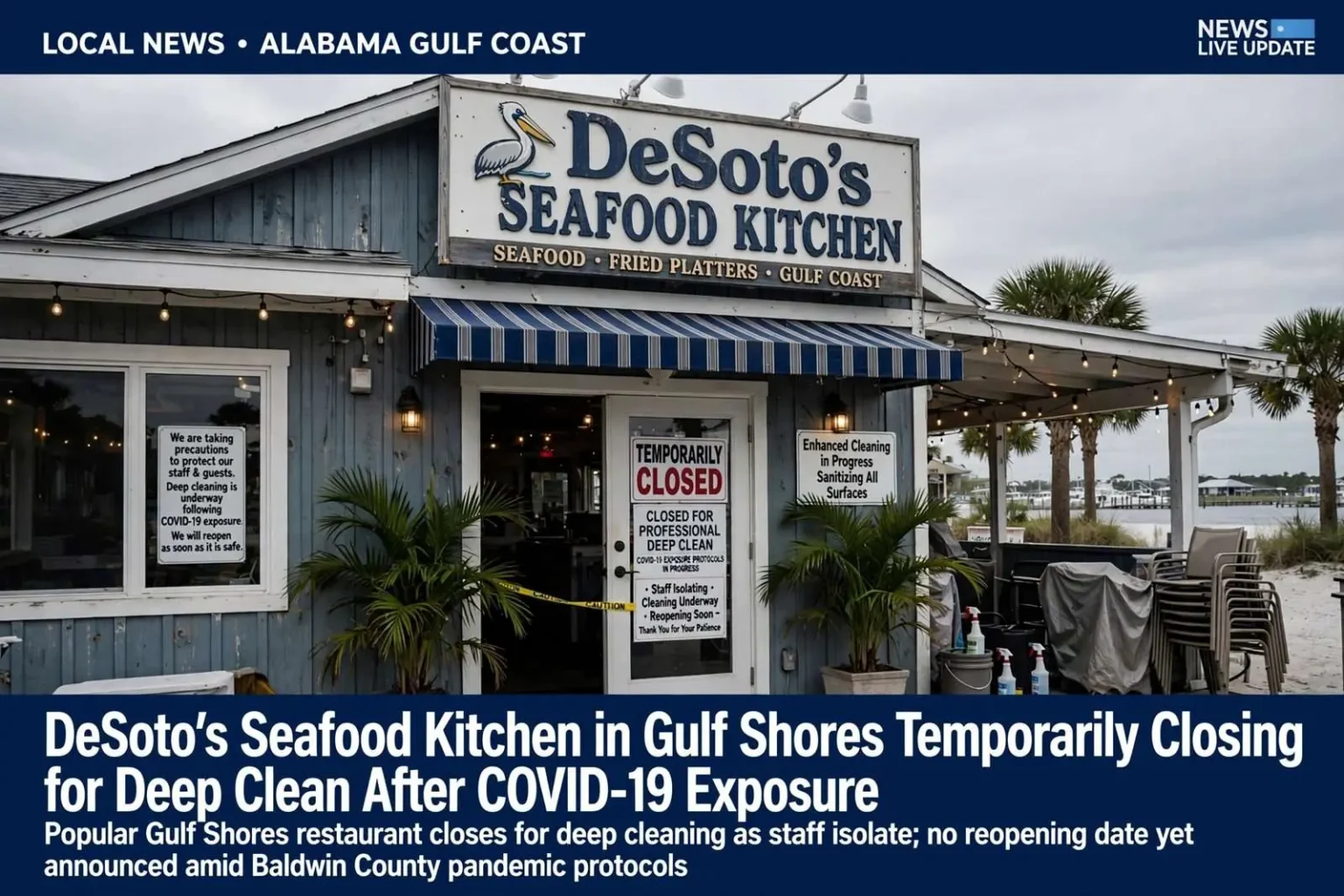
A popular Gulf Shores seafood restaurant is pressing pause on service after coming into contact with COVID-19. DeSoto’s Seafood Kitchen announced it is temporarily closing for a deep cleaning. Staff members were told they can isolate while the restaurant undergoes the cleaning process.
The restaurant has not announced a reopening date but said it hopes to welcome customers back soon. The temporary closure comes as Baldwin County and the Alabama Gulf Coast continued to grapple with the coronavirus pandemic. Restaurants across the region have adopted enhanced sanitation measures, and several have temporarily shuttered when employees or patrons were potentially exposed.
DeSoto’s, a long-standing Gulf Shores establishment known for its seafood, asked for patience from its customers as it works to reopen safely.
The Deep-Cleaning Decision
Closing for a professional deep clean became a familiar ritual for restaurants during the pandemic, and DeSoto’s approach followed the pattern health officials recommended when a potential exposure occurred. A deep clean goes beyond nightly sanitizing: surfaces throughout the kitchen, dining room, restrooms and service areas are disinfected with products rated for the virus, high-touch points such as door handles and payment terminals receive repeated treatment, and in many cases the building is aired out before service resumes.
Allowing staff to isolate during the process served two purposes at once. It protected employees who might have been exposed from returning to work while the risk period ran its course, and it kept the cleaning crew’s work unobstructed. Restaurant workers, who spend shifts in close quarters in kitchens and dining rooms, were among the occupational groups most affected by exposure scares throughout the pandemic.
The decision to close voluntarily — rather than remain open with enhanced precautions — reflected the calculus many Gulf Coast restaurateurs made when exposure reached their staff. A temporary closure carries real costs in lost revenue and lost wages, but an outbreak traced to a dining room carries worse ones, and the region’s tourism economy depends on visitors leaving with confidence that eating out is safe.
How Exposure Protocols Worked
Restaurant exposure protocols during the pandemic followed a general sequence that DeSoto’s closure fits neatly. When an owner learned of a potential exposure — an employee testing positive, a household contact, or a symptomatic worker — the standard guidance called for sending potentially affected staff home, notifying others who had close contact, cleaning and disinfecting the affected areas, and reviewing whether any patrons needed to be informed depending on the timing and the local health department’s advice.
Contact tracing efforts, run through the Alabama Department of Public Health and its county health departments, relied heavily on businesses cooperating quickly. A restaurant that closed, cleaned and isolated staff promptly shortened any potential transmission chain and often avoided becoming part of an outbreak investigation at all. Public health officials repeatedly credited voluntary business closures of this kind with keeping dining rooms from becoming superspreading sites.
For employees, the isolation period raised practical questions the industry and government worked to address through the pandemic — sick leave policies, unemployment benefits for workers told to stay home, and return-to-work criteria. Telling staff they could isolate while the deep clean proceeded, as DeSoto’s did, matched the responsible-playbook version of an exposure response: put people’s health ahead of the night’s receipts.
DeSoto’s Place in Gulf Shores
DeSoto’s Seafood Kitchen built its reputation over years of serving the fried platters, fresh catches and Gulf Coast staples that define the area’s dining identity. Gulf Shores restaurants occupy a demanding niche: they must satisfy locals who return week after week and tourists who arrive with high expectations for the coastal seafood experience. A long-standing establishment like DeSoto’s earned its standing by doing both, becoming one of the stops residents recommend when visitors ask where to eat.
That standing is what makes a closure announcement newsworthy in a town like Gulf Shores. Popular restaurants are woven into the town’s identity and its tourism economy, and regular customers follow news of a temporary shutdown the way they follow a hurricane’s approach — with concern for the business and for the people who work there. The restaurant’s request for patience was aimed at exactly that loyal base.
The plea also reflected the economics of an independent restaurant. Unlike national chains, a single-location establishment absorbs a full closure’s cost on its own: no corporate reserve, no other locations to lean on. Staff members told they could isolate faced the same arithmetic, which is why closure announcements of the period routinely included both a reopening hope and a reminder that employees were the immediate concern.
Pandemic Conditions on the Alabama Gulf Coast
The closure played out against the backdrop of the pandemic’s grip on Baldwin County and the coast. The Alabama Gulf Coast’s economy is built on tourism — beaches, restaurants, fishing charters and the businesses that serve them — which made the region’s pandemic experience unlike much of inland Alabama. Seasons that would ordinarily bring crowds instead brought uncertainty, and operators weighed every public health development against the calendar that governs coastal business.
Baldwin County’s case counts and health orders shifted through the period, and restaurants operated under changing rules on capacity, seating and sanitation. State and county health guidance required notification and cleaning when exposures occurred, and establishments across the region responded with the measures DeSoto’s adopted: temporary shutdowns for deep cleaning, isolation periods for potentially exposed staff and enhanced routines once service resumed.
Several other restaurants in the region had already taken the same step by the time of DeSoto’s announcement, making the closure part of a recognizable pattern rather than an isolated event. For diners, the pattern carried a message the industry hoped to emphasize: closures were a sign the system was working — an operator acting quickly to break a chain of transmission — not a reason to avoid restaurants generally.
The Restaurant Industry’s Pandemic Playbook
By the time DeSoto’s announced its closure, restaurants across the country had assembled a pandemic operating playbook, and Gulf Coast establishments ran versions of it nightly. Enhanced cleaning schedules, sanitizing stations for guests, masked servers, separated tables and contactless payment options became standard. Behind the scenes, operators staggered shifts, screened employees at the door and redesigned kitchens to create distance between workers.
The financial strain of those measures fell hardest on independents. Takeout and delivery helped replace dine-in revenue, but seafood houses built around platters and cold beer on a beach-town evening could not move their full business to a to-go window. Every extra day of closure added to the pressure, which is why operators paired announcements like DeSoto’s with a hope to reopen soon rather than an indefinite timeline.
Customers adapted alongside them. Regulars ordered takeout to keep favorite restaurants alive, bought gift cards for future use and responded to closure announcements with the kind of community support that small towns are known for. A Gulf Shores institution asking for patience during a deep clean generally received it, along with a wave of goodwill from the diners waiting for its doors to open again.
What Deep Cleaning Involved
The deep clean itself followed standards the industry refined through the pandemic. Professional crews worked through dining rooms, kitchens, bars and restrooms with EPA-approved disinfectants, giving special attention to the surfaces hands touch constantly — tables, chairs, menus, coolers, faucets, fridge handles, point-of-sale terminals. In kitchens, food-contact surfaces were sanitized under the same food-safety rules that always governed them, with added attention to shared equipment.
Ventilation entered the conversation as well. Improved airflow — from opening spaces up to running air handlers longer and upgrading filtration — became part of the guidance for indoor dining, and operators used closures as the practical moment to make those adjustments. A deep-clean window allowed repairs and rearrangements that would have been impossible during service.
By the time the work was done, a restaurant reopening from a deep clean was typically cleaner, better organized and better equipped for sanitary service than it had been before the exposure scare. In that sense, closures like DeSoto’s did double duty: they broke any potential transmission chain and they reset the operation to a higher standard for the customers who would return.
Looking Toward Reopening
Without a reopening date announced, DeSoto’s plan rested on the essentials: completing the deep clean, letting the isolation period run its course for any staff with potential exposure and resuming service when the restaurant was confident it was safe. Establishments that followed that sequence generally reopened within days, announcing the return on social media to a customer base that had spent the closure asking when.
The episode captured the pandemic’s texture on the Alabama Gulf Coast — a beloved local business doing the prudent thing, workers isolating on paychecks they could ill afford to lose, a tourism town weighing health against the season, and customers waiting with patience. When DeSoto’s fired its kitchens back up, it rejoined the long line of Gulf Coast restaurants that closed for cleaning, reopened carefully and carried their communities one more step through the pandemic.