Dinner and a Movie: Pork Burgers and the Rise of N.W.A in ‘Straight Outta Compton’
A repeat-favorite pork burger plate with sweet potato fries and kale salad set the table for Straight Outta Compton, the music biopic about N.W.A.
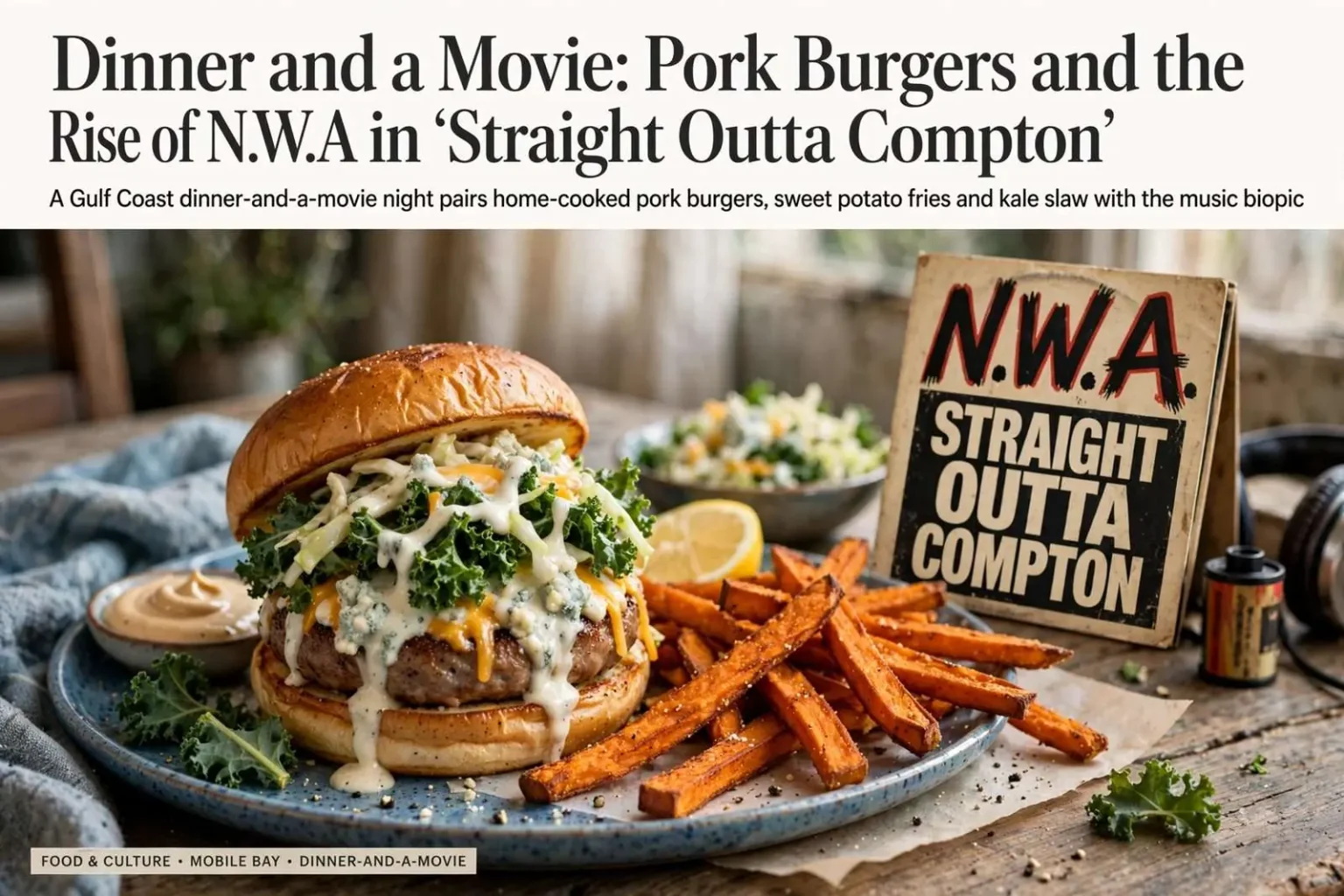
Some recipes earn a place in the regular rotation. Such was the case with the pork burger, sweet potato fries and kale salad that anchored another Mobile Bay dinner-and-a-movie night, this time paired with the music biopic “Straight Outta Compton.” The evening followed a formula this household has refined over many such nights: a home-cooked plate with enough substance to feel like a proper dinner, followed by a film chosen for conversation value as much as entertainment. It is a rhythm familiar to plenty of Gulf Coast families, where long summers make the kitchen a natural gathering point before the television takes over. What made this particular night work was how well the two halves matched — a grounded, satisfying meal paired with a film about ordinary people building something extraordinary.
The plate followed the household’s proven formula. The cook needed about ten ounces of lean ground pork, a sweet potato, Cajun or Creole seasoning, an egg, two potato buns, kale, cabbage, red wine vinegar, shredded cheddar, blue cheese dressing, mayonnaise and Dijon mustard. Nothing exotic, nothing difficult to find in any Mobile-area grocery store, and nothing that required more than basic technique. That accessibility is part of why the recipe earned its rotation status. A busy household does not always have time for a complicated dinner, but it can almost always manage a skillet, a sheet pan and a mixing bowl. Pork, in particular, has long been a staple of Southern kitchens, and ground pork offers a leaner, quicker alternative to the roasts and chops that dominate the region’s traditional cooking.
Fries and the case for the sweet potato
The fries came first, because they needed the oven. At 450 degrees, the sweet potato was sliced into quarter-inch pieces, tossed with olive oil, salt and pepper, and baked fifteen to twenty minutes. The high heat matters. Sweet potatoes have a higher moisture content than russets, and a hot oven is what draws that moisture out at the edges while the interior softens, producing pieces with crisp surfaces and creamy centers rather than limp, steamed sticks. Quarter-inch slicing gives the rounds enough body to hold together, and a single even layer on the pan keeps them from trapping steam against one another.
Sweet potatoes are a natural fit on an Alabama table. The crop has deep roots in the state’s agricultural history, with fields concentrated in the northern counties, and the vegetable shows up everywhere from school cafeterias to holiday tables across the Gulf Coast. Baking them into fries is a weeknight-friendly way to serve them, and the minimal seasoning — oil, salt, pepper — lets the natural sweetness carry the dish. Paired with a savory pork burger, the contrast is the point: sweetness against smoke and spice, soft against crisp.
The burgers
The pork was folded with seasoning and egg, shaped into half-inch to inch-thick patties, and cooked in hot olive oil, four to six minutes a side. The egg acts as a binder, which ground pork needs more than ground beef does; without it, lean pork patties can crumble in the pan. The wide thickness range lets the cook steer the outcome — thinner patties develop more browned crust along the edges, while thicker ones stay juicier in the middle. Four to six minutes a side is enough to bring pork fully to a safe internal temperature while still keeping the meat tender, a range that reflects how forgiving ground pork can be when it is not overworked or overcooked.
The Cajun or Creole seasoning does the heavy lifting on flavor. Either blend typically builds on paprika, garlic, onion, cayenne and dried herbs, and both are fixtures of Louisiana and Alabama home cooking, their exact mixtures varying family by family. Folded into ground pork, the seasoning permeates the meat evenly instead of sitting on the surface, which means every bite carries some spice rather than just the exterior. For households along the Gulf Coast, where Cajun and Creole influence has crossed eastward into everyday Mobile Bay cooking for generations, the choice between the two blends is less about geography than about heat preference.
Slaw that doubles as a salad
Thinly sliced kale and cabbage were dressed with vinegar, salt and pepper, then mayonnaise, blue cheese dressing and cheddar until it came together as a slaw. The sequence is deliberate. Acid and salt go on first to soften the raw greens and draw out a little bitterness from the kale, a technique cooks have long used to make hearty greens more palatable without cooking them. Only after the vegetables have relaxed do the creamy elements go in, coating the leaves instead of pooling at the bottom of the bowl.
The result blurs the line between side salad and slaw in a useful way. Cabbage brings crunch, kale brings color and a slightly bitter edge, and the blue cheese dressing and cheddar add enough richness that the dish holds its own against a spiced burger rather than reading as an afterthought. Red wine vinegar keeps the whole thing bright. On a plate already loaded with savory and sweet elements, that brightness matters — it resets the palate between bites, which is the same reason slaw has accompanied barbecue and fried food across the South for as long as anyone can remember.
Assembly stayed simple. Toasted buns, a mayonnaise-and-Dijon sauce and a scoop of slaw completed the burger, with the fries on the side. Toasting the potato buns is more than a nicety — the brief contact with heat firms up the crumb so the bread resists soaking through from the sauce and slaw, and it adds a faint crispness that makes the sandwich easier to eat. The mayo-and-Dijon spread bridges the gap between the rich pork and the tangy slaw, and piling the slaw directly on the burger means every component arrives in each bite. The kitchen’s rating held steady at two thumbs up.
There is a broader lesson in a meal like this one for Mobile Bay home cooks. Dinner-and-a-movie nights succeed or fail on planning, and this menu illustrates the efficient kind: one oven component, one skillet component and one no-cook component, sequenced so nothing sits waiting. The fries bake while the slaw wilts and the patties form; the burgers go into the pan as the fries come out. Total active time stays reasonable, and the cook sits down to the film with everyone else instead of finishing alone in the kitchen.
On the screen
The feature was “Straight Outta Compton,” directed by F. Gary Gray, chronicling the formation of the influential rap group N.W.A. The film follows a group of young artists writing about the social injustice and policing they knew firsthand, watching their music catch fire, and facing pressure to soften a message that resonated precisely because it did not. That tension — between commercial forces that wanted the group palatable and audiences who connected with it because it was not — gives the film a spine that stretches beyond the standard rise-and-fall biography.
The ensemble included O’Shea Jackson Jr., Corey Hawkins, Jason Mitchell, Neil Brown Jr., Aldis Hodge, Lakeith Stanfield and Paul Giamatti. Casting the son of one of the group’s founding members to play his own father was a gamble that paid off in authenticity, and the supporting turns gave the story its adult ballast. For a dinner-and-a-movie audience, the film’s accessibility was part of its appeal: viewers who arrived with no particular attachment to the music still found a story about young people contending with circumstance, ambition and consequence, themes that travel well regardless of genre.
The reviewers praised the casting, acting and direction, calling the movie both informative and entertaining. The plot wanders a little toward the end, but pulls together into a coherent story and leaves a viewer with a real appreciation for the art form. That is a fair description of biopics generally — compressing years of history and several overlapping careers into a single narrative almost guarantees some sag in the final act — but the film recovers, closing in a way that honors both the group’s accomplishments and the costs that came with them. It earned two thumbs up, a fitting companion to a dinner built on the same principles: real ingredients, honest execution and no pretense.
The pairing worked on a thematic level, too. A film about artists who took what was around them — their neighborhoods, their frustrations, their friendships — and turned it into something lasting sits comfortably alongside a meal that does the same with pantry staples. Both argue that the good stuff does not require elaborate sourcing, only care in the handling. For households along the Gulf Coast that have made the dinner-and-a-movie night a standing tradition, that is a standard worth keeping: a rotation-worthy recipe on the plate, a film worth discussing on the screen, and an evening that ends with everyone a little better fed and a little more informed than when it started. This one cleared both bars, and both the recipe and the film have earned return visits.