
Dispute over which Marine appears in iconic Vietnam War photo with Mobile ties
A new report questions whether Mobile's A.B. Grantham is the Marine in an iconic Vietnam War photo from the Battle of Hue.
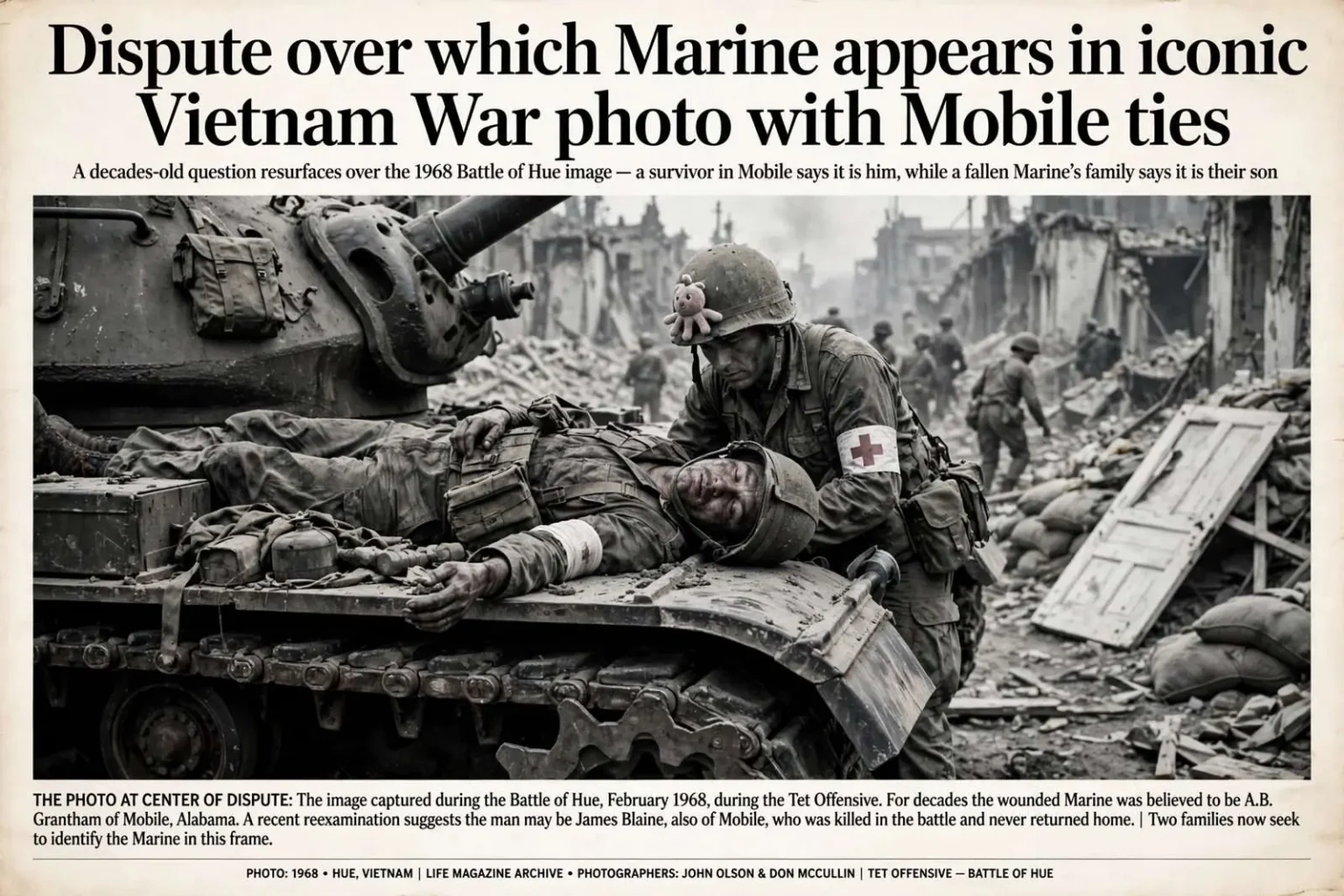
A decades-old question about one of the most enduring photographs of the Vietnam War has surfaced again, and it carries a distinctly Mobile connection. The image, published in Life Magazine, captures the struggle of young Marines during the war and the 1968 Battle of Hue — and for years, the Marine lying on the fender of a tank was believed to be Mobile’s A.B. Grantham. A recent New York Times feature, however, points to someone else.
Grantham still maintains he is the man at the center of the picture. His story was recently featured in a chapter of Mark Bowden’s book about the Battle of Hue, the widely read account that revived the battle’s place in the war’s memory and brought its survivors’ stories back into print half a century after the fighting. But the family of another Marine, James Blaine, believes it is him on the tank — and Blaine did not come home alive.
“James, being the hero of the bunch, he gave his all, he gave everything, he didn’t make it back and his family I’m sure is devastated still,” Grantham said.
The dispute sits at the intersection of memory, identity and the strange permanence of a single photograph. Images from Hue became the war’s most indelible record of how brutal the urban fighting was, and when one picture bears a person’s face for half a century, that picture becomes part of who he is — which is why both the surviving Marine and the fallen Marine’s family have a stake in the answer. There is no version of the dispute in which one side simply drops it.
The Battle Behind the Photograph
The Battle of Hue was the longest and among the bloodiest fights of the 1968 Tet Offensive, when North Vietnamese and Viet Cong forces overran much of the old imperial capital in the opening hours of the offensive and American and South Vietnamese troops fought house by house to take it back. The city fighting — block by block, wall by wall, with neither side willing to give ground — produced casualty levels and images that changed how Americans understood the war they were watching.
Marines moving through Hue fought in conditions the Corps had not faced in the war to that point: dense urban terrain, snipers in the citadel’s towers, trenches and hedgerows converted into strongpoints, and wounded men who had to be carried across open ground under fire. The photograph at the center of this dispute belongs to exactly that world — a wounded Marine on the fender of a tank, with the machines and the men around him marked by days of fighting.
Life Magazine’s photographers documented the battle for the home front, and the images the magazine published became the primary visual record of Hue for Americans who would never see it. In that era a single photograph in Life carried more cultural weight than a week of news footage, and the men in its frames became, for the public, the faces of the battle.
At issue are two pictures taken by two different photographers at the time — one by John Olson and an earlier one by Don McCullin. Both show a corpsman with a toy octopus tucked into the headband of his helmet, and both show the white door used as a stretcher for the wounded Marine. Those matching details are what make the two frames so consequential: they capture the same moment in the same place, minutes apart, from two cameras.
Two Photographers, One Moment
John Olson shot for the Stars and Stripes and other outlets during the Vietnam War, and his Hue work became some of the most recognized photography of the conflict. Don McCullin, the British photojournalist whose war photography spans a half century of the twentieth century’s conflicts, passed through Hue earlier in the battle and exposed frames that closely parallel Olson’s. The overlap is the photographers’ misfortune and the historians’ opportunity — two witnesses, one scene, each image authentic and each incomplete.
The matching details between the frames function like forensic evidence. A corpsman wearing the same toy octopus in his helmet band, a white door pressed into service as a stretcher, a wounded Marine on the fender of the same tank: taken together, the two photographs document a single episode rather than two separate incidents. That is precisely why the question of who lies on the tank matters — the two frames bracket one moment in one Marine’s life, and only one name can fill the frame.
For the Times, reexamining the images decades later meant digging into chronology — which frame was exposed first, what the records of the Marines’ movements say, who was wounded where and when. Photography-based identification of that kind has matured enormously since 1968; the kind of scrutiny modern photojournalism historians apply to disputed images simply did not exist when Life first published the picture and when the men in it came home.
Grantham’s case rests on his own memory of being wounded and carried — the story he has told for decades, the one he repeated to Bowden’s readers and still tells today. The Blaine family’s case rests on their belief that the wounded man is the Marine they lost, a belief given weight by the fact that James Blaine never had the chance to say otherwise. Between those two claims sits a photograph that cannot speak for itself.
What the Picture Means Now
The photograph’s power has only grown with time. It circulates in histories of the war, in classroom materials, in the visual shorthand used whenever Hue is remembered, and in the chapters of Bowden’s book that brought the battle to a new generation of readers. Whoever the wounded man is, the image has carried his face through five decades of the war’s memory — a weight that both families feel, in very different ways.
For Mobile, the dispute gives the national story a local address. Grantham came home to the Gulf Coast and built a life, and the picture long attributed to him has been part of that story locally — a Mobile Marine in one of the war’s most famous frames. The Times’ reexamination does not change where he is from; it changes which man the photograph remembers, and Mobile’s connection to the image now runs through a question rather than an answer.
The case also illustrates how the Vietnam War’s record continues to be revised. Fifty years on, the battle’s photographs are still being examined, its chronologies still being corrected, and its participants still being identified — sometimes against what survivors remember, sometimes in their favor. The truth of the tank fender may eventually be settled by the archives; until then, it remains what it has been for decades: an enduring image, a Mobile man who says it is him, and a family who says it is the Marine who never came home.
War photography of the Vietnam era worked under constraints that make disputes like this one hard to close. Film had to be flown out of the country and developed before anyone saw what the frames held; photographers worked fast under fire and often did not learn their subjects’ names; and captions were written stateside, sometimes days or weeks later, from whatever information reached the editors. The result is a visual record that is authentic in every frame but often uncertain in the details that matter most — including who the subjects were.
The white door and the toy octopus are what photographers call anchor details, and they are why historians treat the two frames as the same scene. Doors became stretchers all over Hue — the fighting had destroyed the city’s ambulances along with much else — and a child’s toy riding in a corpsman’s helmet band is the kind of detail no two separate incidents would coincidentally share. Identification disputes in war photography often turn on exactly this kind of trace evidence, matched against unit records and the timing of the photographers’ movements.
For the families, meanwhile, the photograph has carried a different weight for fifty years. The Blaine family’s claim belongs to the widows, siblings and children of a Marine who died at Hue and was buried as one of the battle’s dead — a family that looks at one of the war’s most famous images and sees the last known picture of their father, brother or son. Grantham’s claim belongs to a survivor who has carried the image as proof of his own survival story. The Times’ feature put both claims on the record; the photograph, half a century later, is still being argued over by the people it touched.
Which is, in the end, what has kept the question alive for five decades — a photograph this powerful does not let go of the people in it, or the people who believe it is theirs.


