
Distinguished Young Women Contestants Perform for Child Patients in Mobile
Distinguished Young Women contestants from across the U.S. performed for patients at USA Children's and Women's Hospital in Mobile.
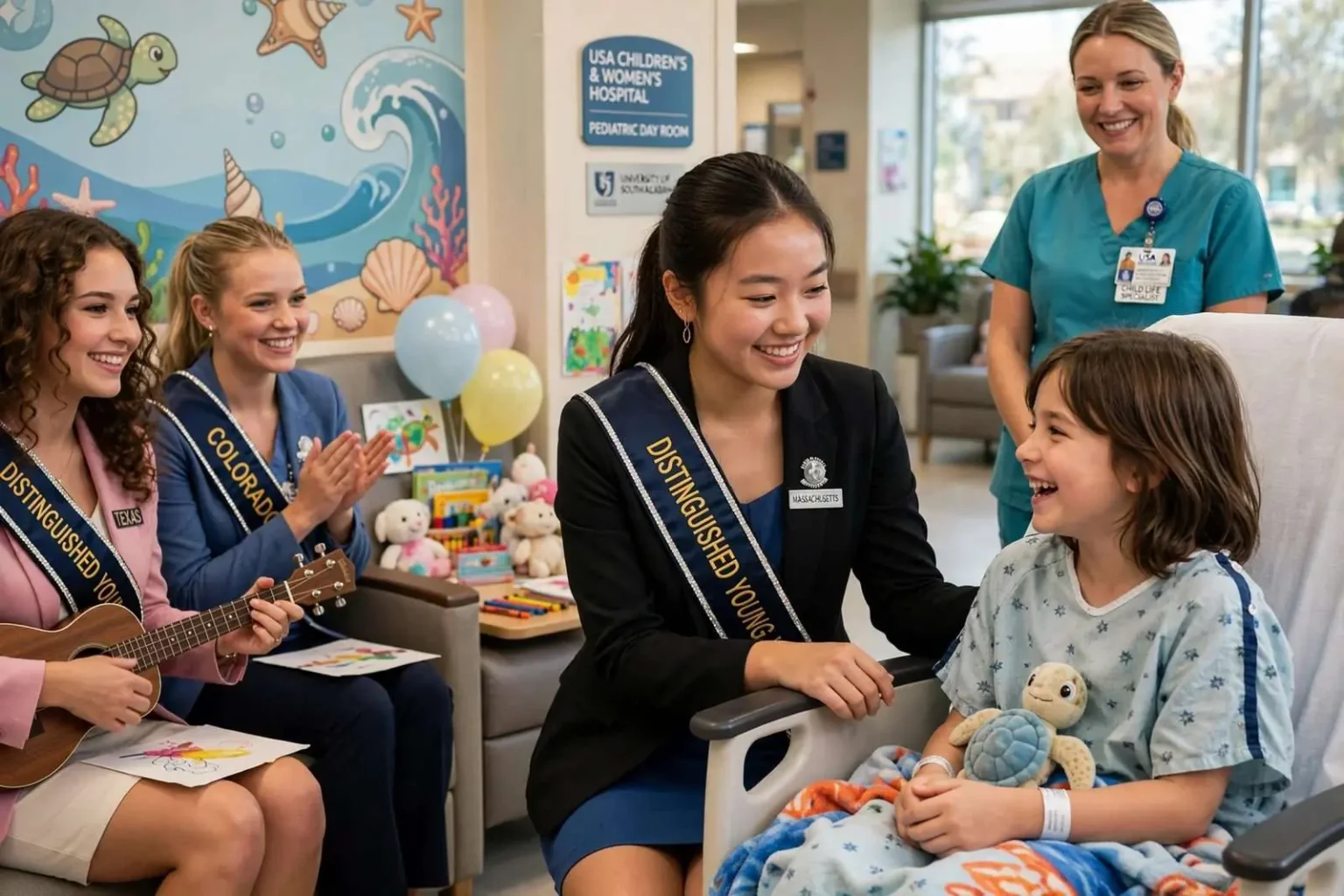
Young women from all 50 states gathered in Mobile for the Distinguished Young Women competition, and on Wednesday morning the contestants took a break from competing to visit patients at USA Children’s and Women’s Hospital.
The group performed for the children, hoping to bring a few smiles to kids spending time in the hospital. Singing, dancing and visits room to room gave young patients a morning diversion, and contestants said the stop was among the most meaningful of their two weeks in Mobile.
Mina Liang, a contestant from Massachusetts, said lifting the patients’ spirits is a big part of what the program is about.
“I think just seeing the smiles on their faces and just trying to make these kids laugh is a big part of this program — just being able to inspire people around us is just what we’re here to do,” Liang said.
The hospital visit is one of the ways the national finalists connect with the Mobile community during their two weeks in the Port City.
A Break From the Competition
The Distinguished Young Women national finals bring contestants to Mobile each June from every corner of the country, filling two weeks with rehearsals, preliminary competitions, fitness and self-expression evaluations, and community appearances. Wednesday morning’s hospital visit offered a change of pace from the stage — and, contestants said, a reminder of what the program’s emphasis on service is meant to be about.
The visit to USA Children’s and Women’s Hospital put the finalists in front of young patients receiving care for conditions ranging from premature birth to cancer treatment. For children spending days or weeks in a hospital room, the contestants’ performances and personal visits offered a burst of the outside world — music, costumes, laughter — delivered room by room and in common areas of the hospital.
Hospital staff have long welcomed such visits, noting that the therapeutic value of a diversion for young patients is real: laughter and engagement ease the stress of hospitalization for children and give parents a welcome break from the routine of care. For the contestants, many of the same age as older pediatric patients, the encounter with children their own age or younger facing serious illness leaves a lasting impression.
About Distinguished Young Women
Distinguished Young Women, known for decades as America’s Junior Miss, has held its national finals in Mobile since the program’s founding in 1958. The program describes itself as a scholarship competition built not on beauty but on achievement: contestants are evaluated on academic performance, interview skills, talent, fitness and self-expression, with scholarships awarded at local, state and national levels.
Each of the 50 states sends a representative to the national competition in Mobile, making the two-week stay in the Port City a genuine cross-section of the country. Contestants arrive in June, stay with host families and volunteers, and pack the calendar with rehearsals and appearances that culminate in the national finals at the Mobile Civic Center.
The service dimension runs through the entire program. Participants are expected to be active in their communities, and the national finals build community engagement into the schedule itself — school visits, civic appearances and charitable stops like the hospital visit. Program officials describe those appearances not as publicity for the contestants but as the embodiment of what the scholarship program is trying to recognize and encourage.
The Hospital in Midtown Mobile
USA Children’s and Women’s Hospital, operated by the University of South Alabama on Spring Hill Avenue in Midtown, is the region’s specialty hospital for women’s health and pediatric care. It serves not just Mobile but the entire Gulf Coast region — families from Baldwin County, south Mississippi and the Florida Panhandle come to its neonatal intensive care unit, its pediatric oncology ward and its children’s emergency department when care close to home is not enough.
Because of that regional role, many of the children the contestants met Wednesday are, like the finalists themselves, far from their own hometowns. The symmetry was not lost on the contestants, several of whom said the visit gave them a new appreciation for the families who spend weeks living at a child’s bedside.
Hospital child life specialists — the professionals who manage therapeutic play and patient activities — coordinated the visit, as they do with community groups throughout the year. Performances and visits are timed and routed to respect patients’ medical schedules, so that children well enough to participate can enjoy the event without disrupting treatment.
Two Weeks in the Port City
The hospital stop was one entry on a long calendar. During their two weeks in Mobile, the contestants stay with area host families, a tradition that has made hundreds of local households part of the program across generations. Mobile’s civic organizations, businesses and volunteers run the logistics of the national finals — a scale of community involvement that has kept the program in its founding city for more than six decades.
Between rehearsals and preliminary competition, appearances take the contestants into schools, civic clubs and community events across the Mobile area. For many of the young women, the visits are their first extended exposure to the Gulf Coast, and program alumni frequently describe their Mobile summers as formative — the beginning of friendships and a network of accomplished peers that lasts well beyond the awards ceremony.
The national finals themselves award college scholarships, with additional scholarship money distributed through the preliminary rounds and state programs. But organizers have always insisted the program’s true product is not the prize money — it is the pattern of achievement and service the program builds into the lives of young women who arrive as state representatives and leave, after two weeks in Mobile, as part of a national community.
What the Visit Meant to the Contestants
For contestants who have spent months preparing talent routines and interview answers, the hospital visit reorders priorities in a single morning. Many of the finalists arrived in Mobile focused on the competition ahead; the visit to the pediatric wards confronted them with an audience whose approval cannot be rehearsed for and whose circumstances dwarf any scorecard.
Liang’s reflection — that seeing smiles and making the children laugh is a big part of what the program is about — echoed what contestants have said after hospital visits for years. The program’s emphasis on being “distinguished” in scholarship and achievement is, in moments like these, translated into something simpler: the ability of a young woman to brighten a child’s day.
Contestants described the visits as exchanges rather than performances. Children asked questions about the contestants’ home states, their talents and their plans; patients well enough to leave their rooms joined the gatherings in common areas; and hospital staff noted that the energy of a visit can linger in a ward long after the visitors have gone.
A Tradition of Community Appearances
The hospital stop sits within a longer tradition. Community appearances have been part of the national finals since the program’s earliest decades, when Junior Miss contestants visited Mobile schools and civic groups each June. As the program grew into a national institution, those appearances grew with it, becoming a deliberate part of how the finals connect a national event to its host city.
Local organizations have come to count on the visits. Schools welcome the state representatives into classrooms, where their stories of achievement serve as peer examples for Mobile students. Civic clubs put the finalists on their luncheon programs. And healthcare facilities, senior centers and charities around the city host stops that put the contestants’ energy to work in the community.
For Mobile, the visits are part of what makes hosting the national finals feel like more than a convention. The city has been the program’s home since 1958, and the relationship between the program and its host city is renewed each June through exactly these kinds of appearances — moments when the contestants step off the stage and into the life of the city.
The Finals Ahead
The hospital visit came in the middle stretch of the contestants’ two weeks, with the national finals still ahead. The competition calendar builds through preliminary rounds — fitness, self-expression, talent and interview categories — before the finals evenings at the Civic Center determine the national winner and the distribution of scholarship awards.
Whatever the competition’s outcome, the two weeks in Mobile conclude with the same tradition for all 50 representatives: a network of peers, a community that has gotten to know them, and a set of memories from appearances like the Wednesday morning visit to USA Children’s and Women’s Hospital.
For the children at the hospital, the morning’s performances will fade into the routine of care and recovery. But the smiles Liang described — and the laughs the contestants worked for — were exactly what the visit was designed to produce, one room at a time.
The program’s organizers say that is the point. Distinguished Young Women measures achievement on a stage, but the quality it is trying to cultivate shows itself off the stage — in a hospital hallway, in front of an audience of children who needed a reason to smile.


