Documentary Spotlights the Wild Beauty and Fragile Future of the Mobile-Tensaw Delta
A new documentary, “America’s Amazon,” premiered at Mobile’s Saenger Theatre, showcasing the Mobile-Tensaw Delta’s rare wildlife while examining the pollution, runoff and weak enforcement threatening its future.
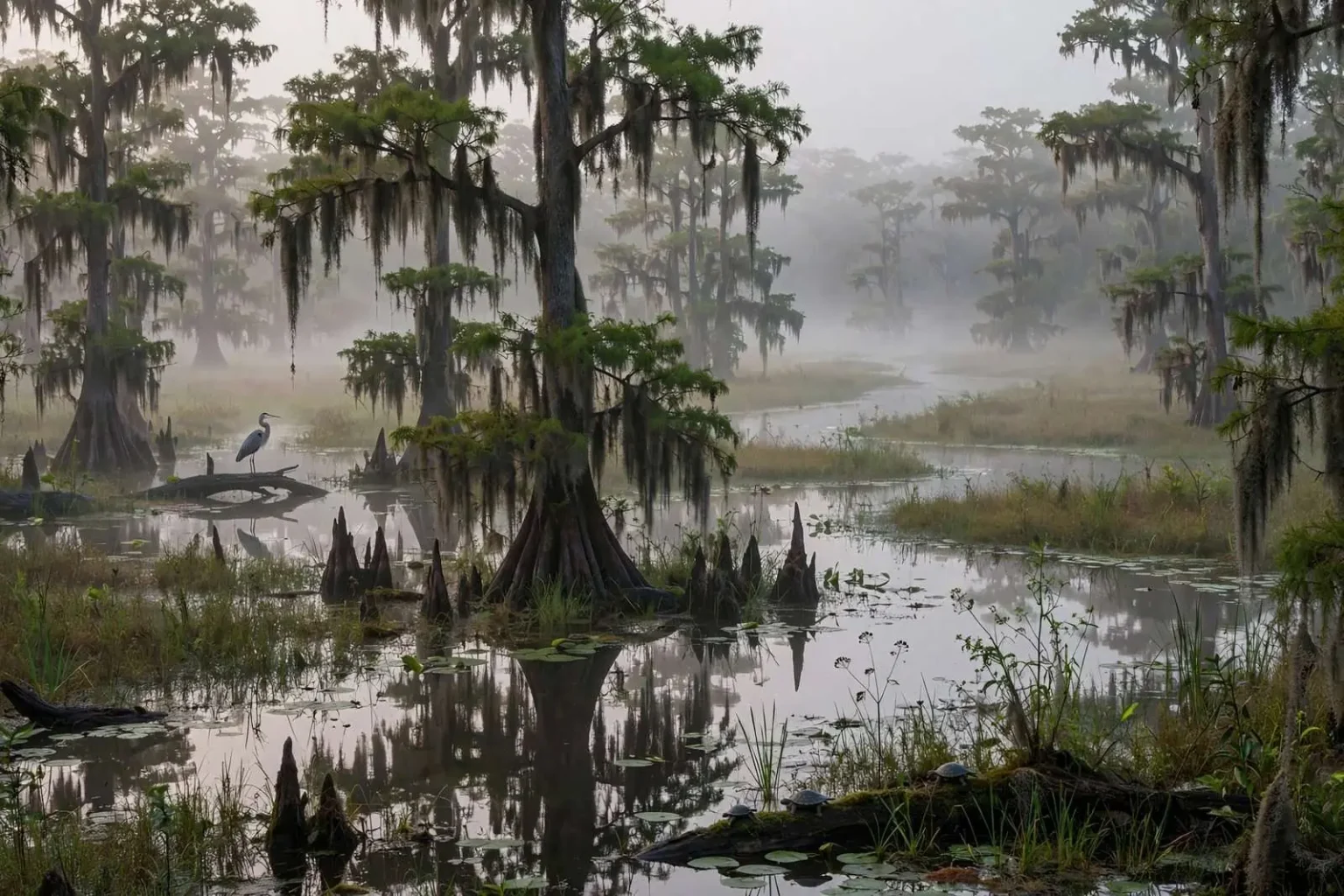
A new documentary exploring the vast wilderness of the Mobile-Tensaw Delta had its Mobile premiere at the historic Saenger Theatre on Dec. 3, drawing attention to one of the largest river delta systems in the country and the environmental pressures it faces. The screening brought an audience that routinely fills the historic downtown theater for concerts and touring shows out for a different kind of night: a close look at the swamps, creeks and bayous that begin practically at the city’s back door and stretch north for dozens of miles.
The film, titled “America’s Amazon,” runs just under an hour but covers vast ground, both literally and figuratively. The delta itself spans roughly 300 square miles and more than a quarter million acres, stretching from the Causeway near Mobile north to the Grove Hill area in Clarke County. It is considered one of the most biologically diverse river systems in North America, and the film sets out to show why that diversity matters and what threatens it. Scientists have long pointed to the sheer density of species found in the delta — freshwater fish, turtles, mussels, wading birds and predators large and small — as something found nowhere else at that concentration on the continent, and the movie puts that claim on screen rather than leaving it in academic journals.
The documentary had its public debut at the Fairhope Film Festival on Nov. 8, where it drew positive reviews before its screening for a Mobile audience at the Saenger. The Fairhope showing made sense as a starting point: the Eastern Shore sits directly along the delta’s edge, and many of the film’s subjects — the bays, the creeks, the development pressures — play out in Baldwin County’s own backyard.
The Man Behind the Camera
It was written and co-produced by longtime environmental journalist Ben Raines, who spent 13 years covering the region’s ecology and natural resources before leaving the newspaper business earlier this year to become executive director of the Weeks Bay Foundation, a nonprofit focused on preserving coastal Alabama habitat. Raines built a regional reputation on stories that mixed adventurous reporting with hard environmental science, and the film functions as a capstone to that decade and a half of work.
Much of the film’s footage draws on stories Raines chased over the past decade, brought to life with sweeping aerial shots of winding creeks and stream banks shrouded in morning fog. Viewers accustomed to seeing the delta from the Causeway or a boat ramp get a perspective few ever witness — the braided channels and flooded timber from several hundred feet up, stitched together into a landscape that looks less like a backyard and more like a wilderness of national-park scale.
Alligators and snakes make appearances, including one scene of a snake swallowing a frog, but the film also captures rarer sights. Cameras follow a biologist coaxing an endangered Red Hills Salamander out of its burrow with a cricket dangled on a wire, and revisit the rediscovery of the Rusty Gravedigger, a crawfish species once believed extinct until it turned up in a bayou near a Daphne sewage treatment facility a few years ago. The salamander, found only in a handful of counties in south-central Alabama, has become a symbol of how much remains unstudied in the state’s forests and waterways, while the gravedigger’s reappearance became one of the region’s most celebrated biology stories of recent years.
Manatees drift beneath the murky surface during their seasonal migrations from Florida, and newly hatched pelicans, still featherless, bob awkwardly in search of food. The presence of manatees on the Gulf Coast is itself a marker of the delta’s reach — the same waters that shelter them connect coastal Alabama to the Caribbean and the Gulf’s broader ecology.
The film also revisits a 15,000-year-old submerged forest documented roughly 10 miles offshore and 60 feet underwater in the Gulf of Mexico, along with a hollow cypress tree near Rice Creek measuring more than 27 feet in diameter, spared from logging only because loggers had no use for it. The underwater forest, revealed by storm-swollen seas and divers’ cameras, preserved the remnant of a coastline that stood exposed when sea levels were dramatically lower at the end of the last ice age. The giant cypress, hollowed out over centuries, escaped the saws that took nearly everything else of its size because the rot in its core made it worthless as lumber — an accidental preservation that now gives researchers a living witness to centuries of the region’s climate history.
The delta is shown through all four seasons, from its spring bloom to its winter floods. The seasonal arc matters to the film’s argument: the system’s productivity depends on the natural pulse of high water and low, the cycles that move sediment and nutrients from the river bottoms down into Mobile Bay and out into the Gulf. In one scene, Baldwin County real estate developer Pat Ogburn navigates a boat through flooded timber to what he calls a “hidden lake,” a stretch of water with no other people in sight and, by his account, excellent fishing. The scene is a quiet reminder that even as the delta’s edges attract subdivisions and marinas, enormous reaches of it remain wild enough that a visitor can spend a day on the water without seeing another soul.
Where the Tone Shifts
Around the midpoint, the tone shifts. More than a century of unchecked logging scoured the delta and filled it with runoff, the film explains, while development along its edges compounded the damage. The old-growth cypress and tupelo that once lined the channels were cut in waves that began in the 1800s, and the sediment loosened by cutting and ditching has been working its way through the system ever since.
Native mussel species have been wiped out and much of the lower delta’s seagrass beds have disappeared. Freshwater mussels, among the most sensitive animals in any river system, filter water and signal its quality; their loss is both an ecological blow and a warning light. Seagrass, meanwhile, once provided nursery habitat for fish, crabs and shrimp throughout lower Mobile Bay, and its decline has been measured in acreage that once supported thriving populations.
Chemical plants upstream have deposited mercury and arsenic into the watershed, which researchers believe may explain why the local osprey population reproduces at two to three times lower a rate than osprey in the Florida panhandle. Ospreys sit near the top of the aquatic food web, so contaminants that accumulate in fish end up concentrated in the birds — making their nesting success a rough index of the watershed’s overall health.
The delta has survived those pressures but has not thrived, according to the film, in part because dams throughout the state have altered its natural hydrology. Migratory fish species have declined as they lose access to historic spawning grounds further upstream. Species that once ran from the Gulf and the bay into free-flowing river reaches to spawn now hit barriers where their ancestors found gravel beds and current, and the film argues that the cumulative effect has quietly reshaped what lives in the system.
The film also highlights the state’s limited environmental enforcement, noting that the agency responsible acknowledged its budget and staffing fall far short of what would be needed for robust oversight. “We have laws on the books that address these issues but they aren’t enforced in any meaningful way,” Raines said following the Saenger screening. “ADEM is underfunded by the state.” The Alabama Department of Environmental Management is the state’s primary regulator for water quality and industrial permits, and critics have long argued that its funding, drawn heavily from fees and federal pass-through money rather than a robust state appropriation, leaves it outmatched by the scale of the watershed it polices.
The Most Immediate Threat
Raines said the most immediate threat to the delta comes from sediment runoff, an invisible but corrosive force that can smother river bottoms and bays over time, pointing to the decades-long degradation of Daphne’s D’Olive Creek and bay as an example. D’Olive Creek has become the textbook case in coastal Alabama: as development climbed the steep slopes of the D’Olive watershed between Daphne and Spanish Fort, stormwater scoured the creek’s channels and carried sediment downstream into the bay, clouding water, burying habitat and converting a clear-water system into a turbid one. What looks like a mud problem is, in ecological terms, a wholesale loss of the stream and bay bottoms that fish and shellfish depend on.
While state funding for environmental protection remains limited, Raines said he hopes some of the hundreds of millions of dollars in criminal fines stemming from the 2010 BP oil spill could eventually be directed toward restoring and protecting the delta. The settlement money flowing from the Deepwater Horizon disaster is being allocated through federal and state restoration processes along the Gulf Coast, and coastal Alabama advocacy groups have made the case that the delta — though it escaped the worst of the oiling on the beaches — is exactly the kind of system those funds were intended to heal. Projects that would restore flow, rebuild shorelines and purchase conservation land are the sort of work the money could fund at meaningful scale.
Reaching a Wider Audience
Following its Mobile debut, “America’s Amazon” is scheduled to air four times on Alabama Public Television in January. The broadcasts will carry the film into living rooms across the state, including many well north of the delta’s Clarke County headwaters, where the rivers that feed the system begin. Raines said he hopes the film eventually reaches state lawmakers and finds a place in grade school science curriculum, reasoning that a generation that grows up understanding the delta’s ecology will be more likely to defend it — and that legislators who grasp the economics of a healthy watershed will be more willing to fund the agencies charged with protecting it.
The hope for classroom use reflects a broader conviction among the film’s makers that the delta suffers less from hostility than from invisibility. Many Alabamians, including many in Mobile and Baldwin counties, have never paddled its creeks or understood that the same waters draining past their neighborhoods end up in the bay that defines the region’s identity and its seafood economy.
“The delta is an incredible resource and the time is ripe to make some changes,” Raines said. “I think we have a world class piece of nature here and we need to do what’s required to protect and conserve it.” For the audiences who filed out of the Saenger after the Dec. 3 premiere, the film made that case on its own terms — not as a requiem, but as an inventory of what remains, what has been lost, and what a state with a world-class delta could still choose to keep.