
Dog rescued from beaver traps in Mobile County
A dog caught in beaver traps in the Irvington and Theodore area of Mobile County was rescued by Animal Control and is recovering at the county shelter.
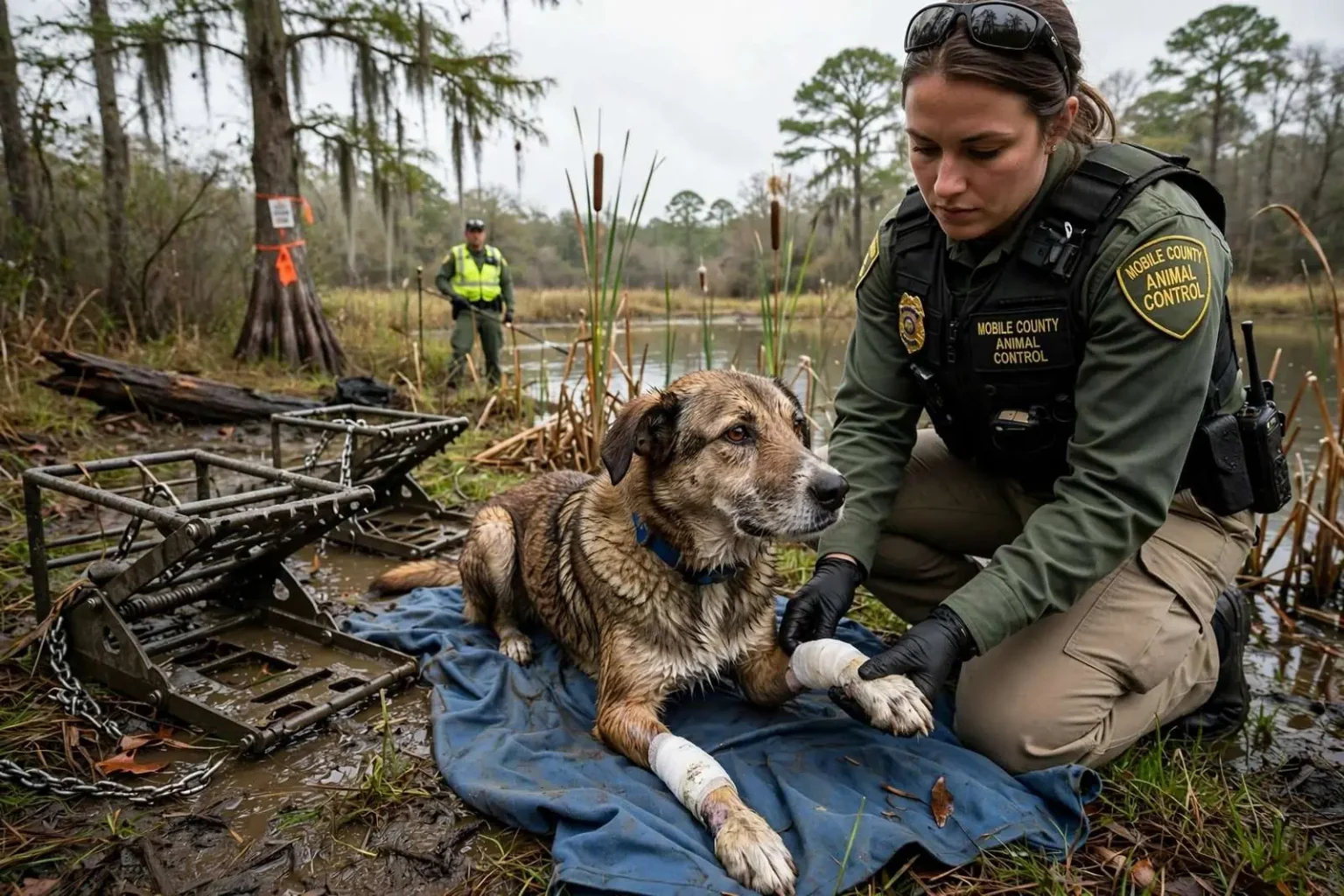
A dog caught in beaver traps in south Mobile County is recovering after a Tuesday afternoon rescue by animal control officers, in a close call that ended with the animal safe at the Mobile County Animal Shelter. The rescue began with a phone call from people who happened to be in the right place at the right time, and it ended with officers freeing a dog that had spent untold hours with both front feet locked in steel traps near a pond.
The Mobile County Animal Shelter said two Animal Control officers responded to a call from employees of FGS Surveyors, who were working in the Irvington and Theodore area when they came across the dog in need of help. The survey crew had been surveying secluded land, the kind of remote terrain where trapping is common and where a trapped animal might go undiscovered for days. Instead of driving on, the employees called the county, setting the rescue in motion.
Reaching the dog was not simple. After driving through a creek, the officers located the animal near a pond with both front feet trapped inside beaver traps. The traps were removed and the dog was transported to the Mobile County Animal Shelter, where staff could assess the injuries and begin care. Trapped animals are typically exhausted, dehydrated, and in pain, and the removal of a leg-hold trap requires care to avoid injuring the animal further, making the officers’ work on scene the decisive part of the rescue.
What beaver traps are and why they were set
Beaver traps are heavy, spring-loaded devices set at the water’s edge to catch beavers, whose dams and burrows can flood timberland, roads, and drainage systems across south Alabama. Landowners in rural Mobile County sometimes hire trappers or set traps themselves to manage beaver populations that back up creeks and ditches, and the practice is legal under Alabama regulations when conducted properly on the appropriate land. The traps, however, do not distinguish between a beaver and a stray dog investigating a pond bank, and domestic animals are caught in them with unfortunate regularity.
The pond setting in this case is typical. Traps placed along the waterline where beavers slide in and out of a pond can just as easily catch a dog following a scent or chasing wildlife, and a trapped dog cannot free itself from a device designed to hold a 40-pound rodent against its own strength. How long the dog had been trapped before the survey crew found it is not known, but animals caught in such traps face exposure, dehydration, and predation, and rescue within a day or two often makes the difference between recovery and tragedy.
The rescue and its aftermath
Shelter employees said the dog was doing well as of Wednesday morning, less than a day after the rescue, and would be examined by a veterinarian to determine the full extent of its injuries. Trap injuries to a dog’s front feet can range from bruising and torn pads to fractures and deep lacerations, and early veterinary evaluation is essential to prevent infection and assess whether the paws will heal fully. The staff’s early report that the dog was doing well was an encouraging sign after what the animal had been through.
The shelter is now hoping to find the dog’s owner. It is not clear whether the animal was lost or abandoned, but a dog found on secluded land miles from any neighborhood may have wandered a considerable distance, or been dropped there, before stepping into the traps. Owners searching for a missing pet in the Irvington, Theodore, and greater south Mobile County area are encouraged to check with the shelter, describe distinguishing features, and bring photographs or records that could confirm ownership.
Animal control’s work across Mobile County
The rescue highlights the day-to-day work of Mobile County’s Animal Control officers, who cover the unincorporated county and respond to calls ranging from stray animals and neglect complaints to injured wildlife situations like this one. Calls into remote terrain are a regular part of the job in a county as large and rural in stretches as Mobile County, where tracts of timberland, farm ground, and wetland sit between the county’s cities and suburbs. Officers routinely find themselves driving unmaintained roads and crossing creeks to reach an animal in trouble.
The role of the FGS Surveyors employees deserves note as well. Survey crews work some of the most secluded parcels in the county, walking land few people ever visit, and they are often the first to encounter abandoned animals, illegal dumping, or injured wildlife. A prompt call to animal control, rather than an attempted DIY rescue, gives the animal the best chance: officers have the equipment to release traps safely and the facility to provide immediate care.
What residents should do if they find a trapped animal
Residents who discover an animal in a trap, whether on their own property or on land they are working on, are advised to keep their distance and call for help rather than attempting a release themselves. Leg-hold traps are powerful enough to injure a rescuer’s hands, and a trapped dog in pain may bite even a well-meaning helper. Animal control officers have catch poles, gloves, and experience with frightened animals, and they can transport the animal directly for veterinary care. Trapped wildlife, such as raccoons or foxes, carries additional risks and should be left to professionals as well.
It is also useful to note the location carefully — GPS coordinates, nearby landmarks, the nearest road — so responders can find the site quickly. In this case, the survey crew’s report got officers to a spot that required driving through a creek to reach, the kind of detail that makes an address alone useless and a good description invaluable.
Trapping and pets in rural Mobile County
The incident is a reminder for pet owners in rural south Alabama. Dogs allowed to roam, or lost dogs traveling in search of home, cross property lines and waterways where traps may be legally set for beavers and other furbearers. Keeping pets confined or leashed near rural ponds and creeks greatly reduces the risk of a trap encounter, and owners of dogs that wander far are encouraged to use identification tags or microchips so that an animal picked up by animal control can be reunited with its family quickly.
For the trappers and landowners who legally manage beaver populations, awareness of the risk to domestic animals matters too. Checking traps frequently, as regulations and humane practice require, limits how long any unintended animal stays caught, and avoiding sets near trails or fence lines where dogs travel reduces the chance of a catch in the first place. The outcome in this case — a rescue in time and a dog recovering at the shelter — is the best-case version of an encounter that too often ends worse.
Reuniting a found dog with its owner
Now the focus shifts to the shelter’s effort to find the owner. A dog held at the Mobile County Animal Shelter is typically cared for while staff attempt to identify the animal through tags, microchip scans, and matching against lost-pet reports. Residents of the Irvington and Theodore area who have lost a dog recently should contact the shelter directly, and anyone who recognizes the animal from the shelter’s postings is asked to come forward with details that could confirm the match.
Until an owner is found, the dog’s recovery continues under shelter care, starting with the veterinary examination scheduled after Wednesday morning’s encouraging report. The journey from a creek-side pond, pinned by two steel traps, to a warm kennel and a waiting adopter or reunited owner is a long one, but it began with a survey crew’s phone call and ended with officers willing to drive through a creek to pull a stranger’s dog out of harm’s way.
Beavers and the south Alabama landscape
The reason traps were set near that pond is a story as old as south Alabama agriculture. Beavers are prolific across the Gulf Coast, and their dams can turn a small creek into an acre of flooded timber in a single season, drowning timber stands, washing out logging roads, and backing water into fields and drainage ditches. For rural landowners, an active beaver colony is a genuine economic problem, and trapping remains one of the standard tools for managing it, alongside dam breaching and water-level control devices. That makes encounters between traps and wandering pets a recurring hazard in the rural stretches of Mobile County and neighboring counties.
The Irvington and Theodore area, where the dog was found, sits in the southern part of the county, a patchwork of small farms, nursery operations, subdivisions, and large wooded tracts threaded with creeks and ponds. Secluded parcels like the one the survey crew was working are exactly where beaver trapping happens and where a lost dog could wander for days unseen. The geography that makes the area good habitat for beavers makes it easy for a trapped animal to go unnoticed.
The veterinary road ahead
The examination by a veterinarian will determine the dog’s prognosis. Trap injuries are often more serious beneath the surface than they appear: the spring force of a leg-hold trap can bruise muscle, damage tendons, or fracture bones even when the skin is barely broken, and a foot held immobile for hours swells and loses circulation. Treatment may involve antibiotics, pain management, bandaging, and rest, with surgery reserved for the more serious fractures and tendon injuries. Dogs that receive prompt care, as this one did within roughly a day of being found, generally have good outcomes.
Shelter staff will also evaluate the animal’s overall condition — weight, hydration, heartworm status, and temperament — as part of the intake process that prepares any found dog for reunification or adoption. The animal’s demeanor through the ordeal, from the creek-side rescue to a Wednesday morning of doing well, suggests a dog with the resilience to come through the medical care ahead.
A community effort in miniature
The rescue is worth retelling because of how many small decisions it took to succeed. Surveyors on secluded land could have noted the dog and moved on, burdened by their own work; they called instead. Animal control could have deferred a response to remote terrain with creek access; two officers drove through water to reach the animal. The shelter could have simply processed an intake; staff reported the dog’s progress publicly and asked for the owner to come forward. Each step is ordinary on its own, and together they saved a dog’s life.
For now, the dog rests at the Mobile County Animal Shelter, its paws healing and its story circulating among south Mobile County residents who may be the key to the ending. The shelter’s request is simple: anyone who knows this dog, or who has lost one matching its description in the Irvington, Theodore, or surrounding areas, should contact the shelter. After everything the animal survived, the best outcome left is the easiest one to give — a familiar voice on the other side of a kennel door.


