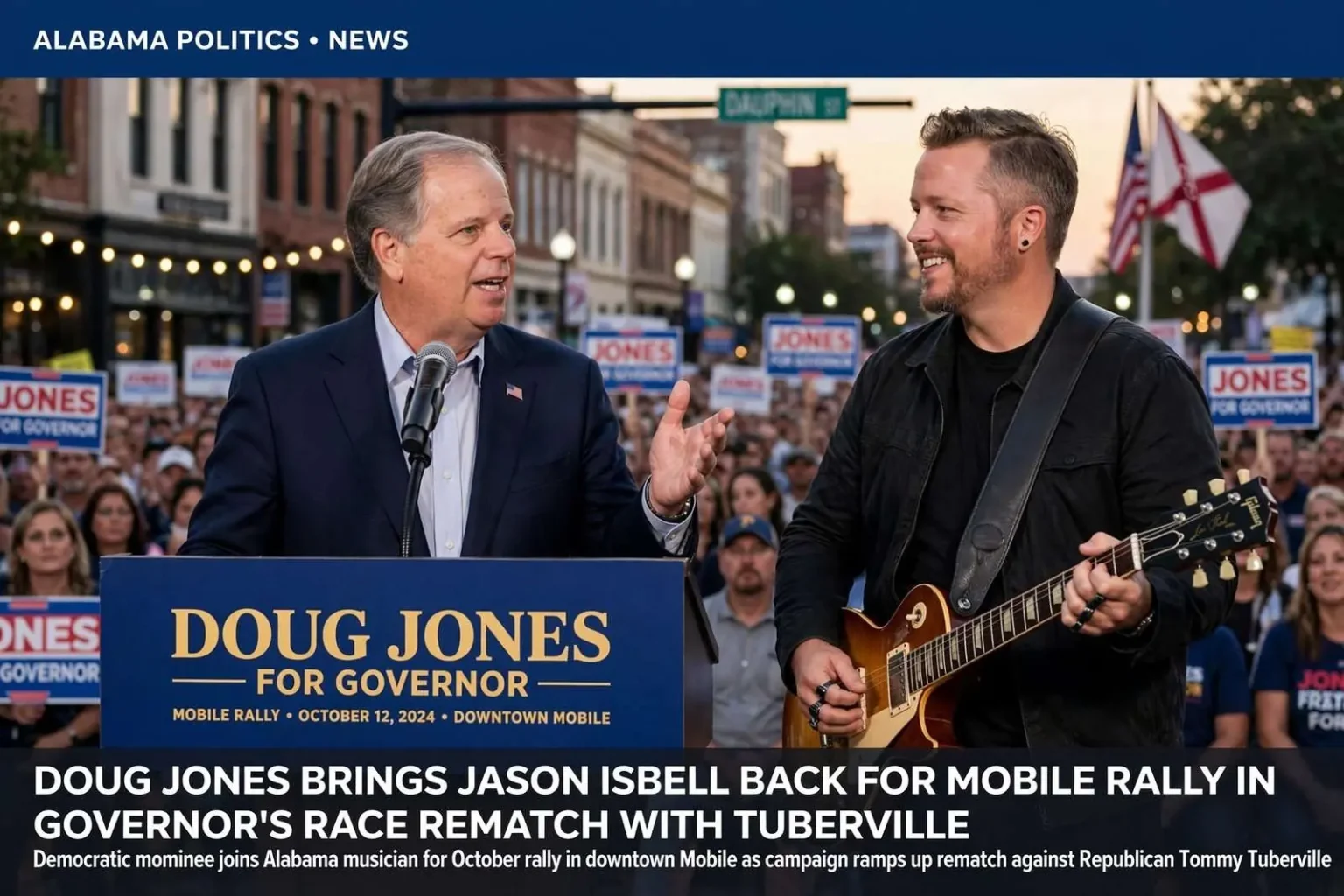
Former U.S. Senator Doug Jones, the Democratic nominee for governor, is bringing Alabama-born musician Jason Isbell back to the campaign trail for a rally next month in downtown Mobile, part of Jones’ rematch bid against Republican Tommy Tuberville. The pairing of the state’s best-known musician-activist with the Democratic ticket gives the campaign a headline event in south Alabama as the general election contest takes shape. Mobile has long been a must-visit stop for statewide candidates, and a rally with a marquee musical act is designed to draw the kind of crowd that ordinary campaign stops cannot.
The announcement
Jones previewed the event during a Sunday night video Q&A with supporters, telling viewers his campaign had “a big event” coming up in Mobile that would include “a big rally with Jason Isbell.” Campaign staffer Lillian Thomas said in a phone call Monday that the rally will be held in downtown Mobile, though she did not specify an exact location. The announcement strategy — a tease during a supporter call followed by confirmation through campaign staff — reflects the campaign’s effort to build anticipation through its network of volunteers before releasing full logistics to the public.
Isbell’s own touring schedule shows he’ll already be in South Alabama around that time — he and his band, the 400 Unit, are set to headline a show at the Halstead Amphitheater in Fairhope on Sept. 24, a show that kicks off the venue’s fall season. The scheduling overlap makes the rally a natural addition to the tour routing rather than a separate trip, allowing the Muscle Shoals native to campaign in his home state without disrupting a national touring calendar. Amphitheater dates across the Southeast anchor the band’s late-September schedule, with the Fairhope show placing the group across Mobile Bay in the days surrounding the planned rally.
A rematch years in the making
Jones and Tuberville are headed for a second statewide matchup after both won their respective gubernatorial primaries in May. The pair faced off once before, in the 2020 U.S. Senate race, when Tuberville defeated Jones by roughly 20 percentage points. That contest, decided during a presidential election year, gave Tuberville a decisive victory in a state that has leaned Republican in federal races for decades. The gubernatorial rematch unfolds under different conditions — a state race, without a presidential ticket at the top, in which turnout patterns and the campaigns’ ground games matter differently — and both campaigns are building their strategies around those distinctions.
For Jones, the rematch carries the weight of defending the seat he won in the 2017 special election, a victory that made him the first Democrat elected to the Senate from Alabama in a generation. His current campaign has emphasized retail politics — town halls, community visits, and organizer-driven events — as it works to build a coalition capable of competing statewide in a gubernatorial contest.
An outspoken ally
Isbell has campaigned for Jones for nearly a decade and has not been shy about his politics. Ahead of Jones’ 2017 U.S. Senate special election against Roy Moore, the singer headlined a free get-out-the-vote concert in Huntsville just three days before Jones won the race. He also performed for Jones during the senator’s 2020 reelection bid, playing an acoustic fundraising concert at Birmingham’s Lyric Theatre, and he returned to headline Jones’ gubernatorial campaign kickoff in Birmingham this past December. The decade-long partnership has made Isbell the most prominent musical surrogate in modern Alabama Democratic politics, appearing at every major campaign milestone of Jones’ statewide career.
The musician has used his platform to criticize Trump supporters, including in a 2018 interview in which he said Christians who backed Trump were not following the example of Jesus and separately remarked that “God is gone from those people” when describing rural Trump voters. The comments, made in the national press at the height of the Trump era, made Isbell a polarizing figure in his home state — celebrated by Alabama’s progressive listeners and criticized by many in the conservative majority whose votes his hometown’s politics depend on. His willingness to say what he thinks has become part of his public identity, and his rallies for Jones double as expressions of a worldview that divides the state’s electorate sharply.
He has also campaigned for Democrats outside Alabama and appeared at the 2024 Democratic National Convention. His political footprint extends well beyond his home state, with performances and endorsements for Democratic candidates in other Southern states and appearances at national party events that have raised his profile among the party’s base nationally.
Building momentum statewide
During Sunday’s Q&A, Jones said his campaign has been drawing large crowds at town halls across Alabama in recent weeks, including roughly 600 people who turned out in Huntsville. “We’re going all around,” Jones told supporters, adding that his campaign will likely make additional stops in Mobile ahead of the Isbell rally. The town hall tour has taken the candidate into communities across north Alabama, the Black Belt, and the Gulf Coast, a schedule his campaign points to as evidence of organizational reach in a state where Democrats have struggled to sustain local infrastructure.
The state of the race
Jones enters the fall as the underdog in a state Republicans have dominated statewide for a generation, but his campaign has shown signs of financial life. He outraised Tuberville in both June and July, according to campaign finance filings, though Tuberville retains a commanding edge in cash on hand heading into the final stretch.
Jones’ message has centered on kitchen-table issues: expanding Medicaid to protect rural hospitals, supporting a state lottery, addressing rising prices and a proposed moratorium on the large hyperscale data centers that have become a flashpoint in communities across Alabama. He has also campaigned aggressively on Tuberville’s Senate record, arguing the state deserves a governor focused on Alabama rather than Washington. In Mobile, the campaign opened a headquarters on Spring Hill Avenue with a Labor Day fish fry.
Why Mobile matters in a statewide race
Downtown Mobile has long served as the traditional stage for south Alabama campaign events, and candidates for statewide office schedule their Mobile stops with the knowledge that Mobile County’s size and its mix of urban, suburban, and rural voters make it a bellwether in general elections. The city’s Democratic-leaning precincts within a Republican-leaning county mirror the coalition any statewide Democrat must assemble: strong margins in the urban core, competitive performances in the suburbs, and enough rural support to stay within reach in the state’s conservative stretches.
Mobile County is also the state’s second-largest voter bloc, and its recent history tracks Jones’ fortunes: he carried the county in his 2017 Senate win, and losing it in 2020 was part of what doomed his reelection bid.
A concert rally aims at a specific slice of that coalition — younger voters and infrequent voters who respond to a cultural event more than a standard stump speech. Campaign organizers use concert rallies to build contact lists and recruit volunteers in a single evening, converting the excitement of a live show into the voter contact databases that decide close races. The Jones campaign’s decision to pair its Mobile rally with Isbell follows a playbook the two have run successfully before, most memorably in the 2017 special election that Jones won by less than two percentage points.
Isbell’s Alabama roots
Isbell’s standing in Alabama music runs deep. The Green Hill, Alabama native came up through the Muscle Shoals music scene, first as a songwriter and guitarist in the Drive-By Truckers before launching a solo career that has earned multiple Grammy Awards and a reputation as one of America’s most respected songwriters. His songs draw heavily on his north Alabama upbringing, and his connection to the Shoals music tradition — the fabled studio scene that produced decades of landmark recordings — gives him a home-state credibility few touring musicians can claim.
The 400 Unit, his longtime backing band, has toured behind a series of acclaimed albums that blend Southern rock, soul, and folk storytelling, filling amphitheaters across the country each summer. The band’s Alabama dates are perennial highlights of its touring calendar, and the Fairhope amphitheater show, perched across the bay from Mobile, gives South Alabama fans a rare opportunity to see the group without traveling to Birmingham or Atlanta.
The road to November
The rally lands at a pivotal stretch of the campaign calendar, when the general election contest moves from primary-season consolidation into the full-court push of the fall. Both campaigns will spend the intervening weeks rolling out policy platforms, advertising, and surrogate events across the state, with each stop designed to reinforce a regional or demographic argument. The Tuberville campaign, for its part, enters the general election with the structural advantages that Republican candidates have enjoyed in Alabama for decades, and its own schedule of events will test its reach into the same communities Jones is courting.
What comes next for the campaign
Campaign officials have not announced the rally’s exact venue or start time, with those details expected as the date approaches. Supporters tracking the campaign’s announcements can expect the standard cadence of a major event: a confirmation of logistics through the campaign’s channels, volunteer recruitment pushes in the days before, and a final round of reminders to the contact lists the campaign has built through its town hall tour. Mobile’s downtown venues have hosted campaign events of every scale, from intimate storefront stops to arena rallies, and the size of the expected crowd will shape the final site selection.
The rally also sets up a wider stretch of Isbell-connected campaigning for Jones, whose December kickoff in Birmingham established the pattern of pairing major campaign moments with the musician’s performances. Campaign analysts in both parties watch these events for the enthusiasm they generate — crowd sizes, volunteer sign-ups, and the social media reach of each appearance — as markers of whether a candidate’s organizing is converting into momentum. Jones’ campaign has leaned on those metrics as it argues that its town hall crowds, including the roughly 600 who turned out in Huntsville, signal a competitive race rather than a repeat of the 2020 margin.
The stakes of the rematch
The governor’s race will decide who leads the state through the next four years of budgeting, infrastructure spending, and the policy fights that define Alabama politics, and both candidates have framed the contest around the contrast between their records. Jones points to his Senate tenure and his career as a federal prosecutor, while Tuberville campaigns on the record of his Senate service and his alignment with the state’s Republican establishment. The Isbell rally gives the Jones campaign a signature moment in the state’s second-largest city, but the election will be decided across all 67 counties, in the same town halls and storefront stops that have defined the campaign’s summer.
Alabamians will choose between Jones and Tuberville on Nov. 3.
For now, the campaign’s message to supporters is the one Jones delivered Sunday night: a big event is coming to Mobile, with a big name attached, and the organizing that surrounds it — the canvasses, the phone banks, the additional stops he promised before the rally even happens — is where the campaign believes the race will actually be won.