Downtown Creative Wellness Foundation Awarded $2,000 Target Grant for Visiting Artist Series
Mobile's Downtown Creative Wellness Foundation has won a $2,000 Target grant to help fund its 2010-2011 Visiting Artist Series, boosting downtown's arts.
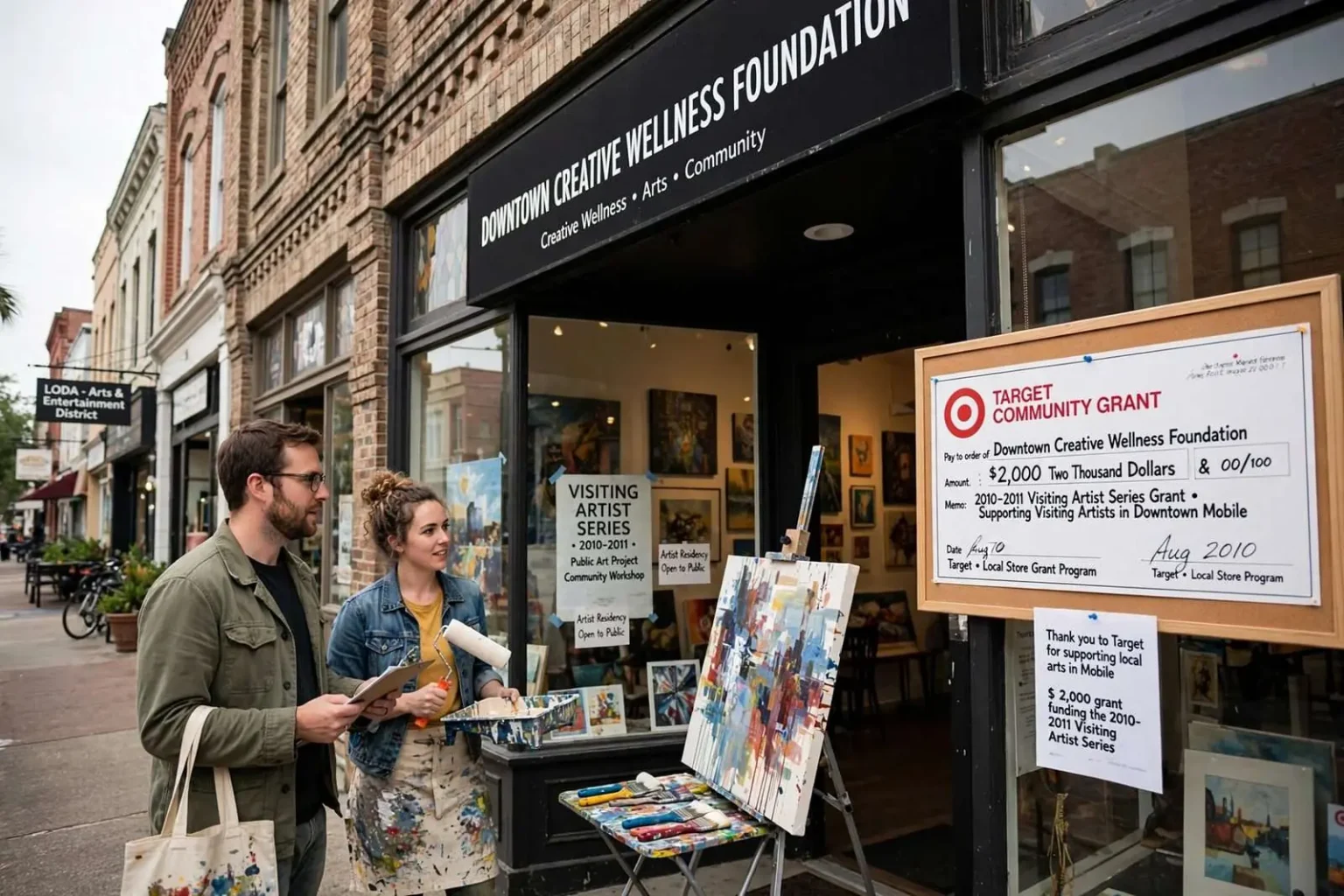
The Downtown Creative Wellness Foundation (DCWF), a Mobile arts nonprofit associated with organizer Zach Depolo, has been awarded a $2,000 grant from Target to help fund its 2010-2011 Visiting Artist Series.
The grant will support the foundation’s ongoing program of bringing visiting artists to downtown Mobile, part of a broader push by local arts advocates to grow the city’s gallery and exhibition scene outside of traditional museum spaces.
The Visiting Artist Series sits at the heart of DCWF’s programming. By bringing artists from outside the city to work in and around downtown Mobile, the program aims to expose local audiences to work they would otherwise have to travel to see, while giving visiting artists a platform — and often a residency-style working experience — in a market far from the major art capitals. For a city of Mobile’s size, that exchange is a meaningful cultural export-and-import operation run on a nonprofit budget.
Depolo has been a familiar name in Mobile’s arts community, including through his curatorial work turning bar and restaurant walls into informal gallery space for emerging local artists. That approach — using the venues where people already gather as exhibition space rather than waiting for formal galleries to open — became a signature strategy of Mobile’s independent arts scene, lowering the barriers for artists to show work and for the public to encounter it.
The model has practical advantages beyond convenience. Bars and restaurants draw steady crowds who never set foot in a museum, and artwork on their walls sells — or at least gets seen — in a way that work sitting in a studio does not. For emerging artists, an informal wall show can be a first step toward representation; for venue owners, rotating art adds atmosphere and a talking point. Curators like Depolo function as the connective tissue, matching artists to walls and keeping the rotation alive.
A boost for downtown Mobile’s arts scene
Target has for years run community grant programs that direct funding toward local arts, education and community organizations in the markets where the retailer operates, and the DCWF award is a small but tangible example of that model reaching Mobile. The retailer’s giving programs have historically emphasized local decision-making — grants awarded through area stores to organizations in their own communities — which is how a national corporate program connects with a grassroots foundation in downtown Mobile.
For a grassroots foundation like DCWF, a $2,000 grant can go a long way toward covering costs such as travel, materials and programming for out-of-town artists brought in to work with and exhibit alongside the local community. At the scale of small nonprofit arts programming, modest grants frequently determine whether a season of programming happens at all: transportation and lodging for a visiting artist, materials for a public project, and the miscellaneous costs of staging an exhibition are exactly the expenses that small organizations struggle to fund through door donations alone.
Details on which artists will take part in the 2010-2011 Visiting Artist Series had not been announced. The foundation was expected to reveal its lineup as the season approached, with each visiting artist’s program typically shaped around exhibitions, public projects or collaborative work involving Mobile’s local artist community.
The award adds to a series of small grants and fundraising efforts that have helped sustain Mobile’s independent arts organizations, which often rely on a patchwork of nonprofit funding, corporate grants and community donations to keep programming alive in the city’s downtown core.
That patchwork is the ordinary financial condition of independent arts organizations in a city of Mobile’s size. Without the endowments and membership bases that sustain larger institutions, grassroots groups assemble each season’s funding from a mixture of small grants, benefit events, volunteer labor and in-kind support — venue space donated, printing discounted, artists exhibiting for exposure and modest sales. The economics are fragile, but the model has proven durable, and corporate community-giving programs like Target’s provide one of the more reliable strands in the weave.
Downtown’s arts revival
The grant arrives during a period of visible momentum for downtown Mobile’s cultural scene. The city’s historic core — LoDa district and surrounding blocks — has spent years cultivating a mix of galleries, music venues, studios and the monthly art walk that draws crowds downtown, building on the neighborhood’s revival as an entertainment destination.
Arts advocates have long argued that a functioning gallery scene contributes to downtown’s economy in ways that extend past art sales: gallery nights bring foot traffic to restaurants and bars, working artists occupy studio space that might otherwise sit vacant, and a visible cultural scene helps the city compete for young professionals and creative businesses. Programs like the Visiting Artist Series feed that ecosystem, adding out-of-town energy and new work to the local mix.
The DCWF’s wellness framing — “Creative Wellness” in the organization’s name — also reflects a broader understanding of what community art does. The foundation’s work treats creative activity as a civic good in its own right, something that strengthens the community’s life beyond the economic ledger: art made and shown locally builds the relationships and shared identity that any downtown revival ultimately depends on.
For Mobile’s independent arts community, the Target grant is a modest sum that carries a larger significance — recognition, from a major corporation’s community-giving program, that the city’s grassroots arts infrastructure is worth investing in. The 2010-2011 Visiting Artist Series it will fund promises to keep new work flowing into downtown’s informal galleries, and to keep Mobile’s artists connected to the wider world of contemporary art that passes, increasingly, through their city.
The Visiting Artist Series model works, in practice, because it serves both sides of the exchange. Local audiences get exposure to artists and ideas that would never otherwise pass through Mobile; visiting artists get a venue, an audience and often the first sustained experience they have had working in a smaller Southern city. The relationships formed in such residencies frequently outlast the individual visits — visiting artists return, collaborate with local artists afterward, and carry word of the Mobile scene back to the larger markets they came from.
For the local artists who exhibit alongside visitors, the benefit is professional development of a kind that is hard to obtain locally. Showing work in the same program as artists from larger markets creates an informal benchmark — a way to gauge where their work stands — and often leads to the kind of peer networks that emerging artists in smaller cities build slowly, if at all.
The grant’s timing also coincided with a stretch of growing national attention to community art funding. Corporate giving programs had increasingly recognized that modest local grants — the $1,000 to $5,000 range — do disproportionate work in small organizations, where a few thousand dollars can be the difference between a full season of programming and a dormant year. Programs like Target’s filled a niche left by foundations whose application processes and award sizes favor larger institutions.
The mechanics of Target’s community giving made the award possible precisely because DCWF is embedded in its neighborhood. The retailer’s store-based grant programs put decisions in the hands of local employees and local advisory structures, meaning that organizations doing visible work within the community — the kind of programming that generates word of mouth among neighbors and store patrons — had a realistic path to support. A national foundation reviewing proposals from across the country might never have found a downtown Mobile grassroots foundation; the store-level program was built to.
Depolo’s organizing work illustrates the person-power behind Mobile’s independent scene. Curating rotating shows in bars and restaurants, coordinating artists and venue owners, and building a nonprofit to formalize the activity all represent unpaid or lightly paid labor — the invisible work that keeps a grassroots art scene functioning. Grants like this one, in addition to funding programming, serve as a form of validation for that labor: an outside funder examined the organization’s work and decided it deserved support.
How small grants sustain a scene
The economics of a visiting artist program bear out why a $2,000 grant matters. Travel to Mobile, lodging for a stay long enough to complete meaningful work, materials, and the costs of staging an exhibition — these expenses arrive before any artwork sells, and small foundations front them on faith. A grant that covers a substantial share of those costs for one visiting artist effectively underwrites an entire programming cycle that would otherwise drain the organization’s general fund.
Small organizations also use grants strategically as leverage. A corporate award like Target’s becomes evidence of credibility in applications to other funders; grant writers describe early corporate support as the seed that makes the next grant possible. Each award compounds the organization’s fundraising position, which is why even modest grants are celebrated in the small-nonprofit world.
The broader pattern in Mobile’s arts funding reflects what cities without major philanthropic institutions rely on: corporate community programs, local business sponsorships, and the dues-and-donations support of the artists and art lovers themselves. Museum-scale funding gets headlines, but scene-scale funding — grants in the low thousands, sponsorships of individual shows, donated venue space — is what actually keeps gallery doors open and programming on the calendar.
With the Target grant secured, DCWF’s immediate task is the programming itself: selecting the visiting artists for the 2010-2011 series, coordinating venues for their exhibitions, and integrating their work with the local artist community the foundation has spent years cultivating. The unannounced lineup will shape the season’s character, but the structure — visitors working and exhibiting alongside Mobile’s own — remains the model the foundation has built its identity around, now with a corporate funder’s stamp of confidence behind it.