Downtown Mobile Business Owners Skeptical as Two Civic Center Redevelopment Proposals Surface
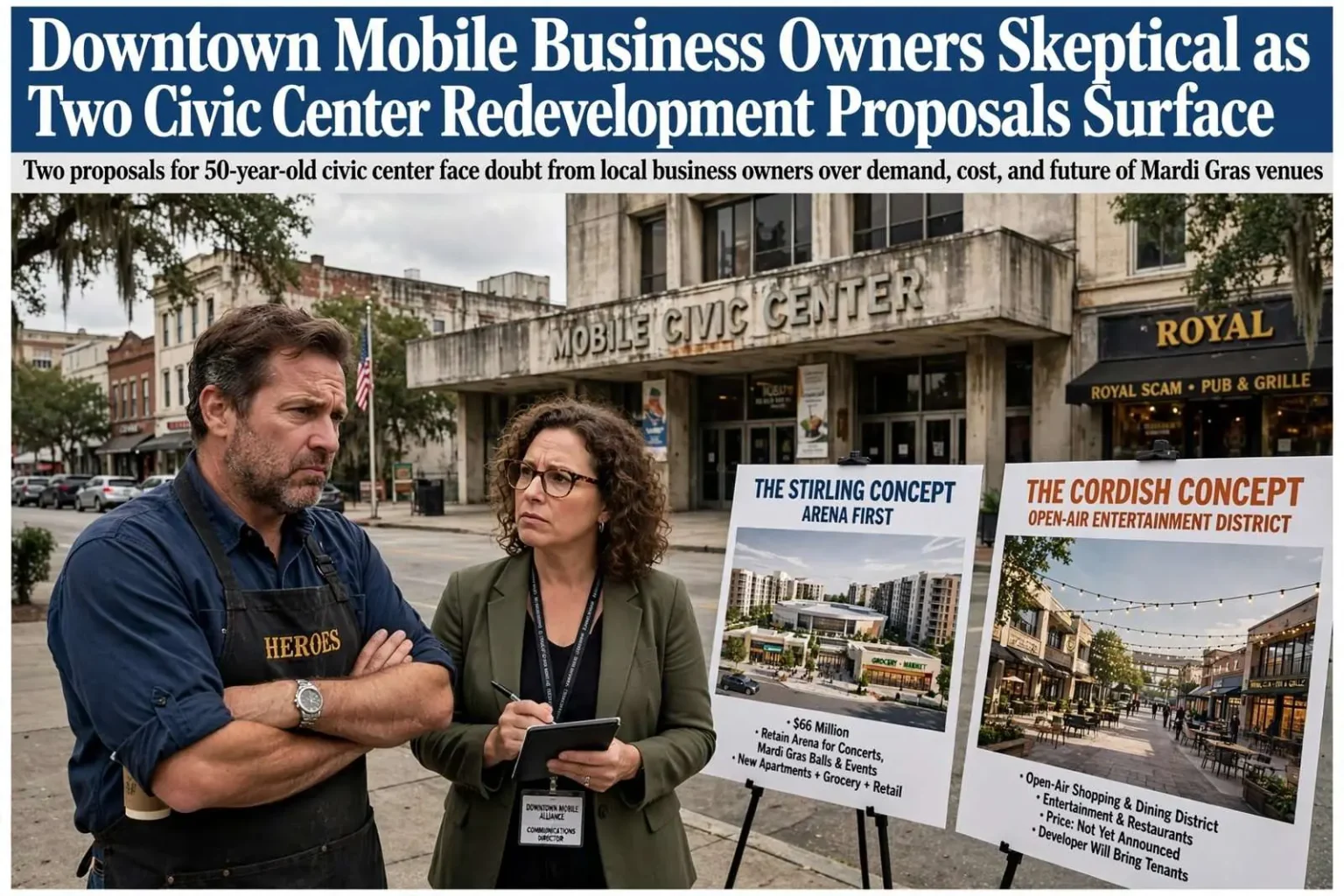
Stirling's $66 million arena concept and Cordish's open-air entertainment district drew skepticism from downtown Mobile business owners.
Two competing visions for redeveloping the Mobile Civic Center were presented to the Mobile City Council this week, and some downtown business owners are questioning whether either plan adds up. The city unveiled the proposals Monday for the roughly 50-year-old civic center property, which officials say needs significant repair.
One concept, developed by Stirling, would retain an arena and potentially layer in other uses such as apartment buildings or a grocery store, at a cost of roughly $66 million. The second, from Cordish, takes a more open-air approach — restaurants and shopping surrounding an entertainment district — with the developer arguing it would bring many of its own tenants to jump-start leasing and keep occupancy high. Cordish has not yet put a price on its plan.
The presentation marks the most concrete step yet in a debate that has hovered over downtown Mobile for years: whether to pour money into an aging civic landmark, replace it with something new, or clear the way for a different kind of development altogether. The two proposals pull in opposite directions — one preserving the city’s largest indoor gathering space, the other dismantling it in favor of street-level commerce.
The Stirling Concept: Arena First
Stirling’s plan keeps an arena at the heart of the property and contemplates adding residential and retail components — apartment buildings and potentially a grocery store — around it. The roughly $66 million price tag makes it the only proposal with a firm cost attached so far, a figure that covers retaining the arena function while repositioning the surrounding site for mixed uses that would put residents and daily foot traffic on the blocks nearby.
The apartment-and-grocery framing speaks directly to one of downtown Mobile’s most persistent challenges: the neighborhood is dense with offices, restaurants and attractions but thinner on full-time residents, particularly in the blocks immediately around the civic center. A residential component would add a permanent daytime and evening population to the area, and a grocery store has long been a missing piece of the downtown living puzzle.
Keeping an arena would also preserve the venue that serves as an anchor for the city’s signature events. The civic center has historically hosted the balls and celebrations of Mobile’s Mardi Gras organizations, along with concerts, graduations, conventions and exhibitions, and any plan that eliminates that indoor capacity raises the question of where those events would go.
The Cordish Concept: Open Air and Entertainment
The Cordish proposal takes the opposite approach, replacing the enclosed facility with an open-air district of restaurants and shopping arranged around an entertainment destination. The Baltimore-based developer, known nationally for entertainment district projects, argues that its plan would bring many of its own tenants to jump-start leasing and keep occupancy high — a claim aimed at the common criticism that such districts open strong and struggle later.
Cordish has not yet put a price on its plan, which makes comparing the two proposals difficult for council members and the public. The developer’s pitch rests less on construction cost than on the promise of a walkable, street-level destination that generates activity every day of the week rather than only on event nights.
What the open-air plan would mean for the civic center’s traditional users — the Mardi Gras organizations above all — remains an open question. Mobile’s Carnival societies have made the civic center a fixture of their season for decades, and losing that hall would force the city’s oldest cultural institutions to find new homes.
The Business Community Pushes Back
David Rasp, who owns Heroes’ Downtown and the Royal Scam in downtown Mobile, questioned whether the projects answer a real demand. “What we’re trying to do here, it seems, is create demand by building these facilities, and that’s not really the way that works,” Rasp said. “Sometimes, if you build it, they won’t come.”
Rasp’s two restaurants sit within blocks of the civic center, giving him a front-row view of how the property affects downtown commerce. Event nights bring a wave of customers to nearby bars and restaurants, while quiet stretches between events expose how much of the surrounding business activity depends on that calendar. His skepticism is aimed at the premise underlying both proposals — that new construction alone can conjure the customers to fill it.
He said any replacement should genuinely serve the city’s Mardi Gras organizations and fit with the wishes of nearby residents if renovation proves impossible. That pairing — Carnival societies and neighborhood residents — reflects the two constituencies with the deepest stake in the property’s future and the ones most likely to feel a proposal’s failures first.
Carol Hunter, communications director for the Downtown Mobile Alliance, voiced similar doubts about whether downtown can support that much new retail and restaurant space without more residents in place. “Until you have the residents to support that much more retail and restaurant, then somebody is going to struggle,” Hunter said.
The alliance, which promotes downtown’s economic vitality and represents businesses across the district, has watched the area gain momentum in recent years even as its residential base lags behind other Southern downtowns. Hunter’s comment crystallizes the arithmetic problem: every new restaurant and shop added downtown eventually competes for the same pool of customers, and that pool grows only as slowly as the residential population does.
The Repair Alternative
City figures put the cost of simply repairing the existing facility at $34 million, plus an estimated $13 million more over the following decade. Hunter noted renovation plans for the current building already exist, and said she hoped the city would consider investing that kind of money in what she called a civic asset that has served Mobile well for years.
On paper, the repair path is by far the cheapest — less than the Stirling proposal, and a fraction of whatever Cordish’s plan ultimately costs. It also preserves a venue whose stage configuration, ballroom capacity and loading infrastructure were built around the needs of the organizations that use it most. The trade-off is that even a full repair leaves Mobile with a decades-old facility, subject to the escalating maintenance costs that come with age.
The $34 million figure comes with the caveat that repair estimates on aging buildings tend to move in one direction, and the additional $13 million over ten years acknowledges that reality. Still, for advocates of renovation, the comparison is stark: for the price of the Stirling proposal alone, the city could restore its existing civic asset and bank a decade of upkeep.
A Landmark Showing Its Age
The civic center property is roughly 50 years old, and officials say it needs significant repair — language that understates the accumulation of deferred maintenance typical of public assembly buildings of that era. Roofs, mechanical systems, plumbing and electrical infrastructure in buildings of this vintage approach or pass the end of their design lives all at once, which is why the city’s repair estimate is followed by a standing $13 million commitment over the following decade just to keep the facility running.
The property occupies a prominent site in downtown Mobile, within walking distance of the city’s historic districts and its Government Street corridor. Its scale — an arena floor, exhibit space and meeting halls under one roof — has made it the default venue for events too large for a theater and too local for a new-build convention center. Generations of Mobilians have attended Mardi Gras balls, flower shows, circuses, concerts and political events on the site, and the building carries a reservoir of civic memory that neither proposal quite knows what to do with.
That history is exactly why the Mardi Gras question looms so large. Mobile’s Carnival predates New Orleans’, and its societies’ balls and parades anchor a season that fills downtown hotels and restaurants each winter. The civic center’s ballroom and arena have hosted society events for decades, and the organizations that stage them are protective of a venue that was, in many respects, designed around their needs. Rasp’s insistence that any replacement genuinely serve the Mardi Gras organizations echoes a widely held view in the city’s Carnival community.
What Happens Next
Neither proposal is a done deal. The presentations to the Mobile City Council are an early step in a process that will require cost confirmations, financing plans and, ultimately, votes from council members who answer to districts with different priorities. Cordish’s refusal so far to attach a price to its plan leaves the council comparing a known number against an open-ended one, and developers’ tenant commitments — however confident — have a way of shifting between the drawing board and the groundbreaking.
The council’s deliberations will also weigh the proposals against the repair option that the Downtown Mobile Alliance has pressed. Hunter’s argument is essentially a sequencing one: if renovation plans already exist and the repair bill is the lowest number on the table, the burden should be on the new-build proposals to prove they deliver something the repaired building cannot.
For downtown business owners, the stakes are both immediate and long-term. Construction on the site would disrupt the event calendar that feeds nearby restaurants and bars, and whatever rises in the civic center’s place will shape downtown foot traffic for a generation. The skepticism from Rasp and Hunter reflects a concern that the city could spend heavily and still end up short of both goals — a vibrant destination and a home for Carnival — if demand on the ground does not match the vision on paper.
What both critics and supporters share is the belief that the decision should be driven by Mobile’s realities rather than by renderings. The city council now holds the proposals, the repair estimates and the public comment that follows, and the future of one of downtown’s largest properties will be settled by how those numbers and those wishes line up.