More Than 80,000 Revelers Filled Downtown Mobile in 2009
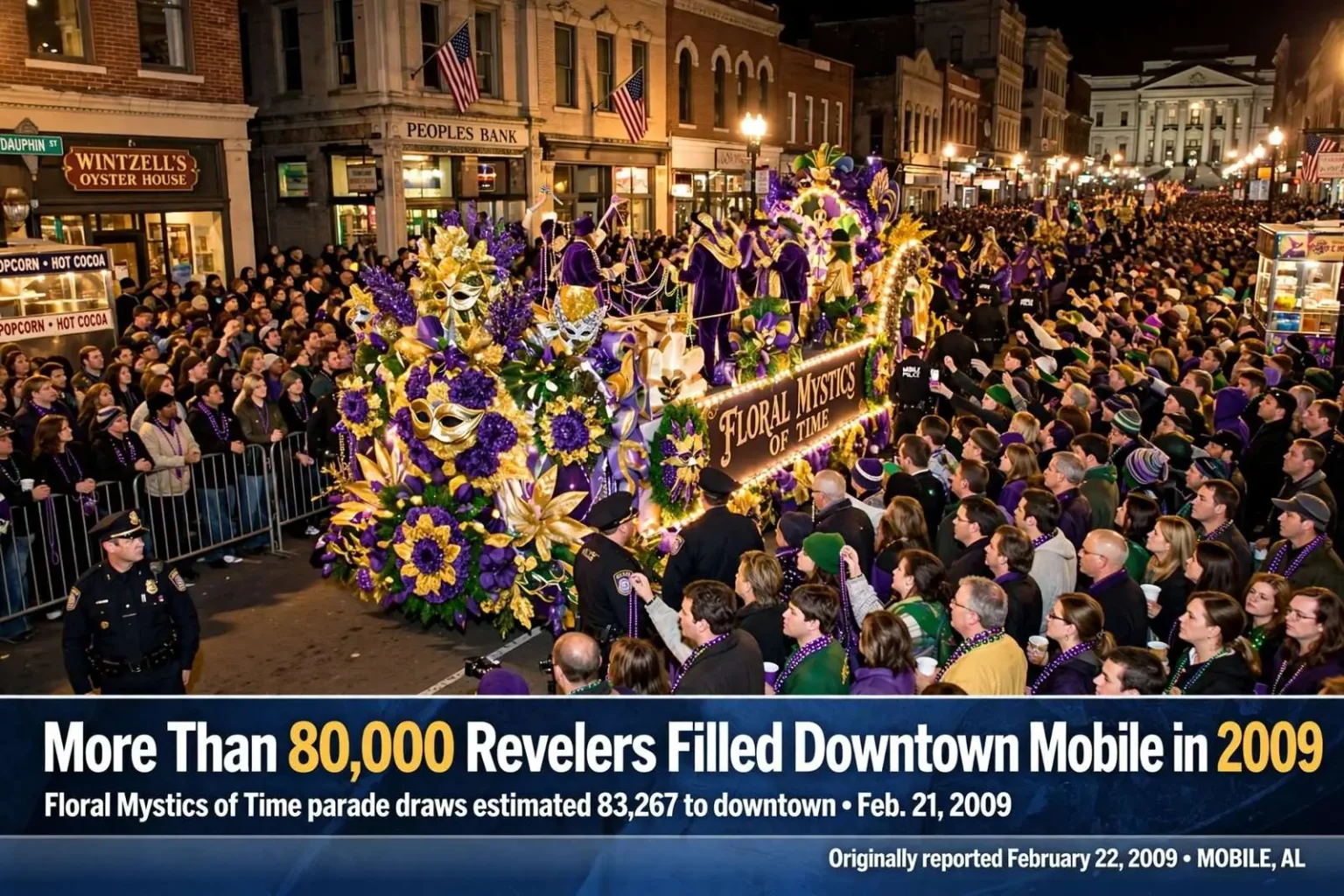
Mobile Police estimated that 83,267 people attended the Floral Mystics of Time parade in downtown Mobile on Feb. 21, 2009.
Originally reported February 22, 2009.
Mobile Police estimated that 83,267 revelers filled downtown Mobile to watch the Floral Mystics of Time parade on Feb. 21, 2009, according to a local station. The Saturday night crowd was one of the largest single-parade turnouts of the Carnival season that year, packing the route through the city’s historic downtown district.
The evening parade followed an afternoon event that drew an estimated 17,360 people, putting the day’s combined downtown crowds above 100,000 and giving the city one of its busiest weekends of the season. Police reported no major incidents across either event.
The department’s arrest log for the night was short by any standard: nine adult misdemeanor arrests, two juvenile misdemeanor arrests, two traffic tickets, 18 parking tickets and 31 towed vehicles. For crowds of that size, the numbers reflected the family-friendly character that Mobile’s parades have long cultivated along their downtown routes.
Counting the crowds
Crowd estimates like the ones released that weekend come from police observers who divide a parade route into sections, estimate density in each, and apply standard formulas used across the event-safety field. The figures are approximations rather than exact counts, but year over year they give the city a consistent way to compare the pull of individual parades and to plan staffing, barricades and sanitation for the next season.
An 83,000-person estimate for a single parade put the Floral Mystics of Time among the season’s heavy draws in 2009, when weekend nights in the heart of the season routinely turned downtown streets into a sea of people from the waterfront parks to the streets north of Government Street.
Policing Mardi Gras in Mobile
Mobile’s police department runs one of the most practiced crowd management operations in the Southeast. Every Carnival season, officers work the parade routes on foot, on horseback and in patrol vehicles, coordinating with fire-rescue medics stationed along the route and with the city’s Public Safety officials who monitor weather and crowd movement from a command post.
The arrest categories from that February weekend illustrate how the operation works. Misdemeanor arrests — typically public intoxication, disorderly conduct and similar offenses — are handled on the spot, while parking enforcement and tows keep the routes clear for floats, marching bands and emergency vehicles. Traffic citations cluster around the streets feeding downtown before and after each parade, when the crush of vehicles tests the limits of the street grid.
Mobile’s Carnival heritage
Mobile lays claim to the oldest Carnival celebration in the United States, with organized mystic societies dating to the early 18th century — years before New Orleans held its first parade. The city’s season runs from November social events through two weeks of back-to-back parades culminating on Fat Tuesday, when the Order of Myths, the city’s oldest parading society, traditionally closes the season at midnight.
The Floral Mystics of Time takes its place in that long roster of parading societies, each with its own ball, throws and traditions. On weekends in February, multiple parades roll on the same day, with afternoon processions aimed at families and children giving way to the big evening parades that draw the largest crowds of the season.
The 2009 season arrived amid the national recession, and city officials had braced for thinner crowds that winter. Instead, the estimates released that February suggested residents and visitors kept the tradition intact, filling downtown hotels and restaurants and giving the season one of its more robust turnouts in recent years at the time.
What the numbers meant
Beyond the headline total, the arrest and enforcement figures from the weekend were the numbers city officials watched most closely. Low arrest counts relative to crowd size were cited season after season as evidence that Mobile’s parade culture — families camped along the route with coolers and ladder chairs — remained fundamentally orderly, in contrast to the rowdier reputations some other Carnival cities carry.
Towed vehicles, 31 that night, represented the weekend’s most common frustration for visitors, and police urged parade-goers in every season to park in designated lots rather than along restricted streets near the route. The city’s signage and tow operations along the parade corridor have been a recurring point of emphasis for department planners ever since.
The anatomy of a parade night
A big Saturday parade night in downtown Mobile follows a familiar arc. Families claim spots along the route hours before the floats roll, staking out sidewalk territory with chairs and tape. Food vendors and downtown restaurants run at full capacity, and the streets between the civic center and the waterfront fill with bands, marching units and the flatbed floats that mystic societies spend all year building.
After the last float passes, the crowd disperses gradually, and police shift from crowd control to traffic management as tens of thousands of people funnel toward parking lots and exit routes. The hours after a parade are when the parking tickets and tows pile up, and when officers on the route handle most of the night’s misdemeanor arrests.
The archive record
This article records a 2009 Mardi Gras crowd report and is not a current event or policing update. The figures stand as a snapshot of a single weekend in the city’s Carnival history — a Saturday in February 2009 when more than 100,000 people came downtown across two parades and went home with, by the department’s count, barely a page of arrests and citations.
Crowd reports of this kind are released by Mobile police after nearly every major parade, and they form a season-long ledger that city officials use to compare parades, allocate police staffing and plan sanitation and barricade work. The 2009 numbers, with their low incident counts, fit a pattern the city has pointed to for generations: large, festive, largely family crowds that come downtown to catch moon pies and throws and head home safely.
A tradition that endures
The parades of February 2009 belong to a continuum that stretches back more than three centuries in Mobile. Mystic societies have come and gone, routes have shifted, and enforcement details have modernized, but the fundamentals of a parade night — floats, bands, moon pies, and a downtown packed shoulder to shoulder — remain what they were that February weekend when the Floral Mystics of Time rolled to an estimated 83,267 revelers.
Economics of a parade season
Each Carnival season is a significant economic event for downtown Mobile. Hotels fill with visiting families and society members returning for balls, restaurants and bars along Dauphin Street and the surrounding blocks run their busiest stretches of the winter, and retailers sell everything from gowns and tuxedos to throws and decorations. City estimates over the years have placed the season’s economic impact in the tens of millions of dollars across the metro area.
The 2009 season tested that engine against the recession, and the strong crowd estimates that February were welcome news for merchants who had braced for a lean winter. Parade nights put tens of thousands of potential customers on downtown sidewalks within a few blocks of local businesses, which is one reason the city and the mystic societies have historically worked closely on route planning and scheduling.
How the season is staffed
Policing a parade season is a year-round planning exercise. The department assigns officers to each parade based on the expected crowd, positions medics and fire crews at intervals along the route, and coordinates street closures with the city’s public works crews, who set barricades and signage before each event. Downtown businesses receive notice of closures, and residents of the route’s neighborhoods plan their evening routines around the rolling schedule.
By the time a season’s peak weekends arrive, the operation runs almost like clockwork. Command staff monitor the route from a central point, supervisors can move officers to trouble spots quickly, and the department’s long institutional experience — generations of officers have worked Mardi Gras in Mobile — shows up in statistics like the ones from that February night in 2009.
Comparing the eras
Crowd figures from the 2009 season sit in a long archive of estimates the department has produced across decades of parades. Downtown’s parade corridor has evolved over the years, with route adjustments and growing attendance in the newer parades, but the peak Saturday nights remain the measure of the season. For longtime observers, the numbers from February 2009 were right in line with the city’s biggest modern-era weekends.
The report from that weekend — 83,267 revelers at the night parade, 17,360 at the afternoon event, nine adult and two juvenile misdemeanor arrests, two traffic tickets, 18 parking tickets and 31 tows — remains a tidy record of a big, orderly night in downtown Mobile’s Carnival history.
For the officers, medics and city crews who worked that Saturday, the low numbers in the incident log were the measure of a successful night. For the mystic societies, the estimate was proof of their parade’s pull. And for the 83,267 people who came downtown, it was simply another February Saturday on the parade route in the city where Mardi Gras in America began.