Downtown Mobile Nightclub Closes Permanently Following Weekend Shooting
Studio 5'4 in downtown Mobile shut down for good days after a shooting wounded two people outside the club, prompting a city safety debate.
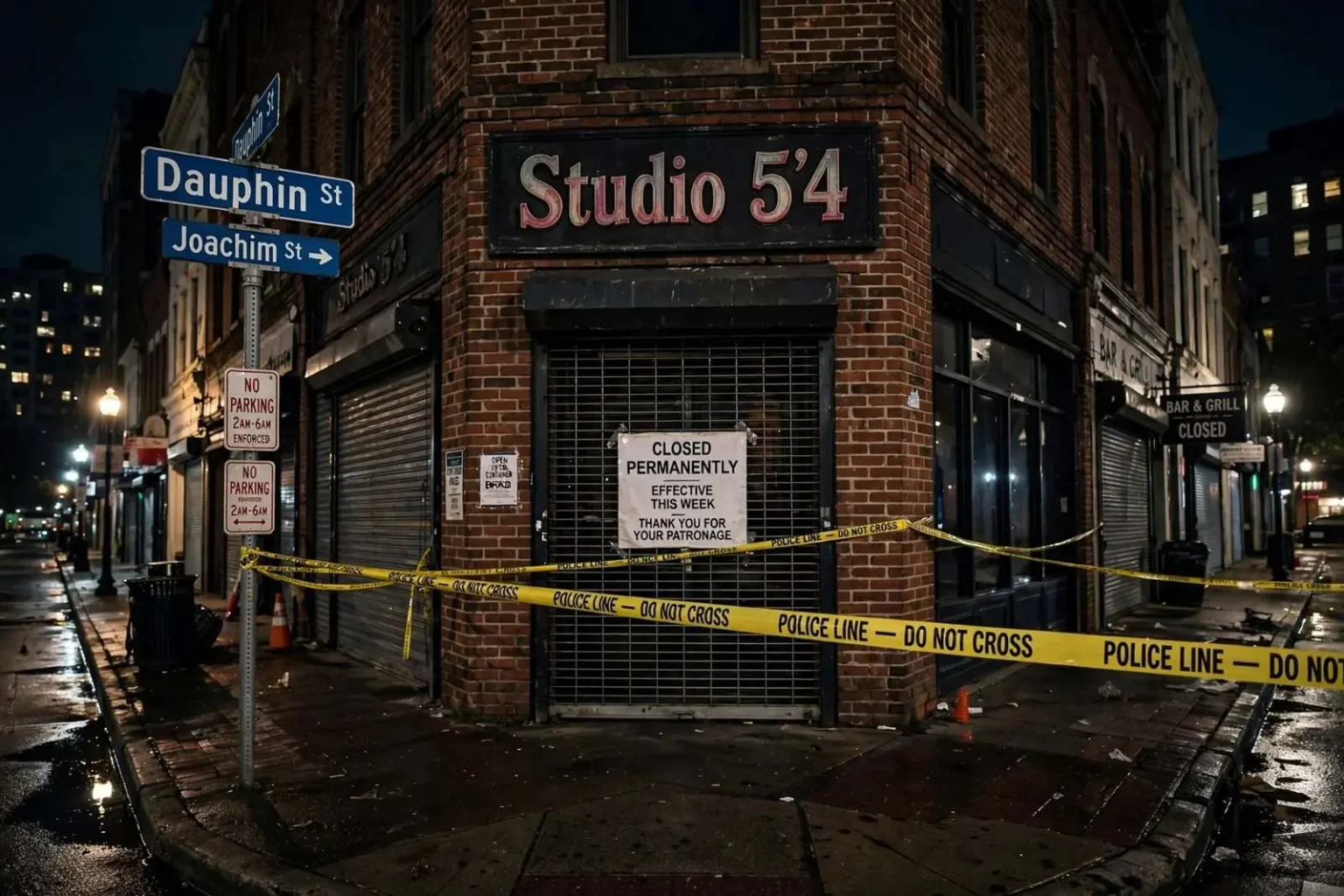
A downtown Mobile dance club has closed its doors for good, just days after a shooting outside the venue left two people wounded and reignited concerns about safety in the city’s entertainment district. Studio 5’4, located along the busy Dauphin Street corridor, announced its permanent closure this week following the early Sunday morning incident.
The closure removes one of the venues along the block-long stretch of bars and clubs that anchors Mobile’s downtown nightlife, and it came with unusual speed — within days of the shooting that put the street back at the center of the city’s public safety debate.
A Voluntary Decision by Ownership
An attorney representing the business said the decision to shut down was made voluntarily by ownership and was not the result of any order or threat from Mobile police or city officials. According to the attorney, club ownership wanted to protect both patrons and the broader downtown business community rather than risk being at the center of further violence or controversy. He also stressed that the club itself never sanctioned any informal street gatherings that had been forming outside the venue — those, he said, were organized independently through social media and without the club’s involvement.
The distinction matters for how the closure is read. No order compelled the shutdown, and no enforcement action forced the doors closed. Instead, ownership concluded that a venue associated — fairly or not — with a shooting and with unruly street crowds had become a liability its patrons and neighbors would be better off without.
Mobile’s police chief issued a statement praising the owners for stepping back in the interest of protecting the downtown entertainment district, while noting that no charges or citations had been filed against the club or its operators in connection with the shooting.
The police chief’s statement drew a line between the club’s conduct and the violence near its doors: the department found nothing to charge the business with, yet still credited ownership with making the choice that officials believed served the district best. That posture — acknowledging legal faultlessness while endorsing the closure — reflected the pressure the shooting had placed on the relationship between the nightlife industry and city government.
City Hall Responds
The incident became a flashpoint at that week’s Mobile City Council meeting, where the city’s executive director of public safety criticized what he described as an unruly atmosphere that had been building around the club in recent weeks, including reports of underage drinking and other behavior circulating on social media. He said the city intended to step up public messaging about expectations for downtown visitors, particularly around open-container behavior on the street.
The council discussion reflected a broader anxiety: downtown’s revival depends on crowds feeling safe, and every high-profile incident on the entertainment strip erodes that confidence. Officials pointed to the pattern of late-night gatherings advertised on social media, which draw large groups to a single block whether or not any particular venue planned or sanctioned them — a dynamic that leaves businesses and police reacting to crowds neither created.
Council members used the meeting to underscore the stakes for downtown Mobile’s ongoing revitalization. One councilman pointed to decades of investment aimed at improving the district’s atmosphere and drawing tourists, arguing that maintaining a safe, attractive downtown corridor is essential to that continued progress.
What Police Say Happened
Police say the shooting happened around 2:45 a.m. Sunday near the intersection of Dauphin and Joachim streets, when an off-duty Mobile police officer in the area heard gunfire. Responding officers found a man and a woman with gunshot wounds to their legs. Both were treated for injuries described as non-life-threatening.
Off-duty officers working the entertainment district are often the first to hear trouble start on weekend nights, and the sound of gunfire near Dauphin and Joachim — one of the busiest intersections in the bar district — brought a rapid police presence to the block. Both victims survived their wounds, but the episode marked another act of gunfire in an area the city has spent years working to make safe for late-night crowds.
The timing compounded the concern. A shooting at 2:45 a.m., as bars approach last call, puts hundreds of people on the sidewalk at the moment violence erupts — the scenario downtown business owners and police planners dread most. Mobile, like most cities with a concentrated nightlife district, uses a mix of uniformed patrols, off-duty details and surveillance cameras to monitor the corridor on weekends, and Sunday’s shooting will feed directly into reviews of how those resources are deployed.
The Closure’s Impact on the District
The closure of Studio 5’4 adds to an ongoing conversation among Mobile officials and downtown business owners about balancing a vibrant nightlife scene with public safety, an issue that has periodically resurfaced as the district has grown busier on weekend nights.
Vacant club space on Dauphin Street does not stay empty for long in a district with this much foot traffic, and the property will likely reopen under new ownership or a new concept in time. What the city hopes to control is the terms on which that happens: operators who manage their doors, their security and their closing times in ways that keep problems from spilling onto the sidewalk.
City leaders have signaled that additional oversight and public communication efforts are likely as downtown Mobile continues to draw larger late-night crowds.
Those efforts are expected to include clearer messaging to visitors about the city’s open-container rules, which govern where drinks purchased in the district may be carried, and continued coordination between police and club owners on security staffing during peak weekend hours. For the businesses that remain along the corridor, the club’s closure serves as a reminder that the district’s health — its crowds, its reputation, and ultimately its revenues — depends on every operator keeping the streets outside their doors safe.
Dauphin Street and the District’s Growth
Dauphin Street has been the center of downtown entertainment in Mobile for generations, a corridor of historic buildings that now house bars, music venues, restaurants and galleries. The city’s broader revitalization efforts — from the restoration of the Saenger Theatre to residential conversions of upper floors along the street — have steadily increased the number of people living within walking distance of the nightlife, raising the stakes of every incident that happens after dark.
Joachim Street, where the shooting occurred just off the main drag, crosses the district and carries its own mix of businesses and residences. The grid of narrow streets in the lower dauphin area funnels large weekend crowds through a compact footprint, which is part of what makes the district lively — and part of what makes disturbances there hard to contain.
The social-media dynamic that the attorney and the public safety director both described has become a familiar feature of nightlife cities: informal gatherings advertised at a block or an address, drawing crowds that no venue’s capacity or security plan accounts for. Cities have responded in different ways, from designated event permits to stricter enforcement of sidewalk capacity and noise rules, and Mobile’s stepped-up public messaging suggests officials intend to start with expectations rather than ordinances.
What Owners and Police Watch Next
The coming weekends will test whether the closure changes the tenor of late nights downtown. Police presence along the corridor, coordination with remaining venues, and the city’s messaging campaign will all be visible to the crowds that return, and business owners will be watching whether the crowds that made the district busy also keep it safe.
For now, a business that chose to close rather than risk another violent night has given the city a rare point of agreement: police, city officials and ownership all described the shutdown as the right call for the entertainment district. What remains is the harder work of ensuring the next incident doesn’t happen at all — on a block where thousands of people gather every weekend to enjoy the downtown Mobile that two decades of public and private investment have been building.
The business community’s reaction has been pragmatic. Downtown associations and property owners along Dauphin Street have generally supported stronger coordination with police during weekend hours, recognizing that a single violent incident can undo months of positive perception. Several neighboring venues increased their own door staffing in the days after the shooting, and some shifted closing procedures to move patrons out more gradually in the early morning hours.
Mobile’s experience mirrors that of other mid-sized Southern cities — Birmingham, Pensacola, Baton Rouge — where concentrated entertainment districts have grown faster than the security frameworks around them. The solutions that have worked elsewhere tend to share elements Mobile officials are now weighing: consistent camera coverage, clear rules communicated before the night begins, data-driven staffing of officers during peak hours, and fast follow-up when incidents occur, so that cases are solved and word of arrests travels quickly through the community.
For residents of the neighborhoods surrounding downtown, the measure of success is quieter streets by the early morning and a district that feels welcoming rather than volatile. The city’s messaging campaign about open-container rules and expectations for visitors is aimed squarely at that audience as much as at the crowds themselves — a statement that the revitalized corridor belongs to the whole city and will be governed accordingly.
Studio 5’4’s closure, meanwhile, stands as the most concrete consequence of the shooting so far. Whatever reopens in the space will inherit both a prime location on one of the Gulf Coast’s liveliest nightlife strips and a heightened expectation from police, city hall and neighbors that the operation will be run with the district’s safety in mind from its first night open.