Downtown Mobile Parking Lot Dispute Ends With Man Stabbed, He Says
A man reported being stabbed during a dispute in a downtown Mobile parking lot near Jackson and St. Francis streets, capturing part of it on video.
MOBILE, Ala. — A man says he was stabbed during a late-night confrontation in a downtown Mobile parking lot — and he caught part of the encounter on his cellphone.
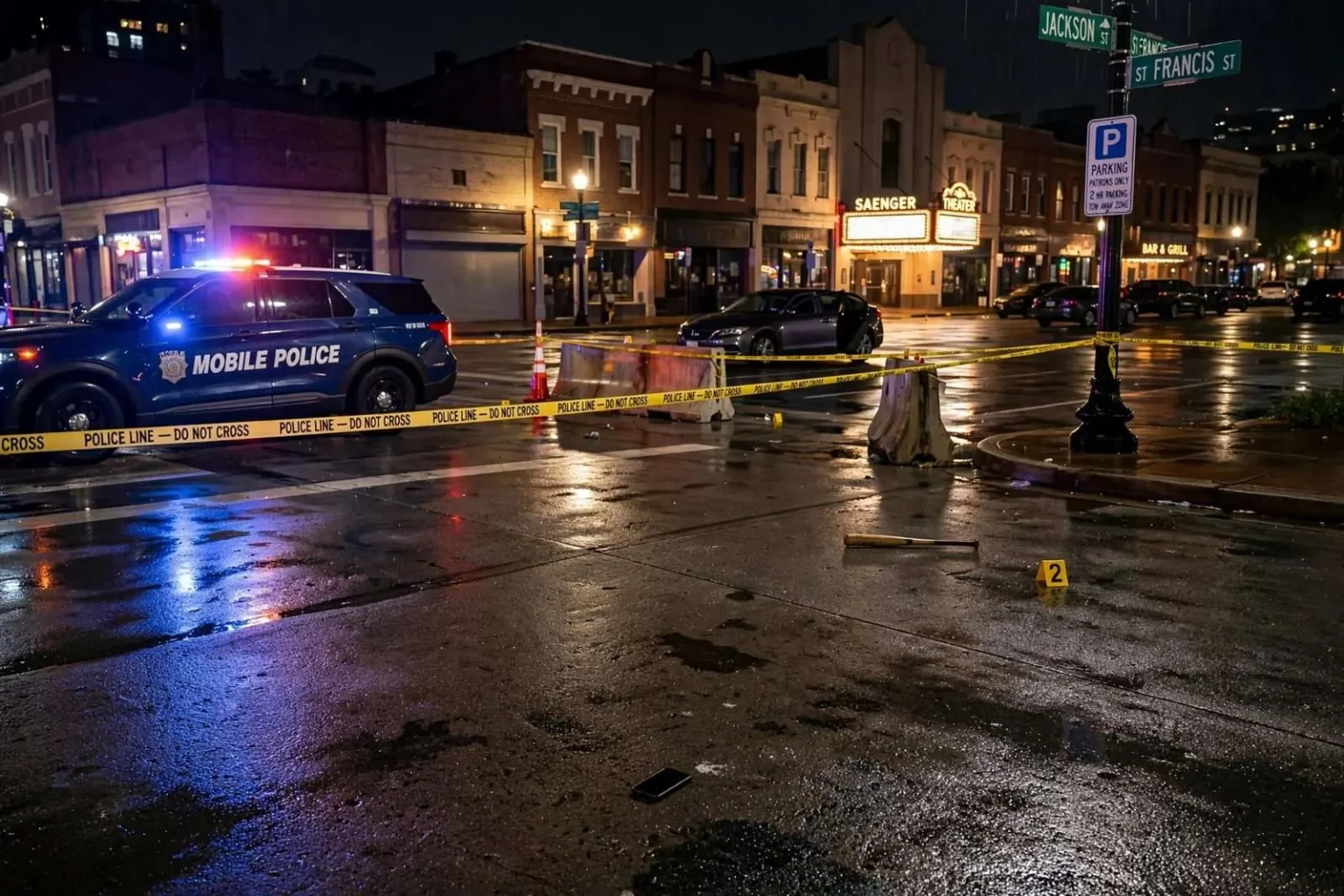
The victim, who asked not to be identified over safety concerns, said the incident began around 10:30 p.m. in a parking lot near the intersection of Jackson Street and St. Francis Street. That block sits in the heart of downtown Mobile, a short walk from Bienville Square, the Saenger Theater and the cluster of restaurants and bars along Dauphin Street that draws much of the city’s late-night foot traffic. The lots around Jackson and St. Francis serve patrons of those businesses, and on weekend evenings they fill and empty in waves as people come and go.
According to his account, a car backed into him as he was walking through the lot. “So I slapped the back of the car to alert them that they just struck me,” he said.
What he described as a routine effort to get the driver’s attention set off a chain of events that ended with him bleeding from a stab wound to the abdomen. His account, along with the video he recorded, offers an unusually detailed view of how quickly a minor traffic dispute in a parking lot can turn violent — a pattern that police departments in Mobile and across the Gulf Coast have warned about for years.
From Fender Bender to Violence
The man told police that a male and female occupant got out of the vehicle and that the situation escalated quickly. He said the man assaulted both him and a companion, at one point grabbing a small wooden bat.
“Runs over to my friend with a small wooden bat, hits my friend with a bat and then repeatedly strikes me in the chest until it breaks off,” the victim recounted.
It was then, he said, that he pulled out his phone and started recording. The video captures the two groups facing off for several minutes before the man suddenly lunges at him. As the man backs away, a knife is visible in his hand.
The recording then pans down to show the stab wound to the victim’s abdomen. Cellphone video has become an increasingly common form of evidence in assault cases across Alabama, and investigators routinely ask victims and witnesses to preserve recordings rather than edit or delete them, since unedited footage can be examined frame by frame and its metadata verified.
Bystanders who see a confrontation escalating are generally advised to keep their distance and call 911 rather than intervene, a point Mobile police have repeated in public safety messaging about disputes that turn physical. Words exchanged over a minor collision can become a felony assault within minutes, and stepping in physically puts the third party at risk of injury or criminal exposure.
How Such Cases Are Handled
When a stabbing is reported in downtown Mobile, the initial response typically involves patrol officers securing the scene, arranging medical care for the injured and separating the people involved so each account can be taken down separately. Detectives then take over, collecting physical evidence, canvassing for additional camera footage and reviewing any video recorded by witnesses.
Alabama law gives prosecutors several charging options in cases like the one the victim described. A disagreement that stays verbal may end without charges, but striking someone with a bat can support an assault charge, and causing serious physical injury with a dangerous instrument can elevate the offense further. Pulling a knife and stabbing someone can support even more serious counts, depending on the severity of the wound and the circumstances investigators are able to establish.
Self-defense questions often come into play when the two sides tell conflicting stories about who struck first. Alabama’s self-defense statute allows a person to use physical force to protect himself or a third party from what he reasonably believes is the imminent use of unlawful deadly physical force. The law’s protections are strongest inside a person’s home or vehicle, but they can apply in public spaces when the facts support it, which is why investigators document statements, injuries and video evidence carefully before presenting a case to the district attorney’s office.
In this case, the account of the attack comes from the victim himself; authorities had not released additional details about any arrests or charges connected to the incident. Until an arrest is made or charges are announced, key questions remain unanswered, including whether the man with the knife acted in self-defense, whether the bat-wielding assailant has been identified, and what the victim’s companion told investigators.
Parking Lot Disputes: A Recurring Pattern
Police departments across the Gulf Coast have long identified parking lots as flashpoints for late-night violence. The combination of slow-moving vehicles, pedestrians, tight spaces and, in entertainment districts, alcohol can turn small mishaps into serious confrontations. A car that backs into a pedestrian at low speed often causes little or no injury, but the encounter that follows — an exchange of words, a slap on a trunk, an insult — can escalate in ways neither party anticipated.
Mobile’s downtown core has changed considerably in recent decades, with Dauphin Street anchoring a nightlife strip of bars, music venues and restaurants, and new residential development bringing more people into formerly office-dominated blocks. More pedestrians and more cars competing for the same lots naturally produces more minor collisions, and police have encouraged drivers and walkers alike to treat fender benders calmly and to let insurance and law enforcement sort out the details.
Law enforcement agencies commonly advise that after a minor collision in a parking lot, the parties should move to a well-lit area, exchange insurance information, avoid accusations and, if the other driver becomes hostile, get away and call police rather than argue. They also advise photographing the scene once it is safe to do so, both to document damage and to preserve evidence of any subsequent threats or aggression.
The Role of Video Evidence
The cellphone recording the victim made is likely to be central to any prosecution that results. Prosecutors in Alabama routinely build cases around video evidence, which can corroborate a witness account, establish the sequence of events and undercut claims made by a defendant. Footage recorded in public places is generally lawful to capture, and courts have admitted such recordings in assault and homicide cases throughout the state.
Investigators also look for surveillance video from nearby businesses. Downtown Mobile has a growing number of cameras mounted on commercial buildings, and footage from surrounding blocks can help establish where a suspect went after an incident, whether anyone accompanied him and what happened before the recording began. Private business owners who voluntarily share footage with detectives often provide the missing minutes that a victim’s cellphone does not cover.
Anyone with information about the incident is encouraged to contact the Mobile Police Department. Tips can also be submitted anonymously through Mobile Area Crime Stoppers, which allows callers to provide information without revealing their identities and offers rewards for tips that lead to arrests in violent felony cases. Anonymous tips have played a role in closing many of the city’s most serious assault and robbery cases, particularly in dense downtown blocks where a single arrest can depend on identifying a person seen only on camera.
What Victims of Violent Crime Should Know
Victims of assault in Alabama have access to support beyond the criminal case itself. The Alabama Crime Victims’ Compensation Commission can reimburse eligible victims for medical bills, lost wages and counseling costs tied to a violent crime, and hospital social workers and victim services officers can help file those claims. Mobile County also has victim advocates who accompany victims through interviews and court proceedings, and judges can issue protective orders when a case involves ongoing threats.
For people recovering from stab wounds, medical follow-up matters as well. Abdominal wounds can involve damage to internal organs that is not immediately apparent, and doctors generally recommend that anyone stabbed seek emergency evaluation even if the wound appears minor on the surface. Infections, internal bleeding and nerve damage are among the complications that can surface days after an initial injury, and delayed treatment can turn a survivable wound into a fatal one.
An Unresolved Case
For now, the incident remains what it appeared to be in the hours after it happened: a late-night dispute in a downtown parking lot that left one man stabbed, his friend assaulted, and the people responsible unidentified in public records. The victim’s video preserves what he says happened, but it will be up to investigators and prosecutors to decide what the evidence supports and whether charges are warranted against anyone involved.
The case serves as a reminder of how quickly ordinary encounters can turn dangerous. A slap on the trunk of a car that backed into a pedestrian is, on its face, a trivial act. What followed it — a bat, a knife, a wound — is a measure of how volatile late-night confrontations can be, and of why police in Mobile and across the Gulf Coast continue to urge drivers and pedestrians alike to de-escalate rather than engage.