Downtown Mobile Senior Housing Complex Cathedral Place Sold to Tennessee Developer
The Archdiocese of Mobile has sold Cathedral Place, a downtown senior housing complex on Conti Street, to a Tennessee-based developer that plans to keep it running as low-income housing for seniors.
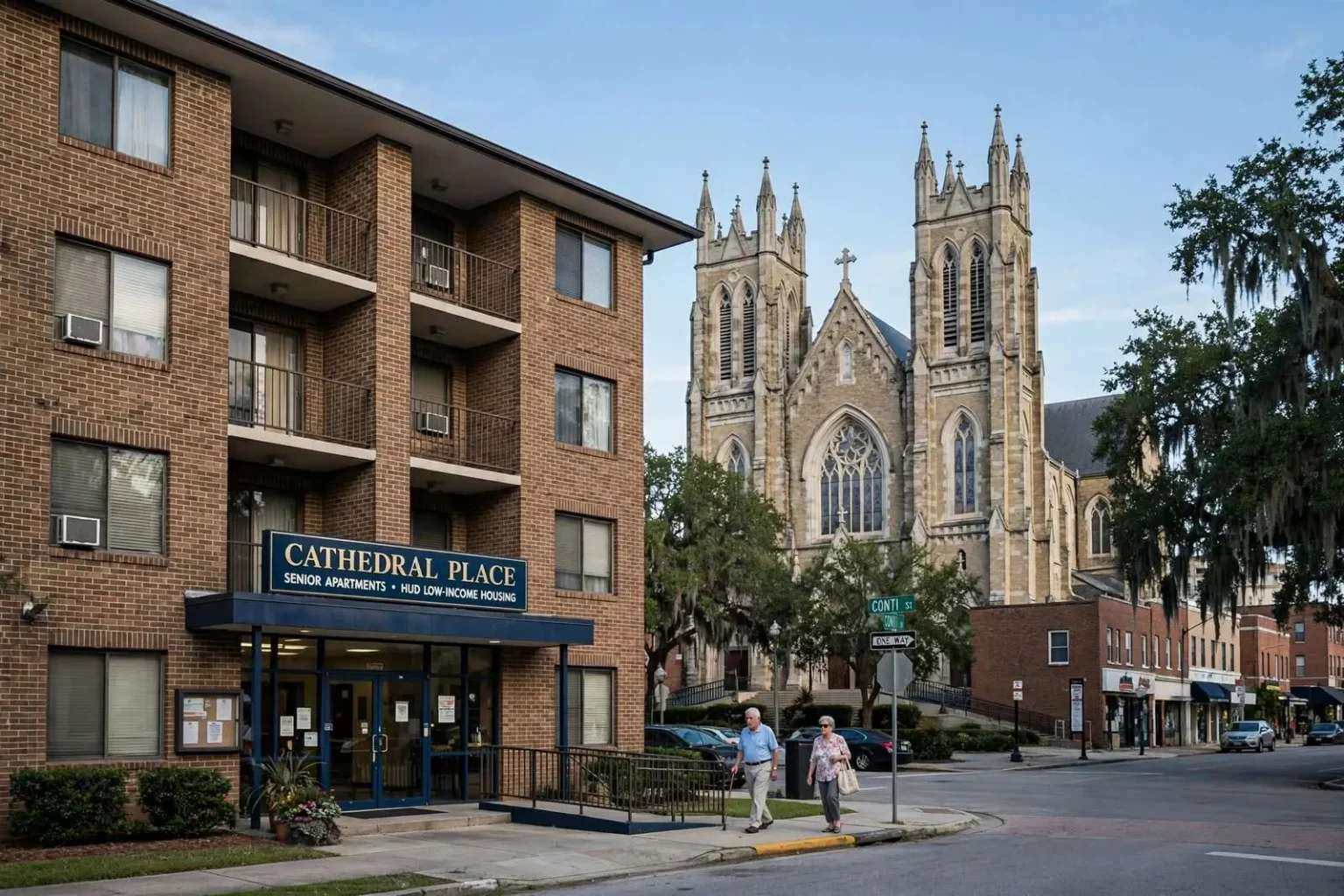
A longtime fixture of downtown Mobile’s skyline has changed hands. The Archdiocese of Mobile has sold Cathedral Place, a low-income apartment complex for seniors on Conti Street, to an affiliate of Memphis, Tennessee-based Alco Properties. The sale closed April 25, though the purchase price has not been disclosed, and the transaction ends a decades-long run of Catholic ownership for one of the city’s most visible senior housing communities.
The complex sits directly across Conti Street from the Cathedral-Basilica of the Immaculate Conception in the heart of downtown Mobile, in the shadow of one of the oldest parishes on the Gulf Coast. The location puts residents within walking distance of the cathedral itself, the restaurants and offices of the central business district, and the waterfront parks at the foot of Government Street — amenities that few affordable senior communities in the region can match.
For Alco, a firm that manages a portfolio of affordable housing developments across several states, including a property in Birmingham, the acquisition marks its first foothold in the Mobile market. “This is our first property in Mobile,” said Thomas Robinson, an acquisition and development analyst with Alco Properties. The company has built its business on buying, managing and preserving affordable apartment communities, a sector where steady federal subsidies and chronic shortage of supply have long made well-located properties durable investments.
Residents should not expect major changes any time soon. Alco plans to keep Cathedral Place operating as a low-income senior residential community and will continue to honor U.S. Department of Housing and Urban Development guidelines that have governed the property for decades, with elderly tenants paying roughly 30 percent of their income toward rent. That formula — the standard for federal housing assistance — ties rent to what a household actually earns, which is what keeps the building affordable for people living on fixed Social Security checks and modest pensions.
A ‘Jewel’ at 100 Percent Occupancy
Although the company often upgrades properties after acquiring them, Robinson said there are no immediate plans to renovate the roughly 40-year-old building. “We’re really enamored with it,” he said. “It’s very well managed … and in a beautiful location. I’ve seen a lot of properties. This is just a jewel, and it’s 100-percent occupied.” Full occupancy is a rarity in the affordable housing business and a sign that the waiting list for a unit reflects the demand for senior housing across downtown and the surrounding neighborhoods.
Cathedral Place currently houses 186 residents, about 27 of whom are Catholic, according to the Archdiocese. The majority of tenants, in other words, have no denominational tie to the building’s longtime owner — a common pattern for church-affiliated housing, where the mission serves the community broadly regardless of faith. To qualify for residency, applicants must be at least 62 years old or disabled, and must meet minimum requirements for independent living, meaning the building provides homes for seniors who can manage daily life on their own rather than the assisted care a nursing facility offers.
The Archdiocese’s decision to part with the property came down to mission, not condition. Archbishop Thomas Rodi did not directly answer questions about the transaction, instead directing responses through Rob Herbst, editor of the Catholic Week and a spokesman for the Archdiocese. Herbst said the property was sold because it “no longer met the spiritual mission” the Archdiocese requires of the institutions it operates directly.
That rationale reflects a wider trend among Catholic dioceses and other faith-based owners across the country. Running subsidized senior housing requires regulatory compliance, federal reporting and property management at a scale many church organizations no longer want to sustain, particularly when the buildings age past their fourth decade. Selling to a buyer committed to keeping the subsidy in place lets the ministry step back without displacing a single tenant — the outcome residents and advocates watch for most closely when a housing provider changes hands.
The preservation of the project-based assistance is the critical detail. In affordable housing, a building’s subsidy can be lost when a sale leads a new owner to convert units to market rate or to let a Housing Assistance Payment contract lapse. Alco’s stated intent to continue operating under HUD guidelines means the 186 residents keep both their apartments and the rent structure they have planned their lives around.
Senior Housing in a Growing Downtown
The sale lands in the middle of a remarkable transformation of downtown Mobile. Two decades of investment — streetscape improvements, a new cruise terminal era followed by the convention center expansion, loft conversions of historic office buildings, and a wave of restaurants and bars along Dauphin and Bienville streets — have turned the central business district into a genuine neighborhood. That growth has pushed land values up around the cathedral square, making a fully occupied affordable building on Conti Street both a community anchor and, on paper, a candidate for redevelopment pressure.
Against that backdrop, the commitment to keep the building affordable carries weight. Demographic trends across Alabama and the Gulf Coast point to a fast-growing senior population: the generation born after World War II is aging into its 60s and 70s, and Mobile County’s share of residents over 62 continues to climb. Housing that lets seniors age in place near services, churches, pharmacies and doctors — rather than isolating them far from the urban core — is in short supply everywhere, and scarcest of all in the desirable, walkable neighborhoods they often prefer.
The 30-percent-of-income rent formula under HUD programs deserves a closer look for what it means day to day. A tenant living on a typical fixed benefit pays rent calculated from what actually arrives each month, which smooths out the shocks of medical bills and utility spikes that can otherwise force elderly renters out of their homes. Buildings governed by those rules are operated under federal oversight, with income certifications and inspections that keep conditions consistent regardless of who owns the property.
For the Archdiocese, the sale closes a chapter that began when the complex was new and downtown Mobile was a very different place. The cathedral across the street has anchored the neighborhood since the 19th century, and the church’s presence in senior housing was an extension of a social ministry that includes schools, charitable outreach and health care across south Alabama. Shedding a direct management role does not end that ministry; it transfers the housing mission to a specialized operator while the archdiocese concentrates its resources elsewhere.
For the 186 residents of Cathedral Place, the practical message was reassurance. The owner’s name on the paperwork has changed, the April closing has passed, and the building they know remains fully leased, fully occupied and — by the new owner’s own description — well managed. In a housing market where change usually means displacement, this transaction was framed, on both sides, as the kind that leaves the people inside exactly where they are.
How Affordable Senior Housing Deals Work
Transactions like this one follow a well-worn path in the affordable housing industry. Communities built decades ago under federal programs were often developed by nonprofit and faith-based sponsors that received subsidized financing in exchange for long-term use restrictions. As those sponsors age or refocus, private operators that specialize in compliance-heavy portfolios step in, buying the properties subject to the existing rental assistance contracts and keeping the restrictions running their course.
The buyer’s underwriting depends entirely on that subsidy staying in place. A property where tenants pay 30 percent of income produces predictable revenue backed by federal housing payments, which supports financing for acquisition and, eventually, renovation. That is why operators such as Alco describe fully occupied, well-managed buildings as jewels: in a business where distressed properties and vacant units are common, a 40-year-old complex with 186 households and no vacancies is about as stable an asset as the sector produces.
Preservation has become a watchword for housing advocates nationally. Every year, thousands of affordable units reach the end of use restrictions or change owners, and each conversion to market rate removes homes that are nearly impossible to replace at the same cost. Mobile has felt that pressure like every growing Southern city, as new development concentrates on higher-rent products downtown while the waiting lists for subsidized senior apartments only lengthen. A sale that preserves 186 units intact is, by those standards, a good outcome for the city’s low-income seniors.
The transaction also illustrates the role of specialized buyers in markets of Mobile’s size. National and regional affordable-housing operators often enter a city with a single acquisition, then add properties as they learn the local regulatory landscape and build relationships with housing authorities and municipal officials. Whether Cathedral Place becomes Alco’s first Mobile holding in a larger Gulf Coast portfolio or a one-off purchase, the company’s evaluation of the building — praise for its management, its condition and its location — sets the tone for how the transition is likely to go for the residents who call it home.