
Downtown Pensacola Hit-and-Run Puts Crosswalk Safety in the Spotlight
A man was run over in a downtown Pensacola crosswalk by a driver who fled. The case has renewed concern about pedestrian safety on Palafox Street.
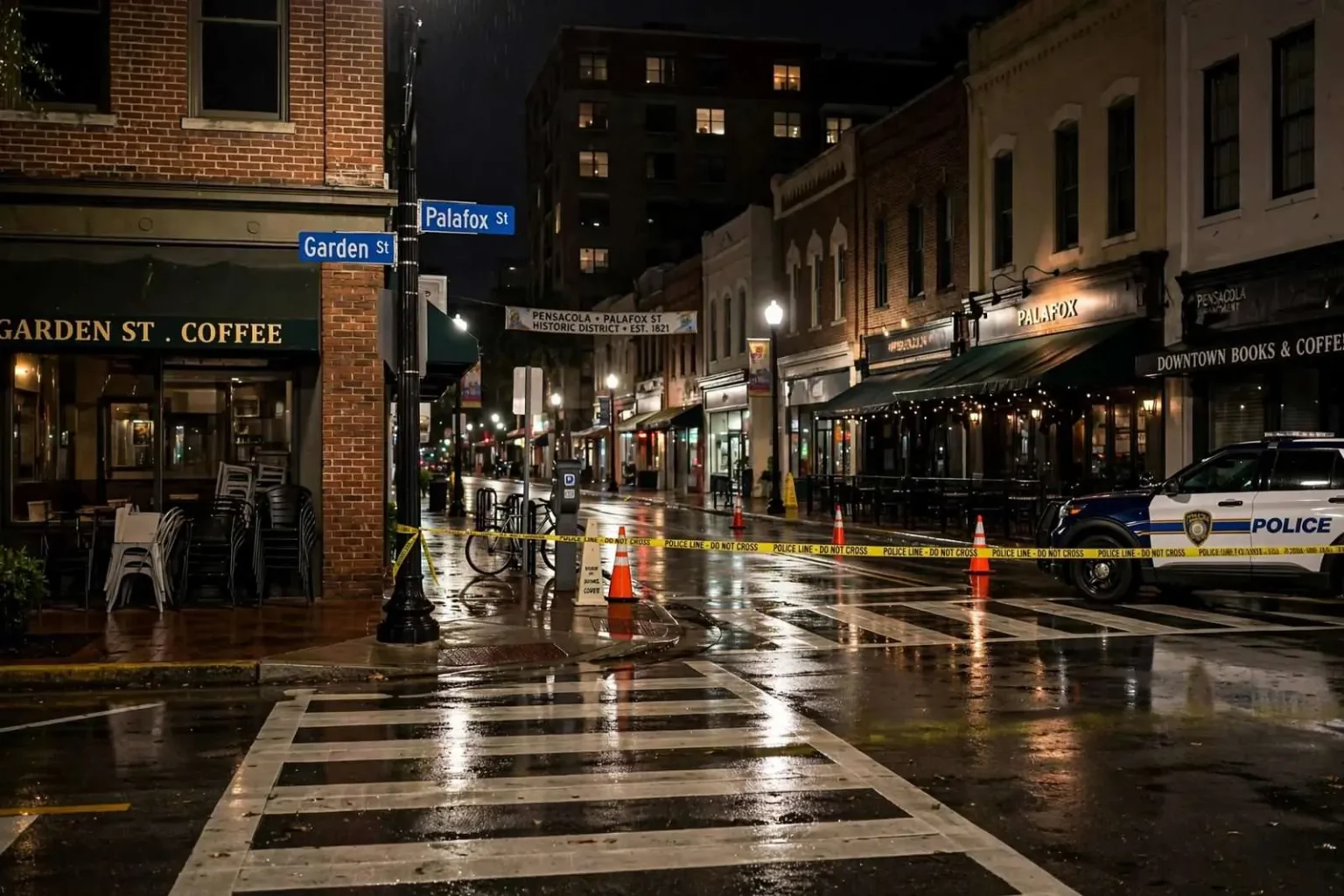
A hit-and-run in downtown Pensacola has left a young man recovering from serious injuries and neighbors asking hard questions about how safe it is to cross the city’s busiest downtown blocks.
According to Pensacola police, 22-year-old Max Whitman was struck by a newer-model white Toyota Tundra around 1 a.m. on Saturday, June 8, while crossing Palafox Street between Garden and Romana streets. The driver sped away without stopping, leaving the young man in the roadway of a downtown block that, hours earlier, had been filled with the district’s usual late-night foot traffic.
Whitman suffered a fractured skull and clavicle and a fracture below his eye. He said he looked both ways before stepping into the crosswalk and never saw the truck coming — he only heard it accelerate just before impact. That detail, an accelerating engine as the last thing a pedestrian hears in a marked crosswalk, has become the case’s most haunting element for the residents and regulars who move through downtown on foot every day.
Police still searching for the driver
Weeks later, investigators are still working to identify the driver who left the scene. Hit-and-run investigations of this kind typically proceed through a combination of surveillance video from downtown businesses, physical evidence from the scene, and tips from the public — and the description of the vehicle, a newer-model white Toyota Tundra, is the central lead police have released as they ask anyone with information to come forward.
Leaving the scene of an injury crash is a serious offense under Florida law, carrying penalties that grow substantially when the victim is seriously hurt, and prosecutors treat the failure to stop and render aid as an aggravating factor in its own right. For Whitman’s family, the unanswered question of who was driving adds a second burden to the physical recovery: the case cannot fully close, in any sense, until the driver is found.
The case has resonated with downtown’s large community of walkers and cyclists, hundreds of whom cross Palafox every day between shops, restaurants and bars. Palafox Street is the spine of downtown Pensacola — the block after block of storefronts, cafes and nightlife venues that anchor the city’s revitalized core — and its crosswalks carry a steady stream of pedestrians from morning coffee hours through the late-night crowds of the weekend.
Those who walk downtown speak up
“Something like this incident that happened, I can’t say it would’ve been prevented by putting up more signage or even flashing lights, but it definitely couldn’t have hurt,” said Drew Buchanan, a frequent walker and cyclist downtown.
Buchanan said he has been struck by drivers three times while riding his bicycle — each time while obeying the law. “There just happened to be a distracted driver,” he said. Three collisions on a bicycle, all with the cyclist in the right, is the kind of personal history that turns abstract safety debates into lived experience, and Buchanan’s willingness to describe it put a local face on the statistics every pedestrian advocacy conversation begins with.
Others who spend time on the downtown sidewalks say the near-misses feel constant, and that drivers moving through the district after midnight often pay little attention to people legally in the crosswalk. The observation points to a pattern traffic-safety researchers have documented for years: the hours after bars close combine impaired or fatigued drivers, reduced visibility and remaining crowds of pedestrians — a mix in which driver error turns most dangerous precisely when pedestrian volume is at its peak.
The case for safer streets downtown
What the incident has done is force a public conversation about what downtown Pensacola owes the people who walk and bike through it. The city’s core has undergone a striking revitalization over the past two decades: Palafox Street has been recognized among the great American streets in national publications, the district’s festivals and weekend crowds have grown year after year, and new residents have moved into the upper floors and surrounding neighborhoods of a downtown that was largely dormant a generation ago. All of that growth has multiplied the number of people whose daily lives involve crossing Palafox on foot.
Streets designed decades ago for cars moving through, rather than people living among, carry that legacy in their signal timing, crosswalk spacing and lighting. Cities across the country that faced the same mismatch have responded with tools ranging from the modest — high-visibility crosswalk striping, improved lighting, signage, speed feedback displays — to the structural: road diets that narrow travel lanes, raised crosswalks, curb extensions and leading pedestrian intervals that give walkers a head start before turning traffic moves. Each intervention carries costs and trade-offs, but the shared premise is that street design, not just driver behavior, determines how often a distracted driver becomes a fatal one.
Buchanan’s caveat — that no signage or flashing light would certainly have prevented this particular crash — reflects the honest limits of that toolkit. A driver accelerating through a crosswalk at 1 a.m. may defeat any passive measure. But the corollary he drew matters just as much: such measures couldn’t have hurt, and a street environment that slows traffic, improves visibility and signals that pedestrians belong reduces the odds of the next one.
What recovery looks like
For Whitman, the weeks since the crash have been defined by the recovery his injuries demand. A fractured skull, a broken clavicle and a facial fracture represent the kind of trauma that unfolds over months — surgeries and follow-ups, restrictions on activity, and the slow return of ordinary function. At 22, he is recovering from injuries most people his age associate with high-speed highway crashes rather than a walk across a downtown street.
His account of the moment — looking both ways, seeing nothing, hearing the truck accelerate — will shape how the case is understood wherever it ends up. It describes a pedestrian doing everything the law and common sense require, struck anyway, in a marked crosswalk on a street celebrated for its walkability. If the investigation identifies the driver, prosecutors will weigh charges that account for both the injuries and the flight from the scene; if no arrest comes, the case will stand as the kind that haunts pedestrian advocates — a vanishing driver, an injured young man, and a community left to ask what it takes to make its most beloved street safe after midnight.
As police continue their search, residents hope the case will push both drivers and city officials to take pedestrian safety more seriously in the heart of Pensacola. The downtown that Pensacola has spent two decades building — walkable, lively, full of people on foot — depends on that commitment holding at every hour, not just the daytime ones.
How hit-and-run investigations work
Identifying a driver who flees a downtown crash scene is a race against the ways evidence disappears. Investigators canvass the security cameras that ring a district like downtown Pensacola — bank cameras, restaurant systems, parking garages — and the newer-model white Toyota Tundra described in this case would be traced through paint transfer, grille and headlight fragments, and the pattern of damage a truck of that size would carry away. Repair shops and online marketplaces become part of the search, since drivers in injury hit-and-runs often seek quick, undocumented repairs.
Public tips close more of these cases than any other single source, which is why police statements in cases like this one emphasize the request for information. Someone saw the truck in the minutes before or after the crash, someone noticed damage appear on a vehicle owned by a friend or relative, and each of those threads can break a case open weeks after the scene itself has been cleaned. The passage of time works against the investigation, but the specificity of the vehicle description keeps the case solvable.
Florida law treats leaving the scene of a crash involving serious bodily injury as a felony, with license revocation and potential prison time that rises with the severity of the harm. Prosecutors also pursue the underlying crash itself — failure to yield to a pedestrian in a crosswalk, careless driving — so a driver found weeks or months later faces a combined accounting of the collision and the flight.
A district built on walking
The response to the crash has drawn its energy from what downtown Pensacola is. The district’s revival was built deliberately around the pedestrian: wide sidewalks and outdoor seating along Palafox, festivals that close streets to cars, a gallery night tradition that pours thousands of walkers into the core each month, and residential conversions that put people’s front doors directly onto the busiest blocks. Walkability is not an amenity downtown Pensacola tolerates; it is the product the district sells.
That makes a crosswalk crash of this severity more than a crime story — it strikes at the district’s central promise. Residents and regulars who cross Palafox nightly between the restaurants, bars and shops are doing exactly what the district invites them to do, and the near-miss stories accumulating among walkers and cyclists suggest the invitation carries more risk than it should after dark.
The conversation Buchanan joined — about signage, flashing lights and what they can and cannot accomplish — is the practical version of that reckoning. Cities that have taken post-midnight pedestrian safety seriously have paired infrastructure with enforcement: crosswalk details and dedicated patrols during bar-closing hours, DUI saturation operations, and coordination with venues about departure patterns. None of it eliminates risk; all of it narrows the window in which a distracted or impaired driver and a pedestrian in the crosswalk can meet.
Waiting for answers
Weeks into the investigation, the case sits at the point hit-and-run families know best: a young man healing from a fractured skull, clavicle and facial fracture, a vehicle description released to the public, and no name attached yet to the truck. The Pensacola police investigators working the case have the elements most such cases lack — a specific vehicle, a defined location, a defined time — and the community watching is one that walks the same block every day.
Whatever the investigation produces, the crash has already changed the conversation on Palafox Street. Drivers passing through the district now do so under neighbors’ eyes; the walkers and cyclists who were struck before and kept riding have told their stories publicly; and the question of what the city will do about post-midnight crosswalk safety has moved from advocacy circles into ordinary downtown conversation. That shift is the case’s living legacy so far — and the driver, when found, will answer for far more than the injuries left in the crosswalk between Garden and Romana streets.


