
Early morning house fire on Dunnaway Drive displaces Mobile family
Mobile Fire-Rescue battled an early morning house fire on Dunnaway Drive; all residents were evacuated safely with no injuries reported.
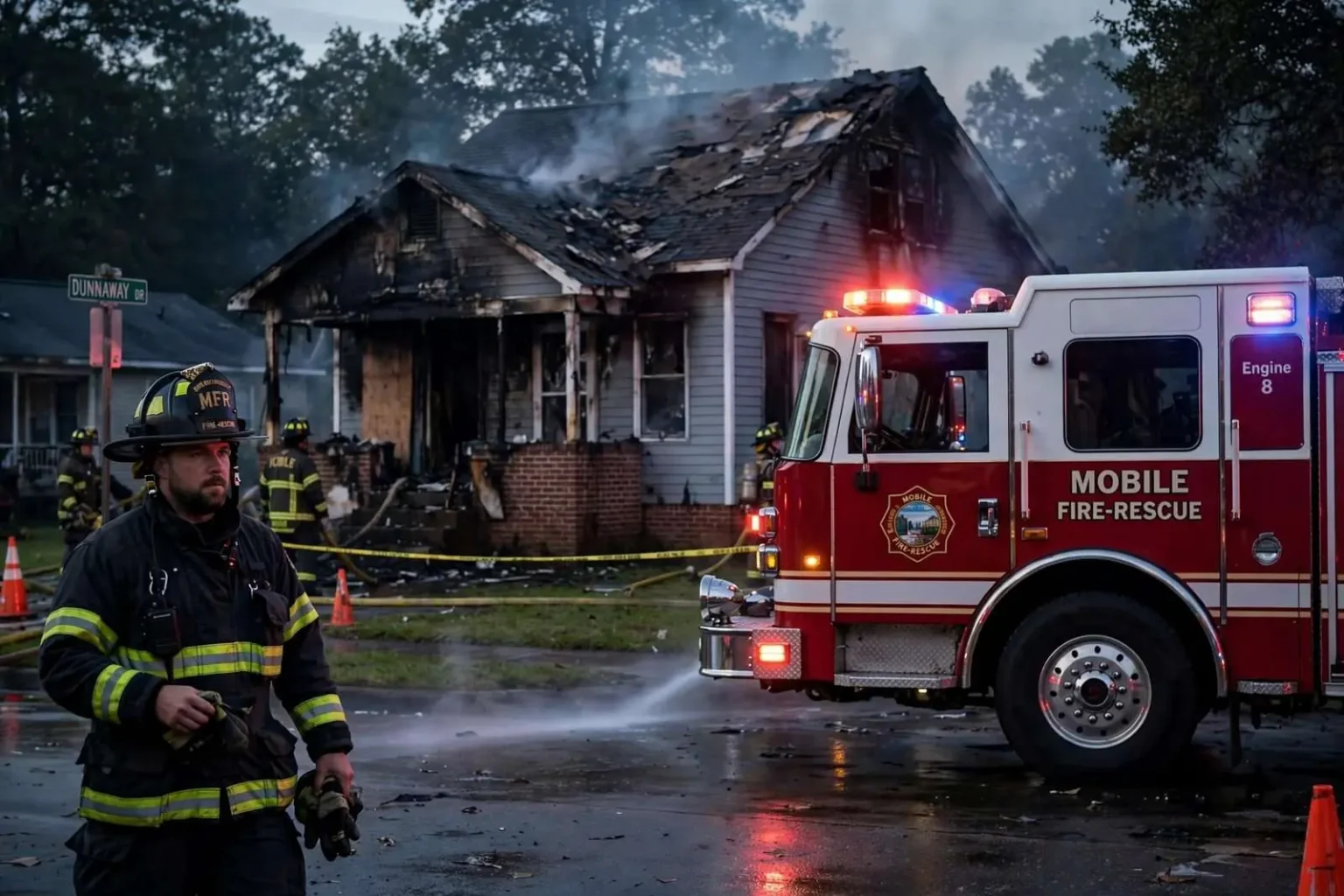
Mobile Fire-Rescue responded quickly Friday morning after a house fire broke out on Dunnaway Drive just before 4 a.m. It took firefighters about 20 minutes to battle the blaze, and everyone inside the home was evacuated safely, according to officials. There was no immediate word on the extent of the damage or the cause of the fire, which remained under review as crews finished their work on the scene.
A fire in the hours before dawn is among the most dangerous calls a fire department answers. Most people in the home were almost certainly asleep when the fire began, and the early stages of a house fire can go unnoticed until smoke alarms sound or someone wakes to the smell of smoke. That the entire household got out safely before Mobile Fire-Rescue arrived is the most important outcome of the morning, and it is the outcome that departments across the Gulf Coast emphasize in their public safety messaging year after year.
A fast response in the dark
Mobile Fire-Rescue operates fire stations spread across the city precisely so that units can reach neighborhoods like the one around Dunnaway Drive within minutes of a call. When the first crews arrived, their priorities follow a familiar order: confirm that everyone is out of the structure, locate the fire, and get water on it before it can spread into the attic or neighboring structures. A blaze knocked down in roughly 20 minutes suggests crews found the fire quickly and had the manpower to attack it aggressively rather than taking a defensive posture from the street.
Nighttime fires also bring complications that daylight calls do not. Visibility inside a burning home is near zero even with flashlights and thermal imaging cameras, crews have to account for furniture and layout they cannot see, and hydrant access and apparatus positioning take extra care on dark residential streets. Dispatchers working the 911 lines gather whatever details callers can provide, including whether anyone is still inside and whether there are vehicles in the driveway, information that shapes how the first arriving crews commit their resources.
What happens after the flames are out
Once the fire is knocked down, the work on the scene is only beginning. Firefighters check for extension into walls, ceilings and the attic, pull ceilings where necessary, and overhaul the structure to find hidden hot spots that could reignite hours later. Investigators eventually walk through the scene to try to determine where the fire started and what caused it, a process that can take days when the damage is extensive and that officials often cannot complete on the morning of the fire itself.
For the family, the hours after a fire like this are disorienting even when everyone is safe. A home that has burned, even partially, is usually not livable right away: utilities are cut, there is water and smoke damage throughout, and belongings that look salvageable often carry smoke odor that is difficult to remove. Families in this situation frequently stay with relatives or neighbors in the short term, and disaster relief organizations step in with assistance for immediate needs like clothing, food and a place to sleep while longer-term arrangements are made.
How fires start in the overnight hours
Nationwide fire statistics have shown for years that home fire deaths are disproportionately concentrated in late-night and early-morning fires, because sleeping residents lose the early warning that awake residents would have. The leading causes of overnight house fires include unattended cooking left on from the evening, electrical problems, heating equipment, and smoking materials, though none of those can be assigned to this fire until Mobile Fire-Rescue investigators complete their work. Officials declined to speculate, which is standard practice while a cause is still being determined.
Smoke alarms are the single most decisive factor in whether a sleeping family wakes up in time. Fire departments across Alabama, including Mobile Fire-Rescue, run public campaigns urging residents to test alarms monthly, replace batteries at least yearly, and replace alarm units themselves on a regular schedule, and many departments install alarms free of charge for residents who cannot afford them. A working alarm turns a fire that might otherwise burn unnoticed into an emergency call placed within the first minutes.
Inside a Mobile Fire-Rescue response
A working house fire in Mobile typically draws multiple engines, a ladder truck, a rescue unit and a battalion chief, along with support vehicles that manage utilities, rehab and logistics. The first engine on scene takes command and makes the initial attack, while later-arriving crews handle water supply, search and ventilation. On a residential street like Dunnaway Drive, apparatus staging matters: engines have to position so they do not block hydrants or each other, and the ladder truck needs room if there is any chance crews will have to work from an aerial.
Mobile Fire-Rescue is the primary fire and emergency medical service for Alabama’s fourth-largest city, answering thousands of calls a year across a city that stretches from downtown and the port district out to growing suburban neighborhoods in the western reaches of Mobile County. Like most urban departments, the majority of its calls are medical, but structure fires are the calls that demand the most personnel at once, which is why a single working fire can pull units from stations across the city and require coverage from neighboring departments to keep other neighborhoods protected while the fire is being fought.
Mutual aid is a routine part of the system. Fire departments in Mobile County train together and can call on one another for additional engines, tankers and manpower, and during major incidents it is common to see apparatus from volunteer and municipal departments across the county working alongside city crews. Gulf Coast departments also plan together for hurricane season, when the same crews that fight house fires become first responders for wind damage, flooding and search and rescue.
What a displaced family faces next
After the crews clear the scene, the practical work of recovery starts for the household. Insurance companies send adjusters to document the damage, contractors assess whether the structure can be dried and repaired or needs to be rebuilt, and belongings have to be sorted into what can be cleaned, what must be replaced and what was lost. Smoke damage reaches further than fire damage, settling into ductwork, insulation and fabrics throughout the house, so even rooms untouched by flames often need professional cleaning.
Neighbors and community members typically play a large role in the days that follow a fire like this one. Clothing, furniture and temporary housing often come first from the people next door, and in close-knit Mobile neighborhoods it is common for churches, schools and civic groups to organize collections for affected families. That community response does not replace insurance and disaster assistance, but it covers the immediate gaps in the first days when a family needs somewhere to sleep and something to wear.
Fire safety lessons for the community
Fires like this one are a recurring reminder of the basics that fire officials repeat after every incident. Have an escape plan and practice it, so that every member of the household knows two ways out of every room and where to meet once outside. Close doors at night, because a closed door slows the spread of fire and smoke significantly. Never re-enter a burning home, for people or for pets or possessions, because the fire will move faster than anyone can move through it.
Electrical and heating safety deserve particular attention in older Southern housing stock. Homes in established Mobile neighborhoods may carry wiring systems decades old, and overloaded circuits, aging panels and extension cords running under carpets are frequent contributors to house fires. Space heaters belong at least three feet from anything that can burn and should never be left running while anyone sleeps, and clothes dryers need their vents cleaned regularly, since accumulated lint is a well-known ignition source. None of these can be tied to the Dunnaway Drive fire before the investigation is complete, but each is a hazard that residents can address tonight.
The safe evacuation of everyone inside the Dunnaway Drive home is the detail that matters most from this incident. Houses can be repaired and belongings replaced, and the 20 minutes that Mobile Fire-Rescue crews needed to bring the blaze under control will be remembered by this family mostly as the morning their alarms, their neighbors and their fire department did their jobs when it counted.
Why early-morning fires move so fast
Modern homes burn faster than older ones, and researchers point to the synthetic furnishings and open floor plans common in recent decades. Couches, mattresses and curtains made from petroleum-based foams ignite quickly and produce dense, toxic smoke, and engineering studies have shown that residents may have only a few minutes to escape a fire that began in the living area, compared with considerably longer in homes furnished a generation ago. In the overnight hours, when everyone is asleep and doors are closed, those minutes shrink further, which is why the time between the first alarm and the first 911 call matters so much.
Smoke itself is the leading killer in house fires, ahead of flames. Carbon monoxide and other combustion gases can incapacitate a sleeping person before heat ever reaches the bedroom, and victims found after overnight fires are frequently located in hallways and near exits they almost reached. That reality drives the standard advice to sleep with bedroom doors closed, to keep escape routes clear, and to get low and move quickly rather than investigating the source of an alarm.
The investigation and the record
Fire origin-and-cause investigations follow a methodical process. Investigators examine burn patterns on walls, floors and ceilings, look at the condition of electrical service and appliances, interview occupants and neighbors, and rule out accidental causes one by one before considering anything else. When a fire is extinguished quickly with limited structural damage, the process can wrap up in days; when a home is heavily damaged, debris has to be carefully removed layer by layer, and the findings may not be released publicly for some time.
For residents of the neighborhood, the visible signs of the response will linger for a while: boarded or tarped windows, the smell of smoke that settles into a block, and the water and debris tracked onto the street by fire crews. Those signs usually fade as repairs begin, and the incident becomes one more entry in the running record of calls that Mobile Fire-Rescue answers every night across the city, most of them resolved with no injuries and a community that never hears about them.
Anyone with information about the fire, or any resident who needs a smoke alarm installed, can reach Mobile Fire-Rescue through its non-emergency administrative lines, and emergency calls should always go through 911. Fire officials stress that reporting a fire immediately, rather than first trying to confirm it or handle it alone, is the single most useful thing a witness can do for the crews responding.


