ECAT bus driver taken to hospital after electrical fire on Pensacola route
An ECAT bus operator in Pensacola was taken to a hospital after an electrical fire broke out at the back of the bus on Route 52 near Cordova Mall.
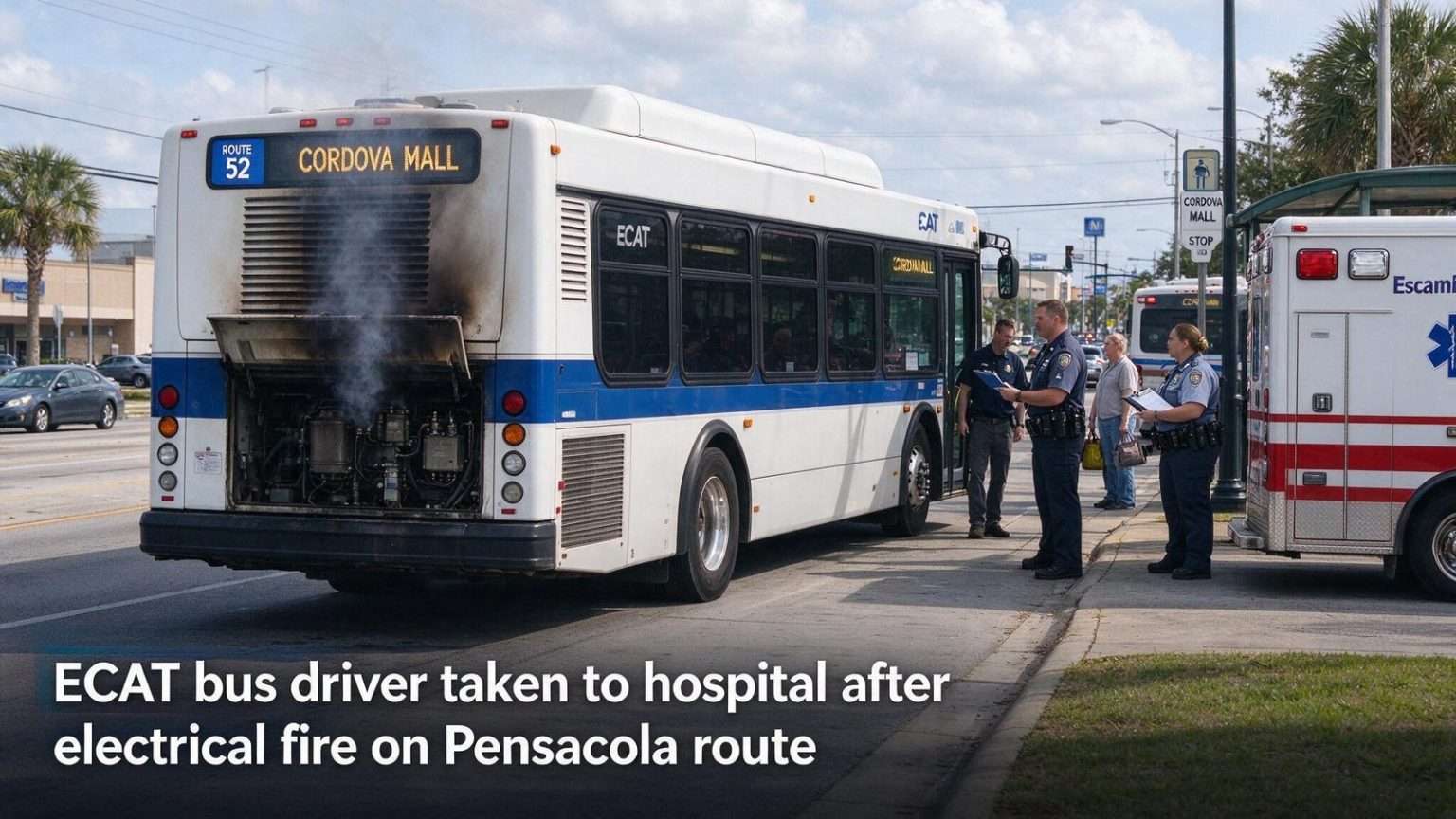
PENSACOLA, Fla. — An Escambia County Area Transit bus operator was taken to a local hospital Monday afternoon after extinguishing an electrical fire that broke out at the back of a bus along Route 52, according to a statement from Escambia County. The incident happened around 2:30 p.m. while the bus was stopped at the Cordova Mall stop, one of the busiest boarding points on the route.
County officials said the operator was transported by Escambia County EMS after the fire was put out. The statement did not describe the operator’s injuries or condition, and no further update on the driver’s status was immediately available. Two passengers were aboard the bus when the fire started. Neither the county statement nor transit officials indicated that either passenger required medical treatment at the scene.
A relief bus was brought in so the two riders could complete their trips rather than being left at the stop to wait for the next scheduled departure. The decision kept the disruption to the route itself minimal, since the affected segment continued to see service once the disabled coach was pulled from the run.
Electrical fires on transit vehicles are uncommon but serious events, and transit systems across the country train operators for exactly this kind of emergency. The fact that the ECAT operator was able to extinguish the fire at the rear of the bus before it spread suggests the crew followed the kind of response procedure transit agencies drill on: stop the vehicle, evacuate or secure passengers, isolate the power source, and address the fire only when it is safe to do so.
About ECAT and its role in Escambia County
ECAT — the Escambia County Area Transit system — is the public transit provider for the Pensacola area, operating fixed bus routes across Escambia County under the authority of Escambia County government. The system connects downtown Pensacola with outlying neighborhoods, commercial corridors, and key destinations such as hospitals, schools, and shopping centers. For many riders, including seniors, residents without vehicles, and workers on fixed schedules, ECAT is a daily necessity rather than an occasional convenience.
The system’s routes are numbered and radiate from a central transfer point in downtown Pensacola, allowing riders to move between routes at scheduled intervals. Like many mid-sized transit operations, ECAT runs a mixed fleet of full-size transit coaches and smaller cutaway vehicles, and it regularly positions spare and relief buses to cover routes when a coach goes out of service. That practice is what allowed a replacement vehicle to reach the Cordova Mall stop quickly on Monday.
Route 52 serves the Cordova corridor, one of the busiest commercial areas in Pensacola. The route’s stops draw steady ridership throughout the day because they sit near major retail, dining, and medical destinations. A stop at Cordova Mall alone can account for a significant share of a route’s daily boardings, which is why agencies place a premium on keeping those runs intact even when an individual bus must be replaced.
Why the Cordova Mall stop matters
Cordova Mall is the largest enclosed shopping center in the Pensacola area and anchors a stretch of retail and restaurant development along North Ninth Avenue and the surrounding streets. Transit stops serving the mall and its outparcels handle workers heading to shifts, shoppers running errands, and patients traveling to nearby medical offices. When an incident interrupts service at a stop of that size, the ripple effects reach more riders than a similar problem at a low-volume stop would.
Monday’s incident occurred in the mid-afternoon, a period when route ridership typically includes students returning home and workers on early shifts. County officials did not report any delays beyond the brief stoppage needed to transfer passengers to the relief bus. Transit agencies generally treat a driver-incident like this as a service-continuity problem as much as a safety event: the first priority is the people on board, and the second is restoring the published schedule as closely as possible.
Electrical fires on buses and how crews respond
Transit buses carry complex electrical systems that power everything from engine controls and lighting to the farebox and climate control. Fires in these systems most often originate in areas where wiring is concentrated — engine compartments, battery compartments, and rear electrical panels. Heat, vibration, and age can degrade insulation over time, and a short circuit can generate enough heat to ignite surrounding materials before anyone notices a problem.
Because of that, bus operators are trained to recognize the warning signs: a burning odor, smoke from the rear of the coach, flickering dashboard indicators, or unusual electrical behavior. Standard practice calls for the operator to pull over or stop as soon as it is safe, shut down the engine and master power switch to cut current to the affected circuits, and get everyone off the vehicle and away from it. Operators on many systems carry fire extinguishers rated for electrical fires precisely so a small, contained fire can be knocked down before it grows.
Escalation is the danger in these situations. An electrical fire that reaches fuels, hydraulic lines, or interior materials can spread quickly and produce toxic smoke. That is why emergency dispatch protocols on most transit systems treat any report of smoke or fire on a vehicle as a full emergency response, even when an operator believes the fire is out. Responding medics and fire crews evaluate the vehicle, the operator, and any passengers before the scene is cleared.
Escambia County EMS and the response
Escambia County EMS provides ambulance service throughout the county outside the Pensacola city fire jurisdiction, and it responds alongside fire and law enforcement partners to vehicle emergencies across the area. On Monday, EMS crews evaluated those involved after the fire was extinguished and transported the bus operator to a local hospital. The county’s statement described the transport but did not detail the nature of the operator’s condition.
Hospital transports after incidents like this are standard practice even when a driver or passenger feels fine at the scene. Smoke inhalation, especially from electrical fires that burn insulation and plastics, can cause respiratory irritation and other delayed symptoms that are not immediately obvious. Emergency crews err on the side of evaluation and treatment, and transport decisions are made by medics based on what they find during assessment.
The two passengers on board were apparently able to avoid injury, and their transfer to the relief bus was handled without reported complications. For riders, the visible measure of how well an agency handles an incident is often exactly that: how quickly normal service resumes and how small the inconvenience turns out to be.
What happens after a bus fire
Once a coach is removed from service after a fire, it typically undergoes a mechanical inspection before it returns to the fleet, with investigators or maintenance staff looking for the ignition source and any related damage. Depending on what they find, an agency may inspect similar vehicles in the fleet for the same defect. Transit agencies also file internal incident reports, and if a fire stems from a systemic problem, manufacturers or regulators may become involved.
For riders, the practical takeaway is straightforward. If smoke or a burning smell appears on a bus, notify the operator immediately and follow instructions about moving to another part of the coach or exiting. Operators are trained to manage these events, and the safest place for passengers is almost always under the operator’s direction rather than acting independently.
Escambia County officials said the investigation into Monday’s fire was handled through the county’s normal post-incident process. Additional details about the cause and the operator’s condition had not been released as of Monday evening.
Context: transit safety in the Pensacola area
Incidents like Monday’s fire are rare in the context of the thousands of trips ECAT completes across Escambia County each week. Public transit remains statistically among the safest ways to travel, and fires on transit buses represent a small fraction of the incidents operators face. When they do occur, however, they draw attention because of the potential consequences for everyone aboard and because a single disabled coach can briefly disrupt an entire route.
The response on Monday followed the pattern safety officials recommend for these events: the operator stopped the bus at a fixed stop with other services nearby, dealt with the fire at the source, and emergency medical crews were brought in to evaluate everyone involved. The presence of two passengers rather than a full load also reduced the complexity of the response, since only two people needed to be moved to the relief vehicle.
Escambia County government oversees ECAT operations and typically serves as the public information channel for incidents involving the transit system. The county’s statement Monday afternoon provided the core facts of the event — the time, the location, the route, the transport of the operator, and the transfer of passengers — while leaving mechanical and medical details to be resolved through follow-up.
What riders need to know
Riders on Route 52 and other ECAT routes should expect normal service to continue. Relief buses are a routine part of transit operations, and agencies plan schedules with enough spare vehicles to absorb single-coach losses without canceling trips. Riders who encounter a disabled or delayed coach can check with the transit system for updated arrival information or catch the following scheduled trip.
Passengers who were on the bus Monday were able to complete their journeys, which is the outcome transit agencies aim for in any vehicle emergency. The operator, whose quick response contained the fire at the rear of the coach, was the only person transported for medical evaluation.
Anyone who witnesses an emergency on a transit vehicle should notify the operator first, then call 911 if the situation appears to threaten anyone’s safety. For non-emergency questions about routes and schedules, ECAT’s customer service line remains the standard contact point.
The fire remains the subject of review by county officials, and further information about the cause and the operator’s condition will be provided through Escambia County as it becomes available. No injuries to passengers were reported, service on Route 52 continued with a relief coach, and the incident concluded without broader disruption to the transit system’s Monday operations.