Eight Mile Woman Killed in Highway 45 Rollover Crash Near Citronelle
Kasey Elizabeth Anderson, 29, of Eight Mile died after being ejected from her SUV in a predawn rollover crash on U.S. Highway 45; a Citronelle passenger was hospitalized with non-life-threatening injuries.
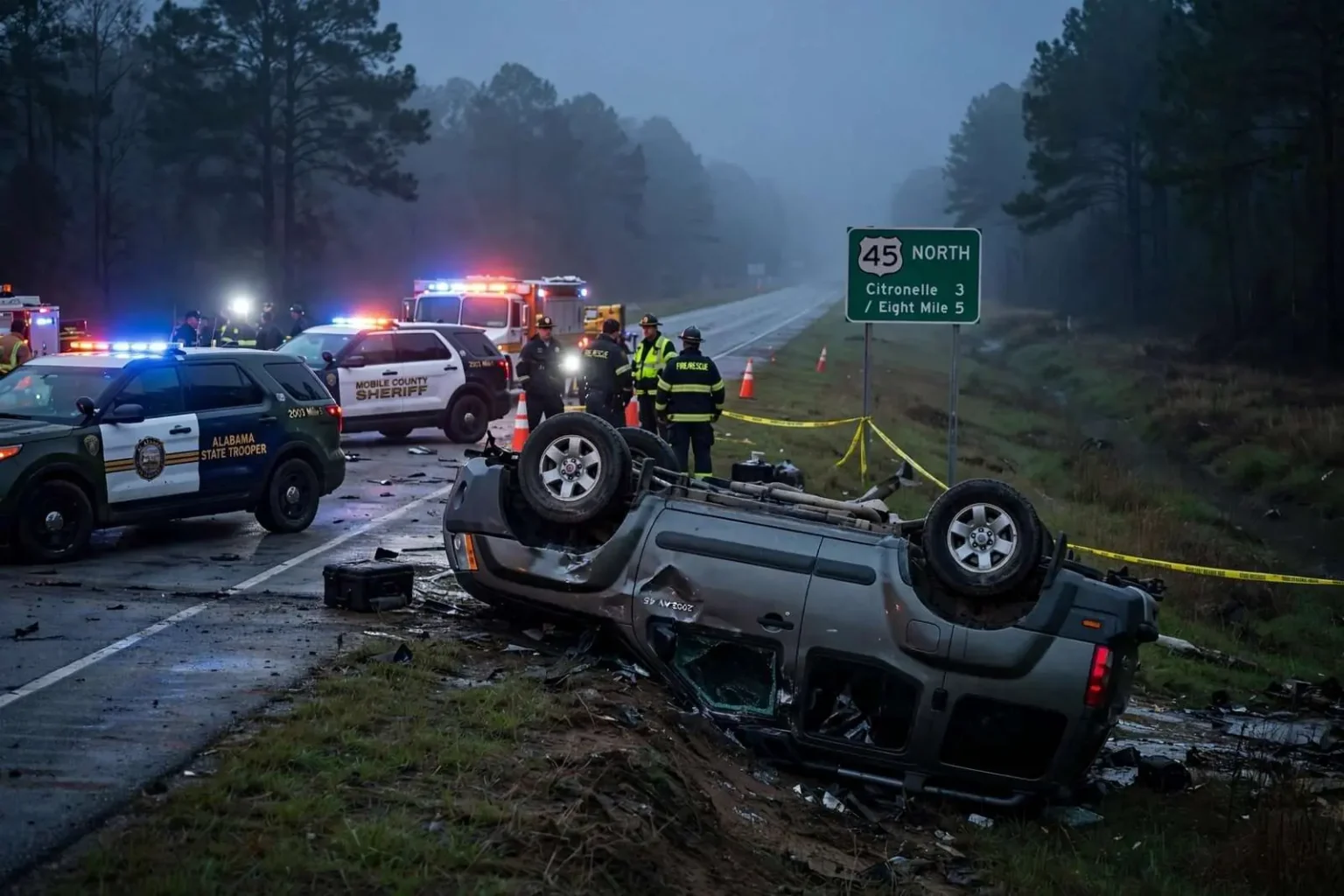
An Eight Mile woman was killed early Wednesday morning in a single-vehicle crash on U.S. Highway 45, according to a preliminary investigation released by Alabama State Troopers.
Troopers say Kasey Elizabeth Anderson, 29, of Eight Mile, was driving north on Highway 45 in a 2003 Nissan Xterra when the vehicle left the roadway and overturned before dawn. Anderson was not wearing a seat belt at the time of the crash and was ejected from the vehicle. She was pronounced dead at the scene.
A passenger in the vehicle, 28-year-old Marcus Gerald Ringer Jr. of Citronelle, was also injured in the crash. He was transported to University Hospital in Mobile for treatment of injuries described as non-life-threatening.
Troopers have not released further details about what caused the vehicle to leave the roadway, and the investigation remains ongoing. Investigators with the Alabama Law Enforcement Agency’s Highway Patrol Division typically examine roadway conditions, vehicle mechanical factors, and driver behavior in crashes of this kind, though no findings have been announced in this case. The crash occurred during the predawn hours, when visibility is reduced and traffic volumes are light but vehicle speeds tend to be higher on rural corridors.
A Corridor That Connects North Mobile County
Highway 45 is a heavily traveled two-lane route connecting Mobile County communities including Eight Mile and Citronelle. The roadway runs roughly parallel to the western edge of the Mobile metro area, threading through Whistler, Prichard, and a series of smaller communities before continuing north toward the Mississippi state line. For thousands of residents of the county’s northern reaches, it is the principal route for commuting to jobs in Mobile, reaching medical appointments, and moving freight between the port city and rural Alabama.
The highway’s character changes noticeably as it moves away from the city. South of Citronelle, long straight stretches give way to curves, shoulder drop-offs, and areas where commercial lighting is absent altogether. Drivers who know the road well can grow accustomed to its rhythm, and safety officials have long cautioned that familiarity on rural routes can breed the kind of inattention that turns a momentary lapse into a serious crash.
Predawn wrecks on rural stretches of the highway are a recurring concern for area law enforcement. Deputies with the Mobile County Sheriff’s Office and troopers assigned to the region have repeatedly responded to serious injury and fatal collisions in the early morning hours along the corridor, particularly in segments where the roadway narrows or curves. Limited lighting, wildlife crossings, and driver fatigue all factor into the risk profile that officers regularly describe when they urge caution during low-visibility hours.
Law enforcement agencies across the region have made restraint use a central theme of their safety messaging on Highway 45 and similar routes, regularly urging drivers to wear seat belts and use extra care between midnight and sunrise, when a disproportionate share of serious rural crashes occurs.
Alabama’s Seat Belt Law and the Physics of Rollovers
Alabama law requires all front-seat occupants to wear a seat belt, and safety officials note that ejection during a rollover crash dramatically increases the risk of fatal injury, underscoring the importance of restraint use even on short, familiar drives. The state’s primary enforcement provision means a trooper or officer may stop a vehicle solely because a front-seat occupant is unbelted, a tool agencies have used during targeted Click It or Ticket-style mobilizations across south Alabama for years.
The reason restraint advocates focus so heavily on rollover crashes comes down to simple physics. When a vehicle overturns, an unrestrained occupant can be thrown entirely from the passenger compartment, often through a window opening created during the rollover sequence. Once outside the vehicle, the occupant may be struck by the rolling vehicle itself or by the ground, and the forces involved in a rollover are frequently fatal on their own. Federal safety research consistently shows that the majority of occupants ejected in fatal crashes were not wearing restraints, and that seat belt use is the single most effective step a driver or passenger can take to survive a rollover.
Older sport utility vehicles like the 2003 Xterra occupy a particular place in that conversation. While such vehicles meet federal rollover standards, their higher center of gravity compared with sedans makes them somewhat more susceptible to tripping and overturning in abrupt maneuvers or when a wheel leaves the pavement edge. Investigators in rollover cases routinely look at whether the vehicle dropped off an unpaved shoulder, struck soft ground, or overcorrected after a tire dropped off the roadway.
Safety officials also point out that a seat belt’s role in a rollover is not limited to preventing ejection. Belts keep occupants positioned within the vehicle’s protective safety cage, where the roof structure, airbags, and interior padding can do their designed work. Unbelted occupants inside a rolling vehicle can be thrown against one another and against hard interior surfaces, multiplying the severity of injuries for everyone in the cabin.
The Predawn Risk Window
Crash investigators and highway safety researchers have long identified the hours between midnight and dawn as among the most dangerous on rural highways. Traffic is sparse, so speeds rise, and drivers may be fatigued after long shifts or late evenings. Alcohol impairment, though not suggested in this case, is statistically elevated in late-night crashes. Headlight range limits how far ahead a driver can spot a curve, debris, or an animal, and on a two-lane route like Highway 45 there is little margin for a late reaction.
For residents of Eight Mile, Citronelle, and the small communities between them, the predawn drive north or south on Highway 45 is a routine part of life — shift workers heading to jobs, early commuters reaching the interstate, hunters and fishermen crossing the county before sunrise. That routine is exactly why troopers and county deputies keep returning to the same guidance: slow down, buckle up, and treat a familiar road with the same care you would give an unfamiliar one.
What Comes Next in the Investigation
With the preliminary report released, the remaining work in the case falls to ALEA’s crash reconstruction and investigation personnel, who in serious-injury and fatal crashes typically document skid marks and gouges in the pavement, measure the vehicle’s final resting position, and inspect the wreck for mechanical defects. Toxicology testing is standard in fatal crashes, though results generally take weeks to return, and troopers do not typically release a final cause determination until that work is complete.
Under state practice, a preliminary report identifies the people, vehicles, and location involved, while leaving open the question of exactly why a vehicle departed the roadway. In cases like this one, possible contributing factors — from a roadway edge drop-off to a medical event or a steering input — remain on the table until investigators say otherwise. The agency has not indicated whether any charges or citations will result, and none would be announced until the investigation concludes.
The injured passenger’s condition at University Hospital was described as non-life-threatening, and no additional vehicles were reported involved. University Hospital serves as the region’s primary trauma center, and crash victims from across Mobile County’s northern communities are routinely transported there by ambulance or helicopter when their injuries warrant a higher level of care.
Community Impact and Regional Response
Fatal crashes along the Highway 45 corridor ripple through small communities where residents know one another well. In Eight Mile and Citronelle, word of a serious wreck spreads quickly through churches, schools, and workplaces, and area first responders — many of them volunteer firefighters who assist at rural crash scenes — are often neighbors of the victims. Counselors and clergy in such communities frequently find themselves supporting not only families but also the deputies, troopers, and medics who responded.
For their part, troopers use each serious crash on the corridor to renew the same appeals. Restraint use, speed appropriate to conditions, and heightened alertness for the curves and intersections north of Eight Mile are the recurring themes. Officials also encourage drivers to make sure their vehicles are roadworthy before long rural drives — tires with adequate tread, working headlights, and cargo secured — since a mechanical failure that would be an inconvenience in town can become a catastrophe at highway speed on a dark two-lane road.
The investigation into Wednesday’s crash remains ongoing, and troopers have asked anyone who may have witnessed the Xterra before it left the roadway, or who has information relevant to the case, to contact the Alabama Law Enforcement Agency. As that work continues, the crash stands as another entry in the long ledger of rural rollover losses along Highway 45 — and another reminder, in the words troopers use at every briefing, that the few seconds it takes to buckle a seat belt remain the best protection any driver or passenger carries.
How Rural Crash Response Works in North Mobile County
When a serious crash is reported on Highway 45 north of Eight Mile, the response typically draws together multiple agencies. ALEA troopers investigate, the Mobile County Sheriff’s Office assists with traffic control and scene security, and volunteer fire departments from nearby communities respond alongside commercial ambulance crews. On dark two-lane stretches, responders often work in the roadway itself, which is why passing drivers encounter flare lines, emergency lighting, and occasional temporary closures while wreckers recover vehicles.
Hospital transport from the corridor generally means a run south to Mobile, where University Hospital operates the region’s highest-level trauma center. The distance from the Citronelle area to the city can stretch response and transport times considerably, which is one reason law enforcement officials in north Mobile County place such emphasis on prevention. In rural crashes, the minutes before an ambulance arrives are often decisive, and the outcome frequently depends on whether an occupant’s injuries were survivable in the first place — a factor that restraint use influences more than any other.
A Recurring Message From Troopers
The circumstances of Wednesday’s crash — a rollover, an unbelted driver, and a fatal ejection — match the pattern that troopers describe most often when they explain why seat belts matter on rural roads. In urban congestion, a crash is more likely to be a fender-bender at low speed. On a two-lane highway at predawn speeds, the same lapse produces a rollover, and the belt becomes the difference between walking away and not surviving.
Agencies across south Alabama reinforce that message through checkpoints, school programs, and public statements after every fatal wreck. Safety officials note that most fatal crashes happen close to home on roads drivers travel every day, which is why they push restraint use for every trip, no matter how routine. The message extends to passengers as well; belts protect not only the wearer but everyone else in the vehicle by keeping bodies from becoming projectiles during a rollover.
As the investigation continues, troopers are expected to release a final report spelling out the factors that led the Xterra off the roadway. Until then, the preliminary account offers the essential outline: a young driver from Eight Mile, a familiar route, a predawn hour, and a crash that a seat belt might well have changed. For the communities along Highway 45, it is a loss that renews a familiar plea — wear the belt every time, especially on the drives that feel safest.