Eleven Candidates Qualify for Special Election to Replace Bonner in Congress
Eleven candidates, including two Democrats and nine Republicans, qualified for a special election to fill Jo Bonner's Alabama First District congressional seat after his resignation.
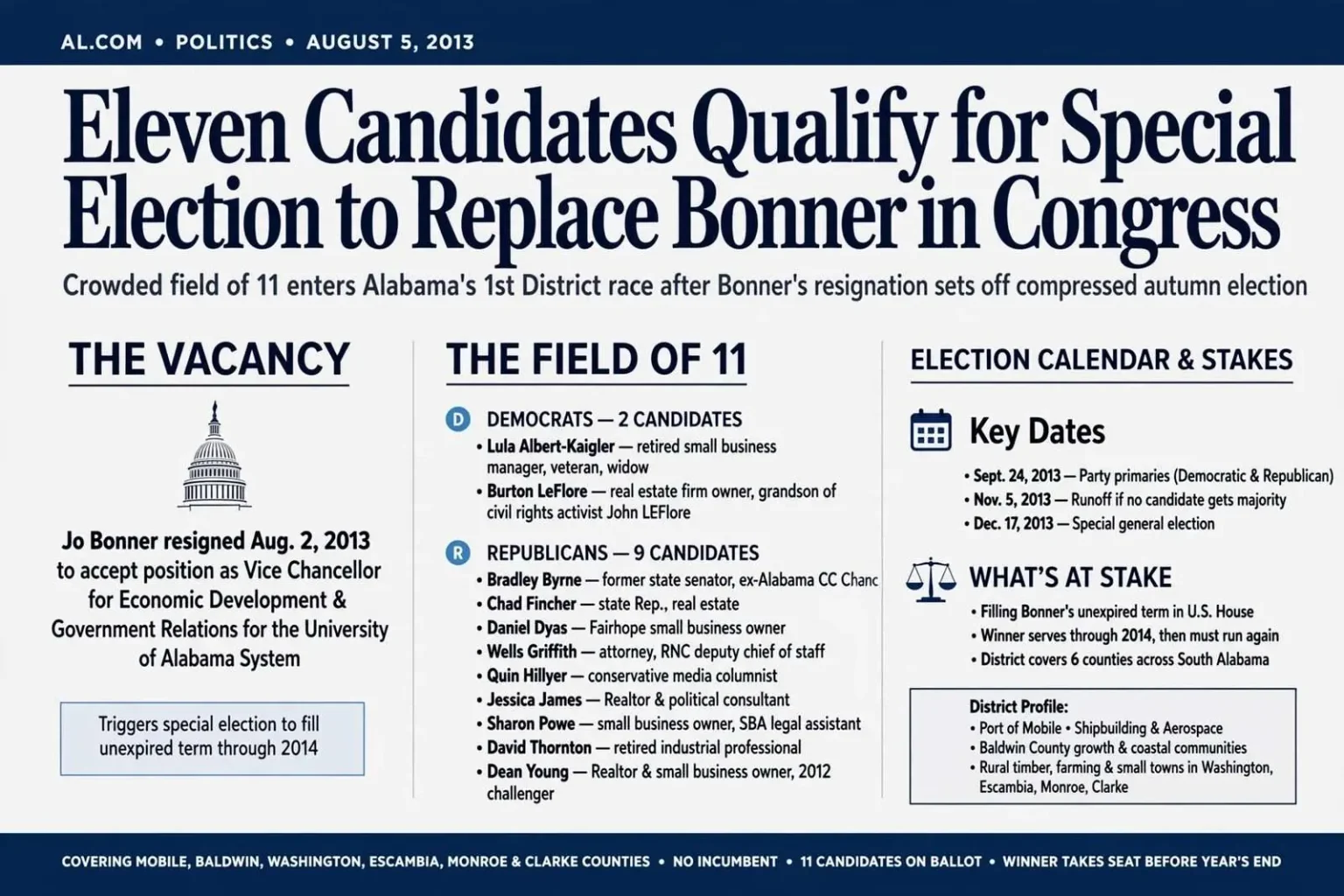
Eleven candidates officially qualified on Aug. 5, 2013, to run for Alabama’s First Congressional District seat, setting up a crowded special election to replace longtime Congressman Jo Bonner.
Bonner resigned from Congress on Aug. 2 to accept a position as vice chancellor of economic development and government relations for the University of Alabama System, triggering the need for a special election to fill the remainder of his term.
The speed of the transition — a resignation announced and a full field of candidates qualified within days — reflected how quickly special election machinery moves once a seat opens. For the First District, it meant an election calendar compressed into a single autumn, with a new member of Congress seated before the year ended.
The First District covers all of Mobile, Baldwin, Washington and Escambia counties, along with portions of Monroe and Clarke counties, making it a politically significant seat for South Alabama that has changed party hands only three times since 1965.
Its geography tells you what the job is. The district includes the Port of Mobile and the industries that surround it — aerospace, shipbuilding, chemical manufacturing and one of the nation’s fastest-growing container terminals. It takes in Baldwin County, one of the fastest-growing counties in the state, where growth management, beach renourishment and interstate funding are standing concerns. And it includes the rural timber and farming country of Washington, Escambia, Monroe and Clarke counties, where a congressman’s attention to agriculture, rural health care and small-town infrastructure matters as much as any port contract.
Special elections for the seat are rare enough to be generational events. Bonner’s departure was the first opening in years, and the district’s voters — accustomed to long tenures in the office — suddenly faced a ballot with eleven names on it, a compressed schedule, and no incumbent to organize around. County party offices, election officials in six counties and the candidates themselves all had to build their operations from scratch in a matter of weeks.
Whoever won would inherit all of it midstream — and, because the winner would be filling an unexpired term, would have to defend the seat almost immediately.
The Democratic Field
Two Democratic candidates qualified for the race.
Lula Albert-Kaigler, who describes herself as a retired, self-employed small business management professional, veteran, senior citizen and widow, will face Burton LeFlore in a special Democratic primary set for Sept. 24.
LeFlore owns a real estate firm and previously ran unsuccessfully for Yvonne Kennedy’s vacant seat in the Alabama Legislature. He is the grandson of civil rights activist John LeFlore, whose work in Mobile helped shape the city’s civil rights history.
That lineage carries weight in Mobile politics. John LeFlore was among the most consequential figures in the city’s 20th century — a founder of the Non-Partisan Voters League and a force for desegregation and voter registration whose influence stretched across decades of city government. His grandson’s candidacy ran on that history as much as on any platform, and it guaranteed the primary would draw attention well beyond the small number of votes a Democratic contest in this district was expected to produce.
Albert-Kaigler’s candidacy, meanwhile, spoke to a different tradition — the citizen candidate. Her self-description stitched together the biography of a generation of south Alabamians: military service, small business, retirement, widowhood. In a special election with no incumbent and no established favorite, the Democratic primary would decide which of those stories carried the party’s banner into the fall.
The Republican Field
Nine Republican candidates also qualified for the race, reflecting the conservative lean of the district.
They include Bradley Byrne, an attorney and former state senator who also served as chancellor of the Alabama Community College System; Daniel Dyas, a Fairhope small business owner and general contractor; state Rep. Chad Fincher, a real estate business owner who has represented Alabama’s 102nd District in Montgomery since 2006; Wells Griffith, an attorney and deputy chief of staff for the Republican National Committee; Quin Hillyer, a conservative media columnist and commentator with experience on Capitol Hill; Jessica James, a Realtor and political consultant who previously ran for a seat on the Alabama State Board of Education; Sharon Powe, a small business owner and legal assistant for the U.S. Small Business Administration; David Thornton, a retired industrial and business professional; and Dean Young, a Realtor and small business owner who had previously challenged Bonner for the seat.
The field’s shape told the story of the party’s coalition in south Alabama. Byrne brought establishment credentials and name recognition from a career that spanned the state Senate, the two-year college system’s reform years and a run for governor. Fincher arrived with a sitting legislator’s base in western Mobile County. Hillyer offered conservative media credibility and deep familiarity with Washington’s machinery. Young, the 2012 primary challenger, carried the social-conservative energy of the party’s activist wing. Around them ranged businessmen, a Capitol Hill veteran and candidates whose appeal rested on their professional roots in the district rather than any political resume.
Given the size and competitiveness of the Republican field, most political observers in the district expected one of the nine GOP candidates to ultimately win the seat, regardless of how the Democratic primary played out.
The arithmetic was simple. A district that had not drifted across party lines more than three times in nearly five decades was not considered winnable for a Democrat in a low-turnout special election, which meant the real contest — and the real expense, and the real attention — would come inside the Republican primary and its inevitable runoff.
With nine names on one ballot, the first test was simple survival. A majority would be nearly impossible in a field that crowded, which meant the campaign was really a two-stage race: distinguish yourself from eight rivals by Sept. 24, then win a head-to-head five weeks later. Candidates priced their strategies accordingly — some aiming to consolidate a home-county base, others gambling on a statewide-profile issue or a deep-pocketed pitch to carry them through the runoff round.
A Compressed Calendar
The timeline for the special election was expedited under a plan approved by Gov. Robert Bentley following Bonner’s resignation.
Separate Republican and Democratic primary ballots were scheduled for Sept. 24. If no candidate secured a majority in either primary, a runoff would follow on Nov. 5, with the winners of each party then facing off in a special general election on Dec. 17. If no runoff was needed in either party, the general election would move up to Nov. 5 instead.
That schedule left almost no idle time. Candidates had less than two months from qualification day to the first primary, and a candidate emerging from a Nov. 5 runoff would face a general election barely six weeks later. For a district spanning six counties, that meant a campaign built on television in Mobile and Pensacola’s coverage area, retail politics in Baldwin County’s growing municipalities, and sign-lined intersections in the small towns of the rural counties — all on a budget that had to last until December.
Third-party and independent candidates had until 5 p.m. on Sept. 24 to qualify for the race, giving the field room to expand further before the general election.
In practice, the window mattered little: with nine Republicans and two Democrats already competing, minor-party additions were expected, at most, to shade the margins of a race whose outcome few observers genuinely doubted. But the qualification deadline gave the ballot its final shape on the same day voters went to the polls in the primaries.
What the Winner Inherits
Whoever ultimately wins the seat will step into a two-year term in the U.S. House of Representatives, which carries an annual salary of $174,000. Because it is a special election filling the balance of Bonner’s unexpired term, the winner will also have to run again in the regularly scheduled 2014 election to hold onto the seat, meaning South Alabama voters will be closely watching this race as just the first round in what could be an extended battle for representation in Washington.
That rhythm — an election, then another election the following year — shapes the decision-making of everyone involved. Donors hesitate to spend twice. Candidates who might otherwise skip a special election see a 2014 opening behind it. And the eventual winner takes the oath with a campaign operation that never really shuts down, because the next primary arrives before the first term can find its footing.
For the district itself, the stakes are practical. A vacant seat means no vote in committee, no clout in appropriations and no voice in the earmark-era questions that remain in a leaner form. The First District’s industries — the port, the shipyards, the beaches, the military installations on the Eastern Shore’s edge — all have business before Congress in any given year. The sooner a new member is seated, the sooner the district’s paperwork resumes its place in the queue. That urgency, more than any candidate’s argument, is what a compressed special election calendar exists to serve.