
Emergency Missing Person Alert issued for 57-year-old Mobile County man
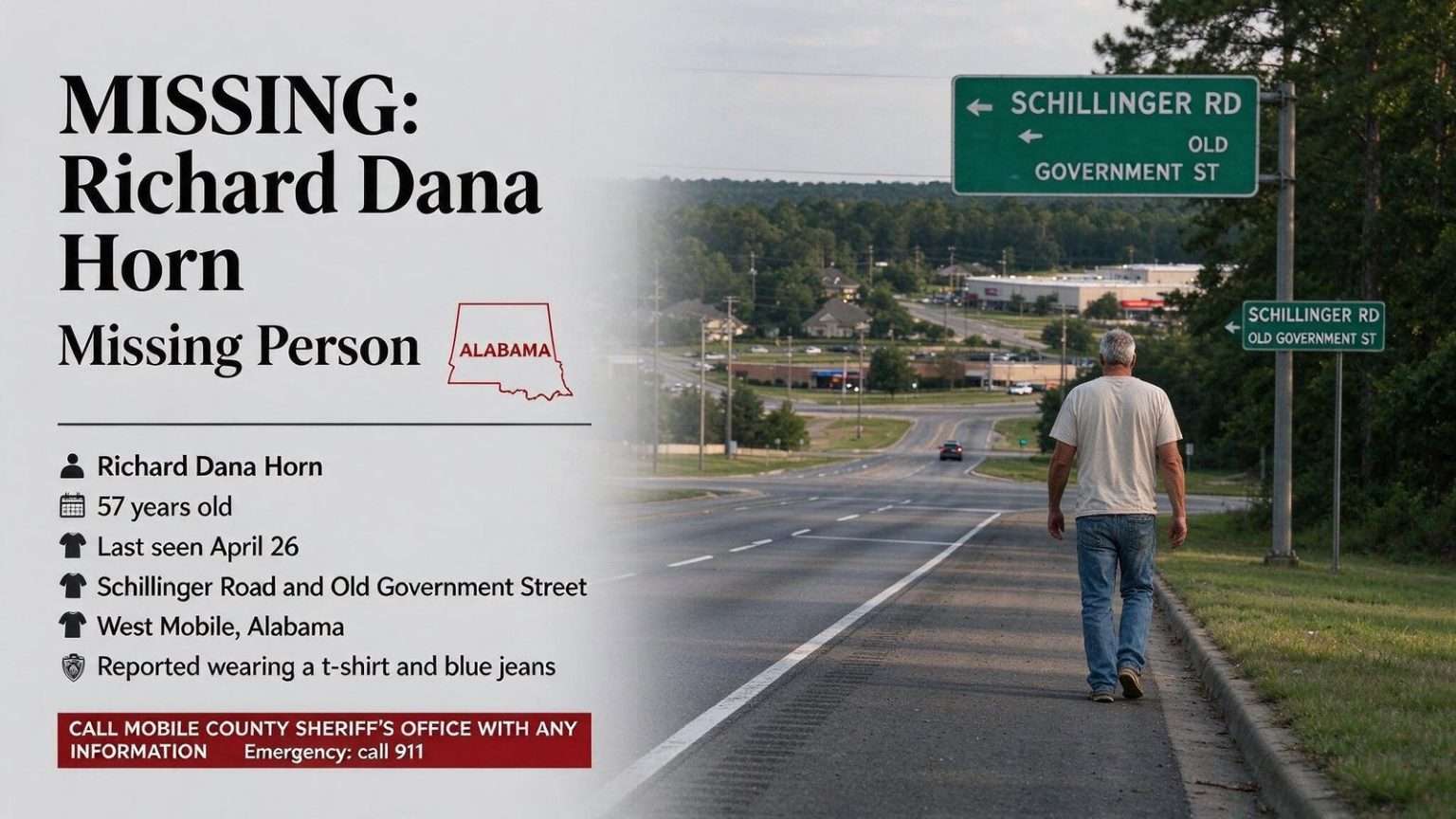
ALEA issued an Emergency Missing Person Alert for Richard Dana Horn, 57, last seen April 26 near Schillinger Road and Old Government Street in Mobile.
How Alabama’s missing person alerts work
Emergency Missing Person Alerts are distributed through the Alabama Law Enforcement Agency to quickly publicize cases involving adults who may be in danger because of a medical or cognitive condition. The alert system fills a gap in public notification: the Amber Alert framework that most residents know from highway signs and phone notifications applies only to abducted children, leaving adults with dementia, mental health crises or other impairing conditions in a category that historically drew far less attention. Alabama’s emergency alert framework gives investigators a way to enlist every radio listener, television viewer and social media user in the search within hours of a determination.
The designation is not automatic. Agencies requesting an alert must present circumstances showing that the missing person’s judgment is impaired or that their safety is otherwise at risk, which is why the detail about Horn’s condition mattered to the issuance. Once activated, the alert pushes descriptions and last-known-location information to media outlets and the public across the state, multiplying the number of eyes looking for the person far beyond what deputies alone could cover.
The search area in west Mobile
Horn was last seen on April 26 in the area of Schillinger Road and Old Government Street in west Mobile, a sprawling part of the county where residential subdivisions mix with wooded tracts and commercial strips. The intersection area sits in one of the faster-growing corridors of Mobile County, but large undeveloped parcels remain between neighborhoods, and someone on foot can travel a considerable distance without being seen once they leave the main roads.
Sheriff’s officials said Horn was believed to be wearing a t-shirt and blue jeans when he was last spotted. Search efforts in cases like this typically combine canvassing by deputies, checks of areas the person is known to frequent, and appeals to residents in the vicinity to review doorbell cameras and security footage from the date of the disappearance — tools that have become central to missing person investigations in suburban jurisdictions.
Why judgment-impairing conditions raise the alarm
Sheriff’s officials said Horn may be living with a condition that could impair his judgment, which heightened concern for his safety and prompted the statewide alert. Adults living with dementia, traumatic brain injury, mental illness or other cognitive conditions face well-documented risks when they go missing: disorientation, exposure to the elements, traffic hazards and vulnerability to exploitation. Search windows are treated as urgent because the outcomes grow statistically worse with every day a vulnerable adult remains unlocated.
Families of missing adults in Alabama often describe the search as a lonely process, because adult disappearances are legal — an adult generally has the right to leave — unless investigators can show danger. That is what an alert designation changes: it formally establishes that the person’s own judgment cannot be relied on to keep them safe, giving law enforcement and the public both the mandate and the urgency to act.
How the public can help
Anyone who believes they have seen Horn or has information about where he may be is asked to call the Mobile County Sheriff’s Office. Deputies advise callers to note the time, location and direction of travel of any sighting, and — when it can be done safely — to keep the person in view while help is summoned rather than approaching in a way that might cause them to run.
Residents outside the immediate search area can still contribute. Sharing the alert description within their own networks, checking rural property and outbuildings for signs of someone passing through, and reporting even uncertain sightings all feed the same investigative pipeline. In cases across the Gulf Coast, missing vulnerable adults have been located after a single tip from a resident who saw the alert hours earlier and recognized the description.
A family’s search continues
For Horn’s family and the deputies searching since late April, the alert represented both an escalation and an appeal — an acknowledgment that the days since his last confirmed sighting have stretched the limits of what an agency can do alone. The Mobile County Sheriff’s Office has continued to ask west Mobile residents to review anything they might have seen on or around April 26 near Schillinger Road and Old Government Street.
The Sheriff’s Office has not announced that Horn has been located, and the alert remains active as the search continues. Anyone with information is urged to contact the agency directly; in an emergency situation where someone matching his description is in immediate danger, calling 911 remains the fastest way to bring deputies to the scene.
The agencies behind the search
The Alabama Law Enforcement Agency, created in 2015 to consolidate the state’s public safety functions, administers the alert program through its fusion center and works with local departments to verify that a case meets the criteria before activation. For a Mobile County case, that means the Sheriff’s Office supplies the investigative facts — the last sighting, the clothing description, the medical context — and ALEA broadcasts the appeal statewide through its media distribution network.
The Mobile County Sheriff’s Office, which covers an area larger than many Eastern states and serves a population approaching half a million, handles a steady flow of missing person reports. Deputies prioritize cases involving children and vulnerable adults, and the county’s mix of dense suburbs, rural tracts and waterfront makes search logistics genuinely difficult — a person can disappear into woods, marsh or crowds depending on where they were last seen.
What families can do in the first hours
Law enforcement agencies advise families of missing vulnerable adults to act immediately rather than waiting to see whether the person returns. The recommended first steps include calling the local agency with a detailed description and photograph, checking places the person has gone before — old workplaces, past homes, familiar stores — and notifying neighbors along routes the person habitually walks. For adults with dementia or similar conditions, the first hours are when a search is most likely to succeed, because the person is usually still within a few miles of where they were last seen.
Caregivers can also prepare before an emergency: keeping current photos on hand, enrolling in identification programs offered through dementia advocacy organizations, and making sure a person with cognitive impairment carries or wears identification. Those steps shorten the search when wandering happens, and wandering — as the Horn case illustrates — is one of the most common ways vulnerable adults go missing.
The role of the community in these cases
West Mobile’s neighborhoods have proved attentive in previous searches, with residents sharing alerts through community social media groups and checking their own security footage without being asked. That pattern matters in a case like this one, because the answer may already sit in a resident’s saved video — a figure in a t-shirt and blue jeans captured on a porch camera near Schillinger Road on the evening of April 26, noticed only after the alert gave the date and location new meaning.
The alert also serves a second function beyond the search itself: it documents that the person was last seen on April 26 in the area of Schillinger Road and Old Government Street, fixing the timeline that investigators will work from as long as the case remains open. Every additional day narrows some possibilities and opens others, and the alert’s statewide reach means that a sighting reported from anywhere in Alabama — not just west Mobile — will reach the detectives assigned to the case.
For now, the most useful thing the public can provide is exactly what the Sheriff’s Office has requested: sightings, no matter how uncertain, and information about Horn’s habits or destinations that might not be in the official file. Family members, acquaintances and even casual contacts often hold pieces of information that never make it into an initial report — a place he used to visit, a relative in a neighboring county, a route he preferred to walk.
The Mobile County Sheriff’s Office has asked anyone with information to come forward, and the agency’s investigators have continued working the case since the alert was issued. The Emergency Missing Person Alert remains the state’s most public tool for a case like this, and its effectiveness now depends on the eyes of thousands of residents who know that a 57-year-old man in a t-shirt and blue jeans, last seen near Schillinger Road and Old Government Street in late April, is still missing — and that his family is still looking for him.
Updates in the case will come through the Sheriff’s Office, which has historically announced recoveries in missing person cases through its public information channels. Until one is announced, deputies continue to treat the case as an active search, and the alert remains active with it — a standing appeal to everyone between the Mississippi line and Mobile Bay to keep watch for Richard Dana Horn.


