Escambia County Prostitution Sting Nets 15 Arrests in Brownsville Area
An Escambia County Sheriff's sting in Pensacola's Brownsville area led to 15 arrests for solicitation and prostitution during an overnight operation.
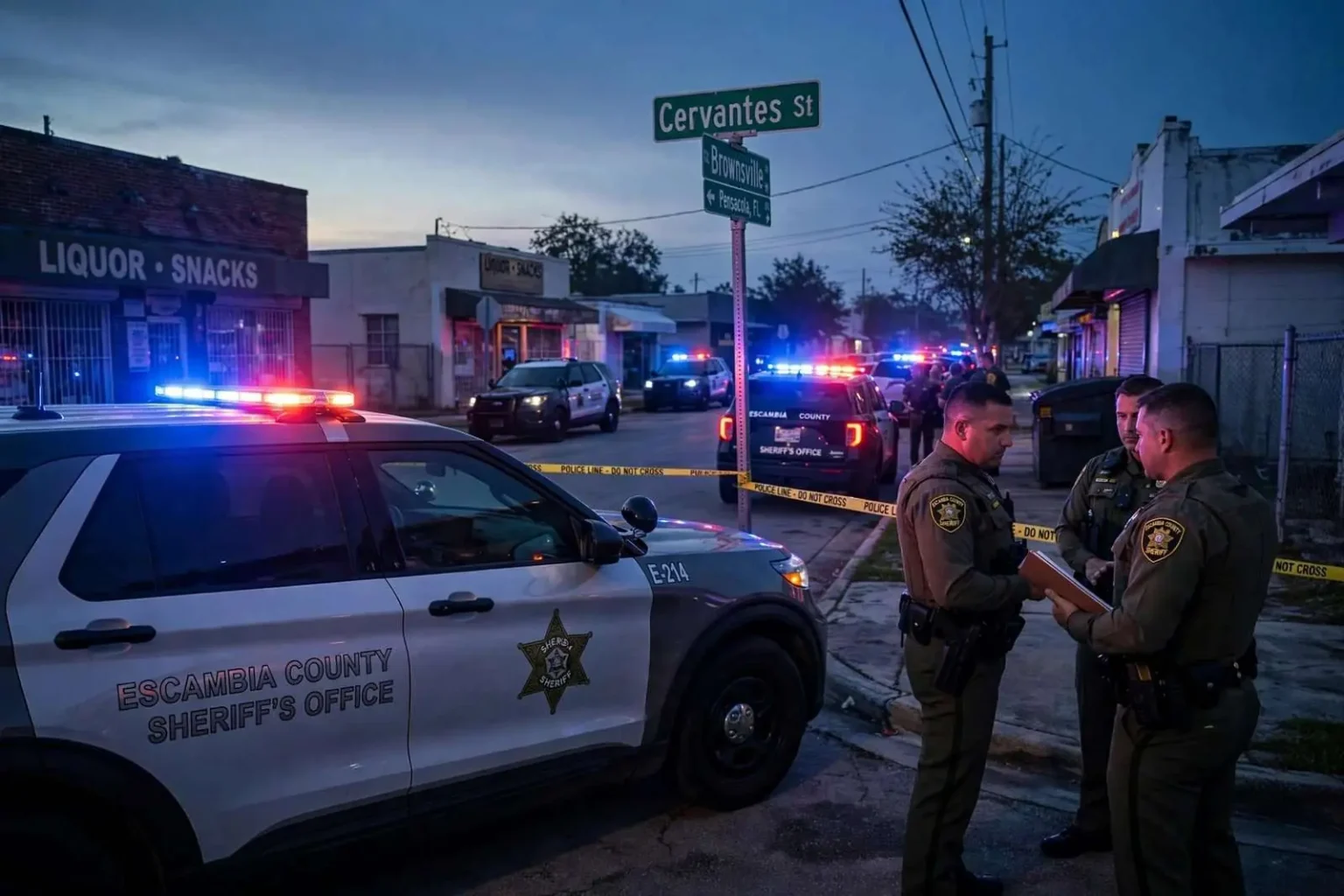
Escambia County Sheriff’s deputies took 15 people off the street during an early-morning prostitution sting in the Brownsville area, capping an operation that ran through the pre-dawn hours of March 23. The sweep was planned around the rhythms of street-level activity, which tend to peak in the hours after midnight and taper off near dawn, and deputies staged teams along several blocks simultaneously so that traffic stops and pedestrian contacts could be coordinated in real time rather than one at a time.
Twelve of those arrested were men charged with solicitation, while three women faced prostitution charges, according to the sheriff’s office. The ratio reflects a common structure in modern sting operations, in which undercover officers alternate roles — some posing as individuals offering to buy sex, others positioning as decoys — so that both sides of the transaction are addressed in a single operation. Each arrest required documentation sufficient to survive review by prosecutors: an undercover officer’s account of the exchange, any recorded communications, and notes on the location and circumstances of the contact.
The sweep targeted an area of Pensacola where street-level vice activity has been a recurring complaint. Brownsville, west of Pensacola’s downtown core along Cervantes Street and its cross streets, has for decades appeared in the sheriff’s office’s complaint logs more often than most neighborhoods for narcotics and prostitution reports. The neighborhood’s position along arterial roads that connect the western reaches of the county to the city’s center makes it a natural corridor for street activity, and residents’ associations and business owners in the area have repeatedly raised concerns about the effect visible vice has on an area already working against economic headwinds.
Escambia’s Long-Running Strategy Against Street Vice
The operation was one more round in the agency’s continuing effort to push prostitution and the criminal activity that often travels with it out of Pensacola neighborhoods. Law enforcement agencies nationally have long observed that street prostitution rarely exists in isolation; the same corridors tend to see narcotics transactions, theft, and in the worst cases trafficking. That overlap is a central part of the rationale agencies give for periodic stings — not only to address the immediate offense, but to disrupt the ecosystem in which other crimes take root.
Deputies have staged similar stings throughout Escambia County in recent years, typically working the same corridors where residents and business owners have flagged problems. The agency’s pattern has been to concentrate resources in a targeted area for a short, intense period rather than maintaining a permanent detail, both because staffing is finite and because the deterrent effect of an unpredictable sweep is considered more durable than a visible, stationary presence that can simply be avoided.
Investigators did not release the identities of those arrested, though booking information for all 15 was made available through the sheriff’s office following the sweep. Under Florida public records law, jail booking data — names, charges, and bond amounts — is generally public shortly after intake, and local newsrooms and residents alike track these logs as a routine window into enforcement activity. The decision not to publish the arrestees’ identities in the agency’s own press release is a common practice for misdemeanor operations, where publicity carries limited deterrent value and where identification errors before formal booking can create liability.
Charges filed in the operation are misdemeanor offenses, but authorities note that repeat offenders can escalate to felony exposure under Florida law. Florida’s statutes provide for enhanced penalties for individuals with prior prostitution or solicitation convictions, and prosecutors in the First Judicial Circuit have historically used that leverage to push repeat offenders toward treatment-oriented outcomes where appropriate. The distinction between a first misdemeanor arrest and a felony-level charge can hinge on details as small as a prior case’s disposition years earlier, which is one reason agencies emphasize that even “minor” vice arrests carry real long-term consequences for those taken into custody.
The enforcement-first approach reflected in the Brownsville sweep sits within a broader national conversation about how communities address prostitution. Advocates for a public-health-centered model argue that street-level enforcement disproportionately affects vulnerable populations and pushes activity into less visible, less safe conditions, and some jurisdictions have shifted resources toward diversion programs, housing assistance, and services aimed at underlying causes. Escambia County’s approach, like that of most Panhandle agencies, has remained enforcement-led, but local agencies have increasingly coordinated with social service providers for individuals who appear to be victims rather than willing participants — a distinction investigators are trained to assess during intake.
Screening for Trafficking Victims Amid the Crackdown
That distinction matters most in cases of human trafficking, which can look superficially like voluntary prostitution from the street. Florida consistently ranks among the states with the highest reported trafficking activity, owing to its size, tourism economy, agricultural workforce, and extensive transportation corridors. State attorneys in Florida operate specialized trafficking units, and law enforcement across the Panhandle receives training in screening indicators — control by a third party, signs of coercion, inconsistent accounts — that separate victims from defendants. Each arrest in a sweep like this one generates an opportunity for that screening, and some individuals taken into custody are ultimately referred to services rather than prosecuted.
The sheriff’s office has encouraged residents to keep reporting suspected vice activity, saying community tips help determine where future operations are concentrated. This feedback loop is a practical part of how agencies allocate limited resources: complaint clusters, combined with deputy observations and data from previous sweeps, shape the targeting map for each new operation. Residents can report activity through the sheriff’s office’s non-emergency line, and increasingly through online reporting forms and anonymous tip services that lower the barrier for those hesitant to be identified.
For the Brownsville neighborhood itself, the immediate effect of a sweep is usually a period of quiet followed by gradual resumption elsewhere. Researchers and police planners alike acknowledge that enforcement displaces rather than eliminates street activity, which is why agencies pair stings with follow-up presence in adjacent areas and with code enforcement actions against properties that facilitate vice. The sheriff’s office’s stated long-term goal — reducing the visible trade that residents complain about while leaving the door open to service referrals — captures the balancing act that Panhandle agencies have struck for years, one sweep at a time.
The demographics of the 15 arrests — twelve men and three women — also illustrate how the enforcement picture has shifted over the years. Older vice operations tended to focus almost exclusively on the individuals offering sex, while contemporary operations more often target buyers as well, on the theory that reducing demand is the more durable lever. That shift, adopted to varying degrees by agencies across Florida and the country, is visible in the makeup of the Brownsville sweep and in the language of the sheriff’s office’s public statements, which emphasized both sides of the street trade rather than one.
Planning the Sting: Logistics and Legal Boundaries
Logistics of an operation of this scale are considerable even for a misdemeanor detail. Fifteen arrests in a single pre-dawn window mean transport vehicles cycling between the corridor and the county jail, intake staff processing arrestees in parallel, evidence technicians logging items recovered during contacts, and supervisors ensuring that every case file contains the elements prosecutors will need. Deputies working the sweep typically operate in two-officer units at minimum, both for safety and so that any contested account of an exchange has at least two official witnesses. The entire detail is usually briefed in advance on the legal boundaries of an undercover contact — what constitutes a completed solicitation under Florida law, what must be avoided to prevent an entrapment claim, and how to hand off an arrest cleanly to the marked units waiting nearby.
The legal line between a conversation and a criminal solicitation is narrower than most residents assume, and it is the reason these operations depend on careful officer conduct. Under Florida statute, an offer or agreement to engage in prostitution, coupled with a lewd act or other corroboration, is generally sufficient for arrest — but the specifics matter, and defense attorneys routinely scrutinize undercover recordings for any suggestion that the officer initiated or persisted in the illegal exchange. The county’s sweeps are structured with that scrutiny in mind, which is part of why they take weeks to plan and produce conviction-ready files when they conclude.
Brownsville’s History and What Comes Next for Suspects
Brownsville’s history gives the current enforcement pattern its context. The neighborhood grew up along the roads that carried workers to Pensacola’s port and naval installations, and its commercial strips have cycled through boom and decline with the broader economy for generations. Community leaders in the area have generally welcomed focused enforcement of vice crimes while pressing the county for the complementary investments — lighting, code enforcement, commercial revitalization — that address why those corridors attract the activity in the first place. The sheriff’s office’s emphasis on community tips reflects that partnership: the agency’s stings are most effective where residents are willing to document what they see and report it consistently.
What happens to the 15 individuals after booking varies widely. Some will post bond within hours; others will remain in custody pending first appearance before a county judge. First-time defendants on misdemeanor charges are frequently offered pretrial diversion in exchange for community service, counseling, or a combination, with the charge dismissed on completion — an outcome prosecutors prefer for those unlikely to reoffend. Those with prior records face the enhanced penalties the sheriff’s office referenced, and a subset will be screened for trafficking indicators that could reclassify their cases entirely. The sweep, in other words, is the beginning of a process rather than its conclusion, and the outcomes will be spread across the county’s court docket for months.