Escambia County School Board Approves New Contracts, Handwriting Curriculum and Dozens of Staff Changes
The Escambia County Board of Education approved new literacy and technology contracts, laptops for W.S. Neal High School, and a long list of personnel changes at its July 16 meeting.
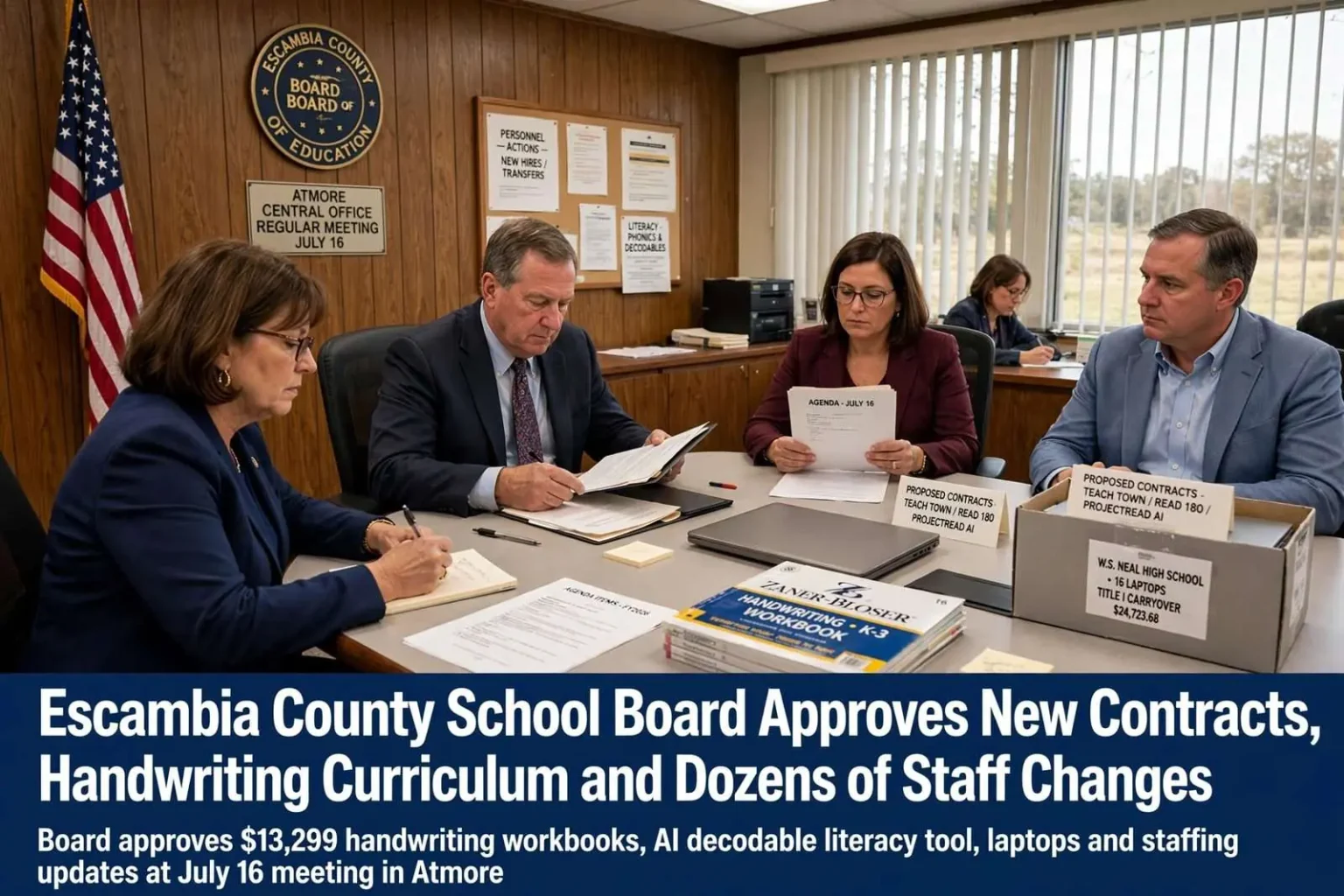
The Escambia County Board of Education approved a batch of new academic contracts, technology purchases and personnel moves during its July 16 regular meeting at the Atmore Central Office. The agenda gave board members a wide sweep of district business in a single session, from elementary handwriting workbooks to multi-year federal contracts, and from laptop purchases to a long roster of new hires ahead of the coming school year.
Escambia County’s school system serves a rural stretch of south Alabama along the Florida line, with campuses in Atmore, Brewton, Flomaton, and smaller communities like Huxford and McCall. Its board meetings routinely bundle state, local, and federal funding decisions into one agenda, reflecting the mix of revenue streams that keeps a small rural district supplied with curriculum, technology, and staff.
Among the items approved was a purchase of Zaner-Bloser handwriting workbooks for kindergarten through third grade, totaling $13,299 and paid from state fund 1227. Zaner-Bloser is one of the most widely used handwriting curricula in American elementary schools, and its workbooks guide young students through print and, later, cursive instruction — a skill set Alabama’s English language arts standards continue to require in the early grades.
The board also approved a subscription to the ProjectRead AI Decodable Generator for literacy instruction, to be funded through Pre-K dollars. Decodable texts — short reading passages built from the letter-sound patterns students have already been taught — are a staple of the phonics-based reading instruction Alabama schools have emphasized since the state’s literacy act raised the stakes on early grade reading. An AI-powered generator lets teachers produce fresh decodable passages matched to each week’s phonics lesson rather than relying solely on a fixed library of printed texts.
Technology and test prep purchases
Technology and staffing purchases made up much of the rest of the agenda. The board approved buying 16 laptops for students at W.S. Neal High School for $24,723.68 using Title I carryover funds. Title I, the largest federal K-12 program, directs money to schools serving high proportions of students from low-income households, and carryover balances — funds appropriated in a prior year but unspent — must be used before the district can claim new allocations, making mid-summer technology purchases a common way to put those dollars to work.
The board also approved Jumpstart Test Prep materials for Escambia County High School, Flomaton High School and W.S. Neal High School totaling $39,169.78 from CCR funds. The CCR designation ties the purchase to Alabama’s college and career readiness standards, and Jumpstart’s materials focus on the ACT-style preparation that now factors directly into Alabama’s graduation requirements and school report cards. Spreading the purchase across all three of the system’s high schools puts the same preparation tools in front of juniors and seniors regardless of which campus they attend.
The meeting followed the board’s standard summer rhythm: a single regular session in mid-July that clears the district’s procurement and personnel decks before the fiscal year and the school year converge in August. For a system of Escambia County’s size, each line item carries visible weight — a $13,299 workbook purchase or a set of 16 laptops represents a meaningful share of the discretionary dollars available to individual schools, which is why board members review each purchase’s funding source as closely as its price.
Multi-year service contracts
Several multi-year service contracts also won approval. TeachTown will continue providing software and programs supporting students with autism and other special needs under a five-year renewal that includes annual teacher training, billed at $23,785 per year through IDEA funding. IDEA — the federal Individuals with Disabilities Education Act — supplies the dedicated funding stream that makes such specialized software sustainable in a small district, and the bundled teacher training means staff are not left to implement the program on their own each year the contract renews.
Kids First was approved for three separate contracts. The largest is writing and teacher-effectiveness training at Escambia County Middle School funded through CSI federal dollars, at $79,500 for the FY2026 budget plus $6,500 in FY2025 carryover. CSI — the School Improvement designation under the federal Every Student Succeeds Act — targets campuses flagged for comprehensive support, and the contract pairs student writing instruction with coaching aimed at improving the effectiveness of the teachers delivering it.
The other two Kids First contracts address the district’s newer teachers. The board approved new-teacher support at Escambia County High School for $44,250 from FY2025 Title II carryover, and new-teacher support at Rachel Patterson Elementary School for $35,400, also from Title II carryover. Title II funds are reserved for teacher quality and professional development, and induction programs for first- and second-year teachers are among the most common uses — a response to the retention challenges rural districts face when young teachers are left to navigate their first classrooms without structured support.
The board additionally approved a contract with HMH for Read 180 software and coaching support at a cost of $44,805.90, split between FY2025 and FY2026 CSI funds. Read 180 is one of the most widely deployed reading intervention programs in the country, designed for older students reading well below grade level, and the coaching component embeds implementation support alongside the software license — an arrangement districts choose when they want results tied to how faithfully teachers use the program, not just whether licenses were purchased.
Along with the service contracts, the board approved an annual membership renewal with the Alabama Association of School Boards for $14,076.07. The association provides board training required under Alabama law, policy support, legal updates, and advocacy for member systems, and the annual dues are calculated from district size — a standing item on nearly every board’s July agenda.
Board members also signed off on an amended summer salary schedule and a budget amendment for FY2026. The salary schedule amendment adjusts summer employment pay, and the budget amendment formally revises the fiscal year 2026 spending plan the board adopted earlier in the year — both routine in July, when final state education budget figures and enrollment projections force mid-year adjustments to district spending plans.
Personnel actions across the district
The board approved a lengthy list of personnel actions covering resignations, new hires, transfers, substitute employment, summer positions and rehires across the district’s schools. July is the peak month for such moves, as summer resignations arrive, budgeted positions are filled, and principals finalize staff rosters before teachers return to their classrooms.
Resignations included Toby Jenkins at Pollard McCall Junior High School, Danielle Brown at Flomaton Elementary, Ahmaud Taylor at Escambia County Middle School, and several part-time interventionists and special education staff, along with Megan Smith and Candace Hendricks in central office and high school roles. The departures span every level of the system — elementary, junior high, high school, and the central office — and include the specialized intervention and special education positions that rural districts often find hardest to refill.
New employees approved for the coming school year include teachers Nikolas Shivers at Huxford Elementary, Paula Blosser at Pollard McCall Junior High School, Charlie M. Henderson and Jessica Bright at Escambia County High School, and Dalton Lewis at W.S. Neal Middle School, along with several paraprofessionals and bookkeepers across multiple campuses. The hiring list fills vacancies in every corner of the county, from the small Huxford campus to the district’s largest high school, and the paraprofessional and bookkeeper hires support both classroom instruction and front-office operations.
Henry Simmons was approved as a school improvement assistant principal at Escambia County High School. The title itself signals the school’s status under the state’s accountability framework: school improvement positions are typically funded and created at campuses designated for comprehensive or targeted support, placing additional administrative capacity where academic results most need attention.
The board also approved several staff transfers, including Nikita Pinney moving from a teaching post at Rachel Patterson Elementary to assistant principal at Flomaton Elementary/W.S. Neal Elementary. The split-campus assignment — one administrator leading two elementary schools — is a familiar arrangement in sparsely populated districts, where student populations are too small to justify a full administrative team at every school but too scattered to consolidate campuses entirely.
Along with rehires such as Brandy Turner and Trevon Lambert returning as teachers, and part-time interventionists Virginia Parker and Gail Peace returning to their previous roles, the personnel package effectively completes the district’s staffing picture for the school year ahead. With the curriculum purchases, technology buys, and federal contracts approved the same night, the July 16 meeting covered most of what Escambia County’s schools will need when students return — and left the board with a roster, a budget, and a set of contracts all pointed toward the fall.
The substitutes and summer positions approved on the same list round out the district’s coverage for the year’s first semester, ensuring classrooms have contingencies when regular teachers are absent and summer programs have staff in place. None of those names will appear on a school sign, but together they form the layer of staffing that keeps instruction running day to day in a district where a single unfilled position can mean a combined classroom or a lost course offering.