Escambia County Voters Head to the Polls for Tuesday’s Primary Election
Escambia County voters cast ballots Tuesday in the county primary, with election officials reminding residents of ID requirements, provisional ballots and absentee deadlines.
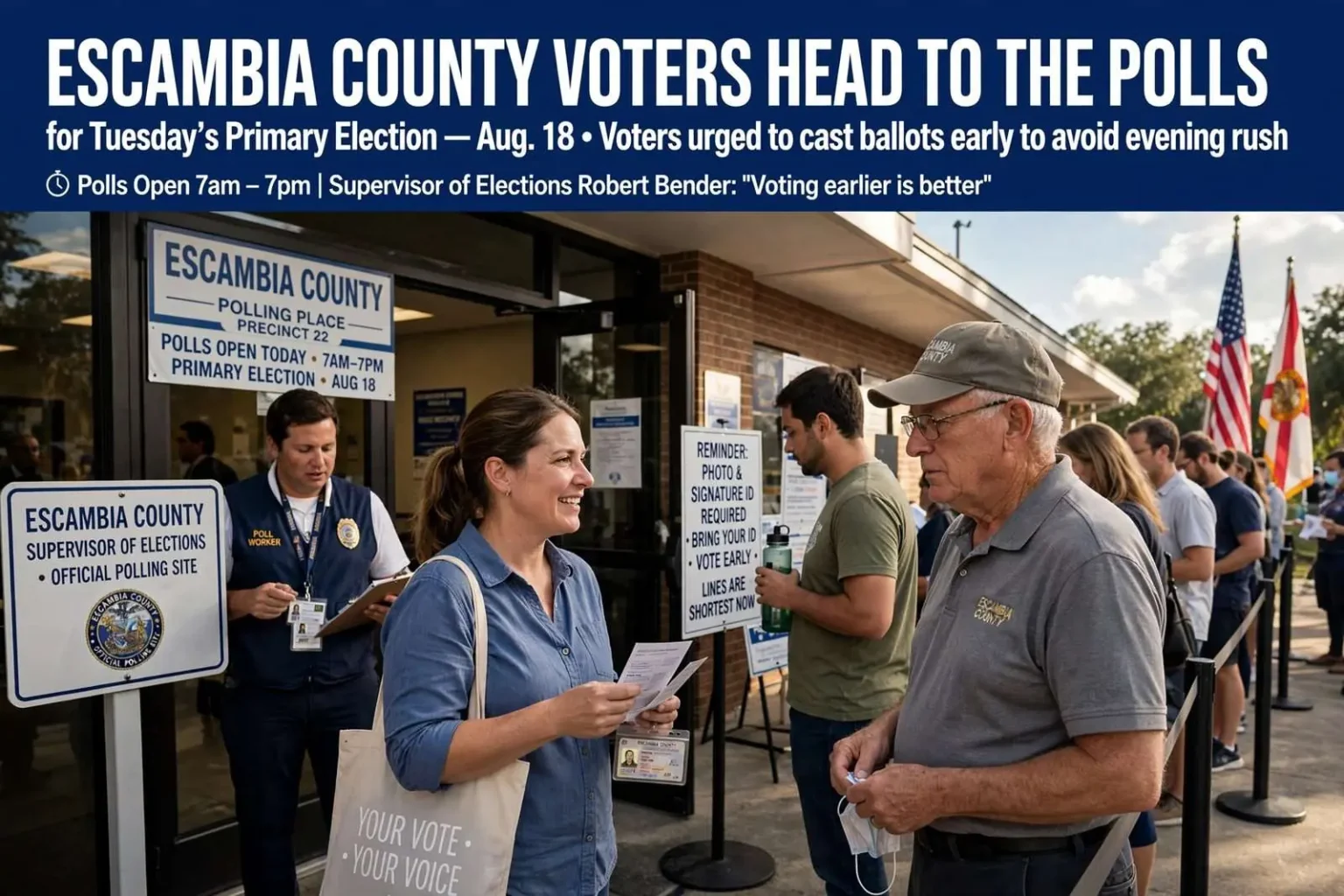
Voters across Escambia County headed to the polls Tuesday, Aug. 18, for the county’s primary election, with Escambia County Supervisor of Elections Robert Bender urging residents to cast their ballots earlier in the day rather than waiting until evening. “Voting earlier is better,” Bender said ahead of Tuesday’s election. “The influx usually grows through the day and tapers off toward evening.”
Bender’s advice reflected the rhythm that election officials see at precincts throughout the county on Election Day. Morning hours before work and the early evening rush typically produce the heaviest lines, while midday often moves quickly. Voters who were able to stop by a precinct during slower periods generally waited less, and officials emphasized that planning ahead — knowing the polling place, bringing the right identification and having decisions made in advance — was the surest way to make the trip quick.
Polling locations were open from 7 a.m. until 7 p.m., and election officials said anyone already in line by the 7 p.m. closing time was still permitted to cast a ballot. That rule matters in every Florida county: a voter who arrives before closing but waits in line past 7 p.m. does not lose the right to vote, and precinct workers account for everyone in line at the closing hour.
Complete local and state results were expected to be released after polls closed Tuesday evening. Early returns typically include absentee and early voting totals, followed by precinct-by-precinct results as poll workers deliver their materials to the elections office, and final certified outcomes follow days later once provisional and outstanding ballots are reviewed.
What Voters Needed to Bring to the Polls
Ahead of the election, the Escambia County Supervisor of Elections Office reminded voters that photo and signature identification was required at polling places. Florida law requires voters to present both a photo and a signature when checking in, and accepted forms of identification range from a Florida driver’s license or state identification card to a U.S. passport, military or student identification, a government employee card and several other photo credentials.
Voters who did not present an approved form of ID were still permitted to cast a provisional ballot, ensuring their vote could be reviewed even without ID in hand. Provisional ballots are counted once the elections office verifies the voter’s eligibility, and voters are given information about how to confirm that their ballot was accepted. Officials stressed that the process exists precisely so that no eligible voter is turned away over a missing wallet or forgotten card.
Election officials also urged voters to make only one selection per contest on their ballots and encouraged residents to study and mark a sample ballot in advance, then bring it to the polls as a reference. Overvoting — marking more candidates than a contest allows — can invalidate selections in that race, and taking a marked sample ballot into the booth is the simplest safeguard against mistakes on a long ballot.
Sample ballots were made available online through the Supervisor of Elections Office, allowing voters to review every contest and candidate before Election Day. In primary elections, the ballot a voter receives depends on party registration, and reviewing the correct sample ballot in advance helps voters confirm which races will appear on their card.
Absentee and Vote-by-Mail Rules
The Supervisor of Elections Office also clarified rules for absentee and vote-by-mail voters ahead of Tuesday’s election. Voters were not permitted to return a voted absentee ballot to their local precinct on Election Day; instead, absentee ballots had to be received directly by the Elections Office by 7 p.m. Tuesday in order to be counted.
The distinction matters because poll workers have no authority to accept voted ballots at precincts, and a ballot dropped off at a polling place — or handed to a poll worker instead of delivered to the elections office — cannot be counted. Voters who had requested a mail ballot but had not yet returned it were urged to deliver it in person to the elections office well before the 7 p.m. cutoff rather than waiting until the final hour.
Residents who requested a vote-by-mail ballot but decided not to return it, opting instead to vote in person at their polling place, were instructed to bring the unreturned ballot with them so it could be formally canceled before they were allowed to vote in person. Surrendering the unused ballot prevents any possibility of a voter casting two ballots, and voters who could not locate their unreturned mail ballots were directed to contact the elections office for guidance before heading to the polls.
Florida’s Primary System
Tuesday’s contest fell under Florida’s closed primary system, in which a voter’s party registration determines which partisan primaries appear on the ballot. Voters registered with a political party may vote only in that party’s primary, while voters registered without party affiliation generally see only nonpartisan contests, such as judicial races, school board seats and local referendums, when they appear on the ballot.
That structure makes the registration deadline and party choice especially consequential in Florida. A voter who wants a voice in selecting a party’s nominees must be registered with that party by the book-closing deadline before the election, and switching parties after that point waits until the next election cycle to take effect. The Supervisor of Elections Office maintains registration records and handles updates, and it encourages voters to confirm their registration status and party affiliation before each election rather than discovering a problem at the polling place.
Primary elections also determine which candidates advance to the general election, and in districts where one party dominates, the primary can effectively decide who holds the seat. Local contests in Escambia County — county commission seats, constitutional offices and school board positions — often draw their most competitive fields in the primary, making August turnout a significant factor in how the county is governed.
The Work Behind Election Day
An election like Tuesday’s takes months of preparation by the Supervisor of Elections Office. Precincts must be staffed with poll workers trained on equipment and procedure, ballots must be programmed and tested, and voter rolls must be maintained through registrations, address changes and removals. In the days before the election, the office also processes vote-by-mail requests, staffs early voting sites and fields thousands of questions from voters about where and how to cast a ballot.
On election night, the focus shifts to collection and reporting. Poll workers close their precincts, reconcile the numbers of voters checked in against ballots cast and transport materials to the elections office, where results are tallied and posted. A canvassing board then reviews provisional ballots, overseas ballots and any ballots requiring further scrutiny before the results are certified, a process designed to catch errors and ensure that only legal votes are counted.
For Escambia County voters, the practical takeaway from Bender’s office in the days surrounding the election was simple: vote early in the day if possible, bring approved photo and signature identification, mark only one selection per contest, hand-deliver any absentee ballot to the elections office by 7 p.m., and bring an unused mail ballot to the precinct if choosing to vote in person instead. Officials said following those steps keeps lines moving and ensures every eligible ballot counts.
Checking Registration and Finding a Precinct
The Supervisor of Elections Office also reminded voters that they could confirm their registration status, party affiliation and assigned polling place before heading out, using the office’s online lookup tools or by calling the elections office directly. Precinct assignments occasionally change between elections because of redistricting, precinct consolidations or the availability of polling sites, and voting at the wrong precinct can complicate a voter’s ability to cast a regular ballot. Confirming the location in advance — along with the hours and required identification — remains the most reliable way to avoid problems at check-in.
Early voting, where offered for a particular election, gives voters a chance to cast ballots at any early voting site in the county rather than only at their assigned precinct, and the elections office publishes dates, times and locations for those sites before each cycle. Voters who miss the early voting window must vote at their assigned precinct on Election Day, making it worth knowing the difference between the two options well before Tuesday.
The office also encourages voters with questions about accessibility to contact it in advance. Polling places are required to be accessible, and curbside voting is available for voters who cannot enter the polling site, with precinct workers bringing a ballot outside. Voters who need assistance marking a ballot may bring someone to help, subject to the limits in state law, or ask for help from the precinct’s election officials.
What Happens After the Polls Close
Once voting ends at 7 p.m., attention turns to the count. Unofficial results posted on election night are exactly that — unofficial — and they can shift as provisional ballots are verified, mail ballots postmarked by Election Day arrive within the allowed window and clerical discrepancies are resolved. Florida’s canvassing process, in which a county canvassing board made up of local officials reviews questionable ballots and certifies the final totals, exists to make sure those judgments are made in public and on the record.
Candidates and campaigns typically watch the early absentee returns, which historically have favored whichever campaigns organized effective vote-by-mail programs, before precinct results begin shifting the totals. Races that remain within a narrow margin on election night can take days to resolve, particularly where the gap falls within the range that triggers an automatic machine recount under Florida law.
For voters, the period after Election Day is a chance to follow up on anything unusual at the polls. Anyone who cast a provisional ballot can check its status with the elections office, and voters who witnessed problems — long lines caused by equipment failures, identification disputes or accessibility issues — are encouraged to report them so the office can address them in future elections. Bender’s office treats that feedback as part of the cycle of running elections, using each contest to refine staffing, equipment placement and voter communication before the next one.