
Everyone Escapes as Flames From Rear of Andrews Street Home Spread Into Attic
Mobile Fire-Rescue fought an early-morning house fire on Andrews Street that started at the rear of the home and spread to the attic.
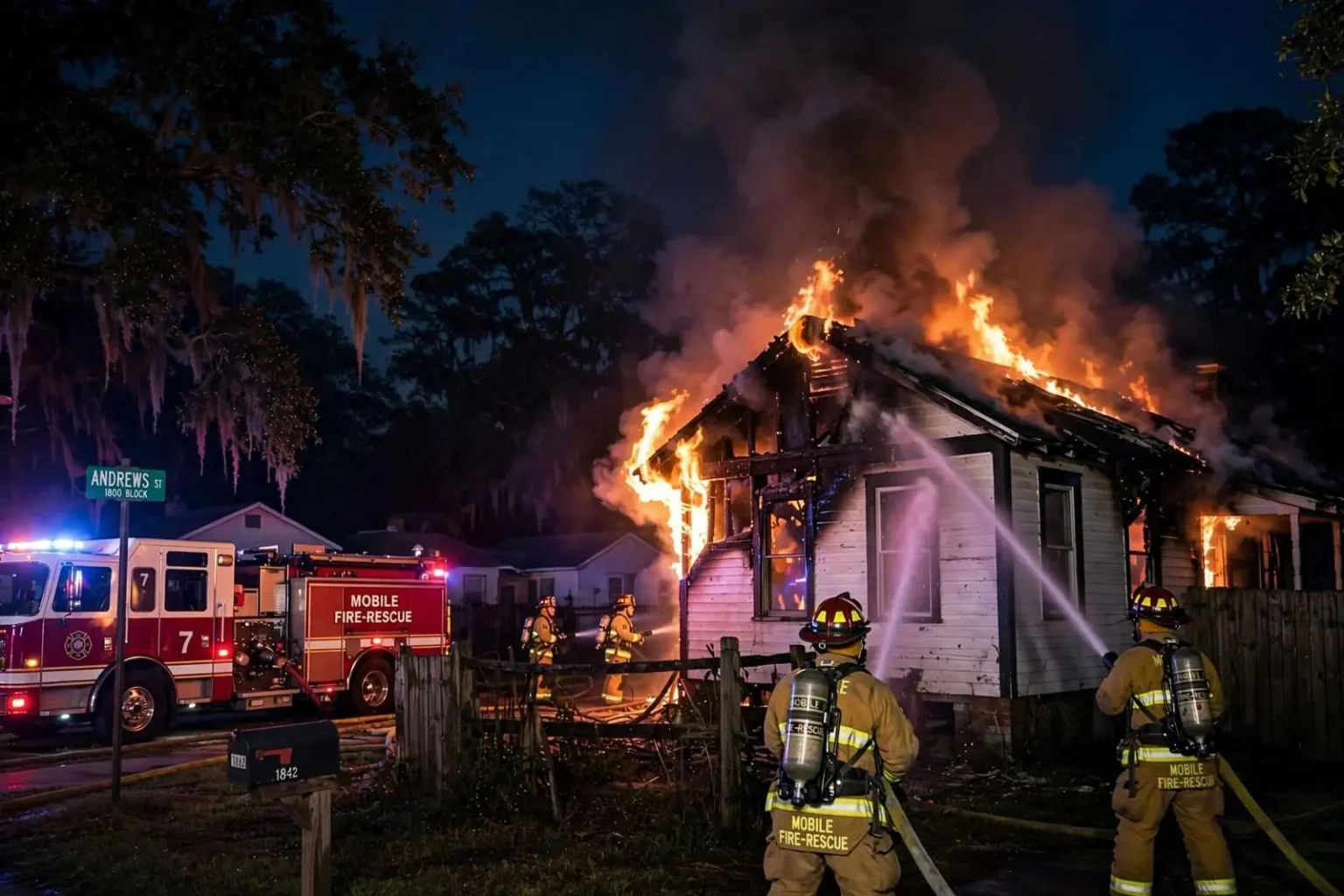
Mobile Fire-Rescue crews battled a house fire in the 1800 block of Andrews Street early Tuesday morning, with all occupants already out of the home by the time firefighters arrived. The fire, reported in the pre-dawn hours in a residential neighborhood of the city, drew a full first-alarm response and ended without injuries, though the structure itself was heavily damaged.
According to the department, crews were dispatched around 1:11 a.m. after reports of flames visible from the rear of a residential structure. Fire arrives differently at that hour than during the day: the neighborhood is dark and quiet, the people inside are asleep, and a fire that shows itself from the back of a house can be burning through a rear wall or into hidden spaces for a significant time before anyone sees it. The callers who reported visible flames gave dispatchers a critical head start in an incident where minutes matter.
On arrival, firefighters found a single-story wood-frame home heavily involved in fire. Wood-frame construction burns fast and hot, and fire that has reached the exterior walls or roof structure of that type of building can compromise the structure while the suppression work is still underway. Crews made their attack knowing the home was already heavily involved, a situation that shifts priorities toward protecting exposures, preventing collapse injuries, and knocking the main body of fire down quickly.
Everyone out, and the search to be sure
All occupants had evacuated before fire crews reached the scene. Early self-evacuation is the single biggest factor in surviving a residential fire, and the occupants’ escape before the first engine arrived meant firefighters could concentrate on suppression rather than rescue, dramatically changing the shape of the response.
As a precaution, firefighters performed a full interior search and confirmed no one remained inside. That step is standard and essential: in dark, smoke-filled structures, families sometimes discover at the curb that a child, an elderly relative, or a pet has not come out, and occupants re-entering a burning home to look for someone is among the most dangerous outcomes a fire scene can produce. A systematic search removes the uncertainty and keeps rescuers, rather than panicked residents, responsible for checking every room.
Crews extinguished the flames without any reported injuries, then ventilated smoke and toxic gases from the structure. Ventilation is a deliberate, tactical part of modern firefighting: cutting openings or forcing exhaust paths lets superheated gases and carcinogen-laden smoke escape, improving visibility for overhaul crews and reducing both the hazard to the structure and the lingering contamination that follows a fire.
Investigators determined the fire started at the rear exterior of the home before quickly extending into the attic. That origin and path tell a familiar story in residential fires: a rear exterior fire, whether it began at a porch, an exterior electrical connection, a grill, or debris burning against the structure, climbed the wall and found the attic, the open, connected cavity that runs the length of a wood-frame house. Once fire enters an attic space, it travels above the rooms below, feeding on insulation and framing while remaining invisible from inside until it breaks through or the smoke alarms sound.
The attic’s role explains why a fire that shows at the rear of a house can escalate so quickly, and why departments attack attic involvement aggressively, opening ceilings and pulling insulation to confirm the fire has not silently spread across the top of the structure. The cause, however, remains under investigation, and fire investigators will now work the origin area the way detectives work a crime scene: photographing, excavating layer by layer, and eliminating possibilities until the evidence points to a conclusion, which may or may not ever be announced publicly.
How Mobile Fire-Rescue works a night fire
The response on Andrews Street reflects how the department’s system operates across the city. A dispatch at 1:11 a.m. sends the closest engines, ladders, and a district chief, with assignments divided on arrival between attack, water supply, search, and ventilation. Overhead, the coordination is procedural, refined across the thousands of structure fires the department has fought in its long history as one of the Deep South’s oldest paid fire services.
Pre-dawn residential fires are among the department’s most dangerous calls. Fatigue, darkness, and the possibility of sleeping occupants push crews to work faster in conditions that offer fewer visual references. The fact that this fire ended with no injuries to civilians or firefighters is the outcome every response is built around, and it depended on the occupants’ early escape as much as on the crews’ work.
The neighborhood context matters as well. The 1800 block of Andrews Street sits in an older part of the city where wood-frame housing stock, close lot lines, and mature trees are the norm. Fire in that environment threatens not just the burning structure but the homes beside it, and crews arriving to heavy fire are trained to check exposures first, positioning lines to keep fire from hopping a fence line or an eave to the neighboring roof.
After the fire is out
For the displaced occupants, the hours after a fire like this involve the practical machinery of recovery: a place to stay, help from family or from organizations like the Red Cross, and the long process of working with insurance and contractors. A single-story home heavily involved in fire is often uninhabitable, even when the flames are confined to the rear and attic, because smoke, water, and structural damage reach far beyond the burn area.
Fire officials use incidents like this one to reinforce the basics that made the difference on Andrews Street: working smoke alarms on every level, a family escape plan everyone has practiced, and the instinct to get out first and call for help rather than stopping for belongings. The occupants of the Andrews Street home were outside when the first engine arrived, and that head start, as much as any tactic, is why everyone escaped.
The investigation into the cause will proceed in the coming days. Investigators have established where the fire started and how it spread, the rear exterior into the attic, but the question of what ignited it remains open, and the department has not indicated when or whether a finding will be released. Until then, the scene on Andrews Street stands as the aftermath of a fire that took a home’s rear wall and attic, but not a single life.
The Andrews Street fire also illustrates the arithmetic of residential fire risk in a port city of Mobile’s age. Older neighborhoods carry older wiring, aging heating systems, and in many cases homes that predate modern building codes for smoke detection and egress. Departments across the Gulf South conduct year-round smoke alarm giveaway and installation programs precisely because the combination of older housing and nighttime fires is where fatalities concentrate.
Modern furnishings and building contents have changed the fire clock as well. Synthetic upholstery, carpet, and insulation burn hotter and faster than the natural materials of earlier decades, shrinking the escape window inside a burning home to a few minutes or less. Fire safety educators frame the modern rule in blunt terms: the time to decide on an escape plan is before the alarm sounds, because after it sounds there is no time left to plan.
For the crews on Andrews Street, the work after knockdown is its own discipline. Overhaul means pulling ceiling sections and wall coverings to hunt hidden fire, watching for rekindle in the attic space the flames had entered, and standing by until the scene is truly cold. Investigators preserve the origin area for examination before crews disturb it further, which is why the sequence on a fire like this runs: extinguish, ventilate, protect the origin, then search and secure.
The Mobile Fire-Rescue Department has not released estimates of damage or named the occupants, consistent with its practice on fires under investigation. What the record shows is the essential sequence: flames visible from the rear shortly after 1 a.m., a heavily involved single-story wood-frame home, occupants already safe outside, a full interior search confirming the house was empty, an aggressive knockdown with no injuries, and an origin determination pointing to the rear exterior with rapid extension into the attic.
The response on Andrews Street involved the resources of a career department accustomed to volume. Mobile Fire-Rescue runs dozens of stations across the city, and a structure fire at any hour draws units from multiple quarters, leaving the rest of the city covered while the working fire absorbs its first alarm. Mutual aid arrangements with neighboring volunteer departments along the city’s edges complete the picture, though the Andrews Street fire was handled within the department’s own assignment before any escalation was needed.
The remaining question, what caused the initial fire at the rear of the home, stays open with investigators. Residents of the block, meanwhile, were left with the sight of a damaged house and the confirmation of something their neighbors already proved in the dark: that an early escape, practiced or instinctive, is the difference between a fire story with damage and one with tragedy.


