Extra Security and Orange Bollards Frame Mobile’s Pride-Themed June Art Walk
Orange bollards and extra MPD presence protected Mobile's June Art Walk and Pride celebrations downtown, with big crowds turning out.
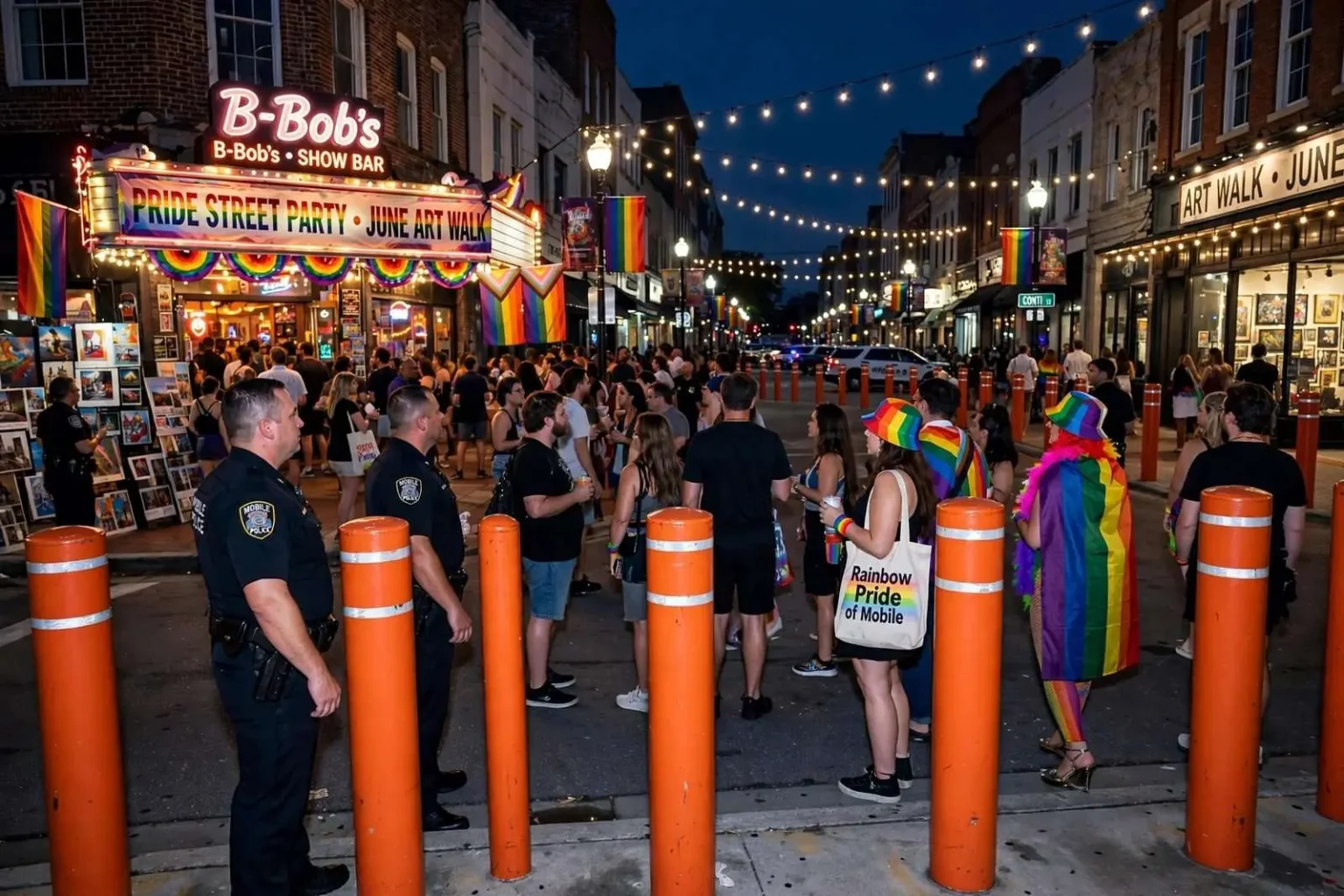
The orange bollards that first appeared on Mobile’s streets during Mardi Gras season made a return engagement Friday night — this time ringing the crowds gathered downtown for June’s Art Walk, the month the event coincides with the city’s annual Pride celebration. The heavy steel barriers, a fixture of the city’s crowd-control planning since they were first deployed to protect maskers and revelers packed along the parade routes, gave the monthly art stroll the same protective perimeter that downtown visitors see during Carnival’s biggest nights. Their return for a June event signaled how broadly the city now applies the lessons it learned about protecting large street gatherings.
The barriers, designed to shield pedestrians from vehicle attacks, were placed for the first time around the stretch of Conti Street where B-Bob’s show bar hosted its street party following the annual Pride Walk. Enhanced police presence from the Mobile Police Department accompanied them. Together, the physical barriers and the added officers formed a layered security plan for the evening — the bollards handling the vehicle threat and the officers handling everything else, from crowd flow to any disturbance that might arise. Event organizers worked with the city on the arrangements in the weeks leading up to the celebration.
Conti Street runs through the heart of downtown Mobile’s entertainment district, a block from the Lower Dauphin corridor where the city’s bars, restaurants and galleries cluster, and it has long been a center of the city’s nightlife and its LGBTQ community. B-Bob’s, a show bar that has anchored the street for years, draws performers and patrons from across the central Gulf Coast, and its Pride weekend street party has become one of the signature events of Mobile’s annual celebration.
Organizers: Threat Feels More Tangible
For organizers and attendees, the added protection was welcome but sobering. Jerry Elhen, who owns B-Bob’s on Conti Street, said the need for such measures underscores why the celebration matters, noting that growing divisiveness in recent years has renewed the purpose of an event built around community. The irony was not lost on the crowd: a party meant to celebrate openness required steel barriers and a police detail, and the visible security became part of the evening’s conversation as much as the music and the art.
Chance Shaw, who helps lead the community group Rainbow Pride of Mobile, said security concerns have always been part of planning but feel more substantial this year — no longer abstract, but shaped by rhetoric expressed locally. Shaw has spent years organizing events in the city, and he described a shift in how threats register with organizers: what used to be a checkbox on an event plan has become a daily consideration, driven not by distant headlines but by language circulating in Mobile itself. Rainbow Pride of Mobile has been the organizing force behind the city’s Pride Walk and associated events, coordinating with venues, performers and city officials each June.
He organized his first Mobile events the same year as the deadly Pulse nightclub shooting in Orlando. That 2016 attack, in which a gunman killed 49 people at a gay nightclub in Florida, transformed security planning for Pride events across the country, and Shaw’s introduction to event organizing came in the immediate aftermath of it. From his first events onward, the question of how to protect a crowd gathered because of who they are was built into the work — a reality that organizers in larger cities had confronted earlier but that reached every community, large and small, after Orlando.
Performers shared similar sentiments. One drag performer recalled being mid-show at a nearby venue during a recent shooting in the heart of downtown, describing how quickly fear spread through the crowd. The performer’s account brought the abstract discussion of security into sharp focus: a stage, a crowd, the sound of gunfire nearby, and the seconds it takes for an audience to understand what is happening. For the people who perform in Mobile’s venues, the memory has become part of the calculus of showing up, and several said the presence of the bollards and officers Friday made the difference in how comfortable they felt doing it.
The vehicle-attack concern that the bollards address is not hypothetical. Across the world in recent years, drivers have deliberately plowed into crowds at street festivals and public gatherings, and police departments in cities that host large pedestrian events have responded with barriers designed to stop a vehicle before it reaches the crowd. Mobile’s own deployment during Mardi Gras placed the bollards along the parade routes where crowds are densest, and the equipment has become a familiar sight downtown during the Carnival season. Extending that protection to Pride weekend puts the June celebration on the same footing as the city’s biggest festivals.
The Mobile Police Department’s enhanced presence Friday covered the Pride Walk route and the surrounding entertainment district. Officers managed street closures, kept the perimeter intact and maintained a visible posture throughout the evening. Department officials have made crowd safety at major downtown events a standing priority, and the coordination between police and private event organizers — bars, venues and community groups — has become routine for events that spill into the streets.
Still, turnout for Friday’s Art Walk was large — by far the most attended of the year. The monthly Art Walk draws visitors through downtown galleries and businesses, but June’s edition, with the Pride Walk and the Conti Street party layered on top, filled the streets well beyond a typical month’s crowd. Organizers said the size of the turnout sent its own message: the visible security measures did not scare people away, and the community chose celebration over caution in numbers no one had seen all year.
Anne Apple, a Presbyterian pastor spending the summer serving in Mobile, said she came out because she wants the city that shaped her family to be a safe place for her gay daughter. Her presence tied the evening to a wider theme of the night — that Pride in Mobile is as much about families and neighbors as it is about the venues and the performers. Visitors and locals alike moved between the galleries of the Art Walk and the street party on Conti, an easy loop through a few blocks of downtown that has become the city’s most visible expression of welcome each June.
The June timing puts Mobile’s celebration in step with Pride events across the country, which trace their origin to the Stonewall uprising in New York City in 1969 and now fill the calendar every June with walks, festivals and remembrances. In cities large and small, the same questions Mobile organizers weighed this week — how to celebrate openly while protecting the people doing the celebrating — have become a standard part of the planning. Mobile’s answer this year mirrored what organizers in bigger cities have adopted: barriers at the perimeter, officers on the street, and an event that proceeds anyway.
Eyes Turn to Saturday
With Art Walk wrapped up, attention downtown shifted to Saturday’s “No Kings” protest outside Government Plaza, one of hundreds staged nationwide. The demonstrations, organized in cities across the country under the same name, drew crowds to public squares to voice opposition to what participants described as overreach by political leadership, and Mobile’s edition was set against the backdrop of a downtown that had just spent the evening under the same kind of heavy security. The protest was set for noon.
The protest Saturday was expected to draw a mix of longtime activists and first-time demonstrators, the pattern that has repeated in city after city as the “No Kings” events spread. Government Plaza sits in the civic core of downtown, steps from the same blocks that filled with Art Walk crowds the night before, and merchants in the area planned for a weekend in which the streets stayed busy from Friday evening through Saturday afternoon. City leaders had framed both events as tests of a simple proposition — that Mobile can host passionate gatherings of any kind and keep them safe.
Police Chief William Jackson said officers will be ready to respond to keep the environment safe for everyone in attendance. The department planned for the demonstration the way it plans for any large downtown gathering — with personnel positioned around Government Plaza and a command structure ready to respond if the crowd or circumstances change. City officials emphasized that the goal is the same whether the event is a parade, an art walk, a Pride party or a political protest: people should be able to gather downtown without fear.
For the organizers of the Pride events, the back-to-back weekend — a protected celebration Friday night and a major demonstration the next day — compressed into forty-eight hours the security questions that now accompany nearly every public gathering downtown. The bollards will come down and the crowds will disperse, but the people who planned this week’s events say the lesson of the season is already clear: Mobile’s celebrations now happen inside a perimeter, and the community has decided that the party is worth having anyway.