Fairhope Brewing Debuts Canned Soda as South Alabama Breweries Chase Summer Trends
Fairhope Brewing Company has released its first nonalcoholic canned soda as a new vineyard takes shape nearby, while breweries in Gulf Shores and Mobile roll out Baja Blast-inspired sours and beer slushies for summer.
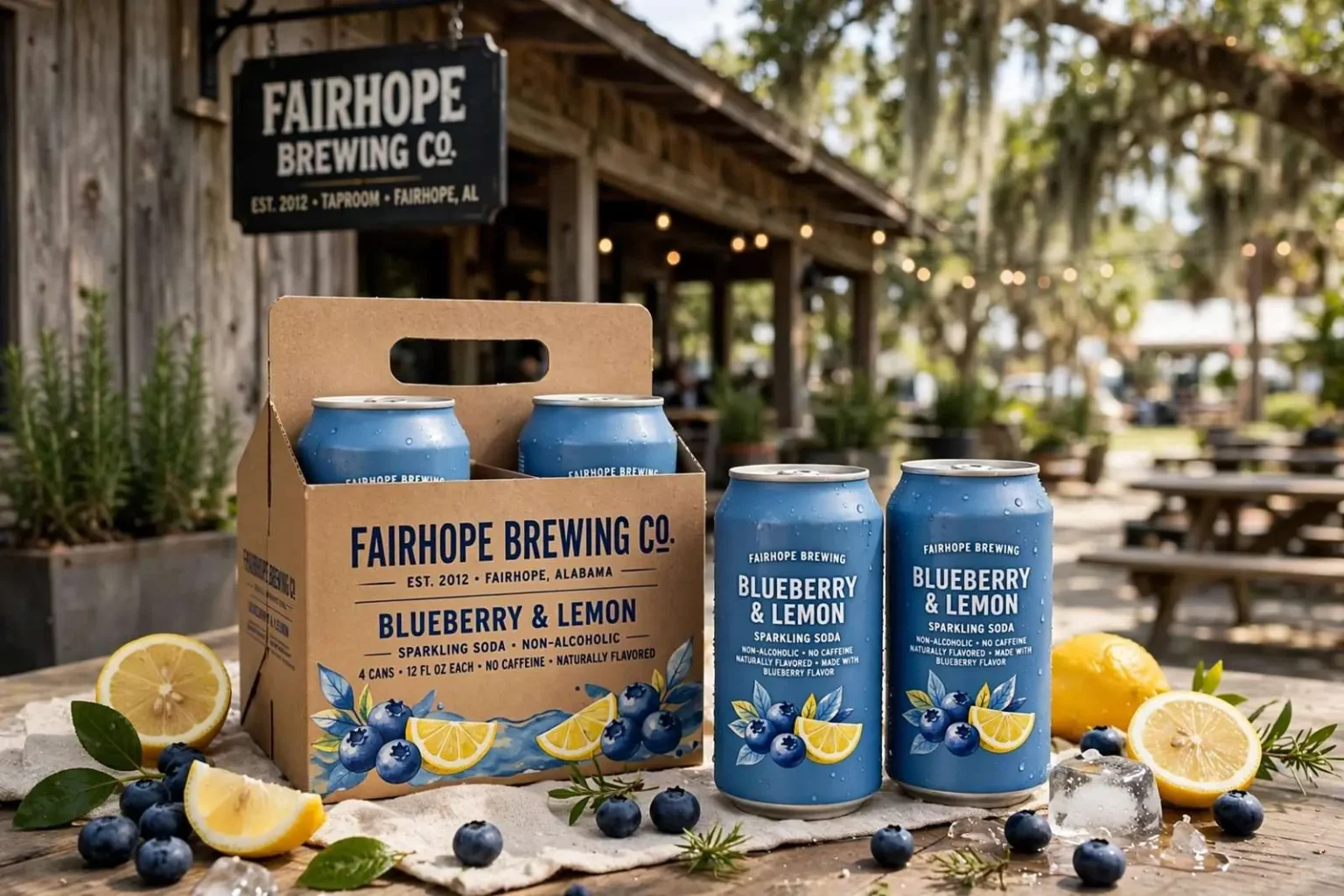
Summer is in full swing across the Eastern Shore and beyond, and South Alabama’s craft beverage scene is keeping pace with a run of new releases, expansions and cross-state collaborations. From a family-friendly soda debut in Fairhope to a fledgling vineyard taking root along County Road 32, here’s a roundup of what’s new in local beer, wine and other refreshments this summer. Fairhope Brewing Company recently released its first-ever nonalcoholic beverage, a canned soft drink called Blueberry & Lemon. The flavor combination mirrors the brewery’s popular Blue Steel sour, and the soda is made with lemon juice, white sugar and natural blueberry flavor, without any caffeine added. It marks the taproom’s first venture into canning sodas, following in the footsteps of breweries elsewhere in the country, such as Louisiana’s Abita Brewing Company, which has built a following for its root beer and vanilla cream soda alongside its beer lineup.
For now, the Blueberry & Lemon soda is only available at the Fairhope taproom, sold in single cans to enjoy on-site or in four-packs to take home, giving the brewery a family-friendly option for customers who don’t drink alcohol. The decision to can rather than keg the soda reflects a broader industry trend: craft breweries are increasingly packaging nonalcoholic options for retail distribution, recognizing that the “sober curious” movement and designated-driver demand represent a growing market segment. Fairhope Brewing’s founders, who started the brewery in 2012, have watched the Eastern Shore’s demographic shift — more families, more retirees, more visitors seeking alternatives to alcohol — and the soda is a direct response to that evolution.
Eastern Shore Beverage Expansion
Elsewhere on the Eastern Shore, a new vineyard operation appears to be taking shape on County Road 32 in Fairhope. Southern Grove Vineyard has begun posting signage on the property advertising itself as a vineyard and winery, and roughly 20 acres of the land is zoned for agricultural use. The property owners have not yet made a formal public announcement about their plans, but the setup suggests the vines being planted are likely muscadines, the native grape variety best suited to withstand South Alabama’s climate and resist local plant diseases that affect other grape varieties. It’s also possible the winery side of the business could supplement local muscadine harvests by importing juice from other grape-growing regions to produce a broader range of wines on-site.
Muscadines have a long history in Alabama. The vines are native to the Southeast, thriving in the heat, humidity, and sandy soils that defeat European vinifera varieties. Pierce’s disease, a bacterial infection spread by sharpshooter insects, makes traditional wine grapes nearly impossible to grow commercially in the Gulf Coast region. Muscadines, with their thick skins and natural resistance, are the foundation of the state’s wine industry. The Alabama Wine Trail, established in the early 2000s, includes several muscadine-focused wineries, mostly in the northern part of the state. A commercial muscadine vineyard on the Eastern Shore would be a significant addition, bringing production closer to the tourism corridor that runs from Gulf Shores to the Florida line.
Collaboration and Cross-Pollination
The summer beverage scene also reflects a growing culture of collaboration among Alabama producers. Fairhope Brewing has partnered with Birmingham’s Avondale Brewing on a limited-release lager, and with Mobile’s Iron Hand Brewing on a hop-forward IPA that showcases Alabama-grown hops from a test plot at Auburn University’s Gulf Coast Research and Extension Center. The hop plot, planted in 2021, is part of a research initiative to identify varieties that can withstand the Deep South’s disease pressure — a long shot, given that hops traditionally require the cool, dry summers of the Pacific Northwest. But early results have been promising enough to brew a wet-hop batch using the Alabama-grown cones.
These collaborations serve multiple purposes. They allow smaller breweries to share equipment, distribution networks, and marketing reach. They create novelty products that generate buzz in a crowded market. And they foster a sense of collective enterprise in an industry that, by Alabama law, was heavily restricted until the 2011 “Gourmet Beer Bill” raised the allowable alcohol content for beer and opened the door for craft brewing. The 2013 “Brewery Modernization Act” further liberalized the rules, allowing breweries to sell directly to consumers on-site. Since then, the state’s brewery count has grown from a handful to more than thirty, with several on the Eastern Shore alone.
Regulatory Landscape and Market Growth
Alabama’s craft beverage regulatory framework remains a patchwork of permissions and restrictions that shapes what producers can do. Breweries can now sell pints on-site and distribute through wholesalers, but they cannot self-distribute beyond a limited radius. Wineries face different rules — they can self-distribute up to a certain volume, but must navigate a three-tier system for larger sales. Distilleries, the most heavily regulated category, only gained the right to sell bottles directly to visitors in 2019, and still cannot serve cocktails on-site without a separate lounge license. These distinctions matter for business models: a brewery can rely on taproom revenue; a winery must balance tasting room sales with wholesale; a distillery must choose between production focus and hospitality investment.
The Eastern Shore’s growth as a beverage destination reflects both regulatory change and market demand. Tourism in Baldwin County has surged over the past decade, driven by beach traffic, the Robert Trent Jones Golf Trail, and a growing reputation as a culinary destination. Visitors who come for the seafood and the scenery now expect a local drink to accompany the meal. The Eastern Shore Chamber of Commerce has begun promoting a “Craft Beverage Trail” map, linking breweries, wineries, and distilleries into a drivable loop. Fairhope, with its walkable downtown and concentration of producers, serves as the natural hub.
New Entrants and Established Players
Beyond Fairhope Brewing and the nascent Southern Grove Vineyard, the Eastern Shore’s beverage landscape includes several established and emerging producers. Big Beach Brewing in Gulf Shores, opened in 2017, has expanded its distribution across South Alabama and into the Florida panhandle, with a core lineup that includes a hazy IPA, a coastal lager, and a rotating series of fruit-infused sours using local peaches, strawberries, and satsumas. Backyard Brewing in Foley, a nanobrewery operating out of a converted garage, has developed a cult following for its experimental small batches — a coffee stout made with beans from a Mobile roaster, a saison fermented with wild yeast captured on the property, a barleywine aged in bourbon barrels from an Alabama distillery.
On the wine side, Bama Wine Co. in Gulf Shores has built a business around muscadine and fruit wines, sourcing from growers across the state and producing a range from dry to sweet. Their tasting room on the Intracoastal Waterway draws boat traffic as well as road trippers. The newer Entrada Wines, a project by a former California winemaker who relocated to Fairhope, is experimenting with hybrid varieties — Blanc du Bois, Lenoir, and Villard Blanc — that offer Pierce’s disease resistance with vinifera-like flavor profiles. The vineyard, planted on a five-acre plot near the Magnolia River, is in its third growing season and expects its first commercial harvest in 2026.
Economic Impact and Community Character
The craft beverage sector’s economic footprint in Baldwin and Mobile counties is difficult to quantify precisely but visibly significant. Breweries and taprooms create direct employment — brewers, cellar workers, taproom staff, sales representatives — and indirect demand for grain, hops, yeast, packaging, equipment, and services. They generate tax revenue through excise taxes, sales taxes, and property taxes. And they contribute to the quality-of-life amenities that attract and retain talent in other industries: tech workers, healthcare professionals, and remote employees cite local breweries and wineries as factors in relocation decisions.
For the Eastern Shore’s small towns, a brewery or winery can serve as a community anchor — a “third place” distinct from home and work where residents gather. Fairhope Brewing’s taproom hosts trivia nights, live music, and fundraisers for local nonprofits. Big Beach Brewing partners with the Gulf Shores City Schools foundation for an annual charity release. Backyard Brewing’s release parties double as neighborhood block parties. These social functions, while secondary to the business of making beer and wine, are part of what makes the industry politically resilient — legislators see the jobs, the tax revenue, and the community goodwill, and the regulatory environment continues to liberalize.
As summer progresses, the Eastern Shore’s beverage producers will roll out their seasonal offerings — watermelon wheat ales, peach sours, muscadine rosés, citrus-infused vodkas. Visitors and locals will navigate the Craft Beverage Trail, collecting passport stamps at each stop. And the region’s identity as a place that makes what it drinks, and drinks what it makes, will deepen — one pour at a time. The glass is raised.